

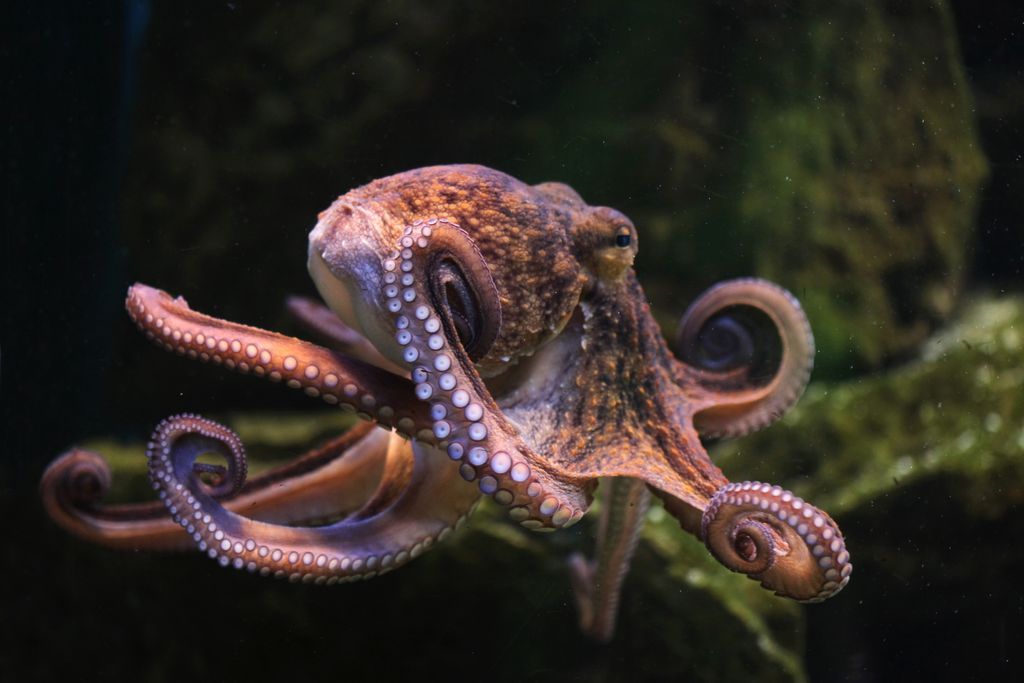
CThe moment was captured by scientists in Brazil, who on Thursday published a new study in the journal IScience It turns out that these animals go through two types of sleep. One, which researchers have dubbed “active sleep,” is similar to REM sleep seen in mammals, birds, and some reptiles – indicating that octopuses can dream like humans.
“Octopuses are unique in terms of behavioral and neurological complexity,” said Siddhartha Ribeiro of the Federal University of Rio Grande do Norte in Brazil and a co-author of the study, told AFP. Their brains are more complex than those of all invertebrates, he notes, “but they are still very different from us.”
To study their sleep, the researchers recorded four octopuses in aquariums over a period of several days. During the stages of “quiet sleep”, the animals were motionless, pale, and their eyes closed. In the period of “active sleep”, on the contrary, they continued to change color, shrink, and their eyes were mobile. The quiet phase lasted six or seven minutes, before being followed by an active cycle of about 40 seconds, both of which succeeded in each cycle.
In total, octopuses slept about a quarter of the day.
Lead author of the study, Silvia Medeiros, told AFP that the researchers ran several tests to verify that the octopus was sleeping well during these stages. The first test was broadcasting a video of a crab near the octopus. “When they are awake, because the crab is prey, they try to attack,” she said. Which did not happen during the two supposed stages of sleep. Likewise, octopuses did not subsequently react to the blows of rubber hammers on their aquarium, unlike when they were awake.
Dreams in gifs?
Most dreams in humans occur during REM sleep. Can we assume the same thing in octopuses?
“We cannot say for sure,” explains Silvia Medeiros. But if that is the case, then these dreams are certainly not as complex as our dreams, given the short duration of the stages of “active sleep” you see in them. “It might be like little videos, or even gifs,” she suggests.
In addition, the colors observed while they sleep could indicate their mood, as if they were awake. For example, when flirting, they are sometimes half white and half black. If an octopus finds sleeping in these colors, does this mean that he is dreaming of love? Perhaps, but it is too early to tell, and this will be the subject of additional studies, according to Siddharta Ribeiro.
In the meantime, knowing more about what we have in common with octopuses, from which our species diverged 500 million years ago, could help understand the evolutionary paths that have been taken, according to the researcher. He explained that, “If we observe a similar phenomenon, where there is a sleep cycle that includes an active phase and then a passive phase, it is certainly the result of a convergent evolution,” meaning that the two species have developed the same biological mechanisms. This, in turn, informs selection processes at work for developing this behavior.
In mammals, REM sleep is a time when memory consolidates and causes a variety of mechanisms that have a repressive effect on brain health. According to the study authors, this may be the case for octopuses as well.

Sophie Laurent is a contributor to Vaughantoday.ca, covering a wide range of topics including local news, politics, business, technology, sports, entertainment, and lifestyle. She focuses on delivering clear, balanced reporting that helps readers stay informed about current events and issues that matter to their communities. Sophie is committed to presenting accurate information, practical insights, and relevant stories in a straightforward and reader-friendly manner, making complex topics accessible to a broad audience.