

BRAMPTON, Ont. — The federal government is pitching Budget 2025 as a decisive response to mounting global economic uncertainty, unveiling targeted investments aimed at strengthening Canada’s domestic capacity in health care, infrastructure and workforce development.
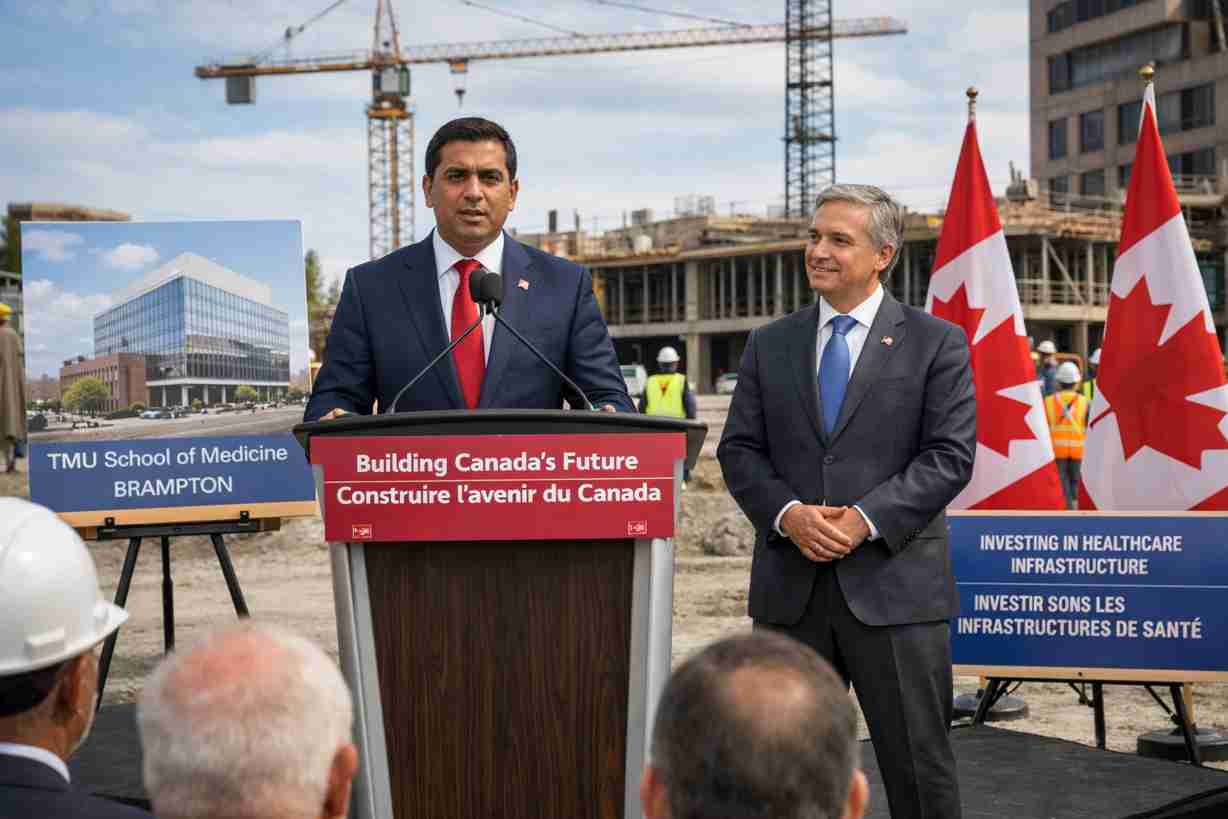
As part of that strategy, the Honourable Shafqat Ali, President of the Treasury Board, announced $25 million in new federal funding Thursday for the School of Medicine at Toronto Metropolitan University (TMU), during a visit to the university’s Brampton campus.
The funding forms part of the government’s broader commitment under Budget 2025: Canada Strong, which it describes as an investment-driven plan to safeguard economic resilience and deliver long-term growth in an increasingly volatile global environment.
Investment to expand medical training capacity in Brampton
The $25-million allocation will support construction of a new student building at TMU’s Brampton campus and fund the establishment of primary care teaching clinics in surrounding communities. Ottawa says the investment is intended to strengthen medical education while directly improving access to frontline care across the Peel Region and beyond.
Over time, the initiative is expected to increase the number of certified doctors and health-care professionals entering Canada’s health system, helping to address persistent shortages that have strained primary care access nationwide.
“The government is committed to making smart investments that improve access to care for Canadians. Supporting TMU’s School of Medicine in Brampton will strengthen the learning experience for future health professionals and help improve access to care for residents across the region in the years ahead,” Ali said.
Federal officials framed the investment as both an infrastructure and workforce measure—one that aligns with demographic pressures and population growth in the Greater Toronto Area, while contributing to national health-care capacity.
Budget 2025 framed as an ‘investment budget’
The TMU announcement comes as the federal government positions Budget 2025 as a departure from traditional spending models, emphasizing capital investment over operational growth.
According to the government, the budget delivers on a Comprehensive Expenditure Review that aims to modernize federal operations, improve efficiency and redirect resources toward what it calls “nation-building” priorities. Ottawa says the plan includes $60 billion in savings and new revenues over five years, alongside major investments in housing, infrastructure, defence, productivity and competitiveness.
The government estimates that these measures could unlock as much as $1 trillion in total investment over the next five years by leveraging public spending to attract private capital.
Officials say the approach reflects a recognition that the rules-based international trading system that long underpinned Canada’s prosperity is undergoing structural change—creating new risks for exporters, workers and domestic supply chains.
Focus on domestic strengths and economic control
Budget 2025 is being promoted as a plan to strengthen areas the government believes Canada can control, including its domestic market, skilled workforce and public services. Ottawa says the strategy is designed to make Canadians “their own best customers,” while reducing exposure to external shocks.
The government argues that investments in health care, housing and infrastructure are critical to maintaining social stability and economic competitiveness, particularly as global economic conditions remain uncertain.
“At a time of global uncertainty, Canadians expect concrete action that delivers real results. Through Budget 2025, we are investing in the infrastructure and talent Canada needs for the future. By supporting Toronto Metropolitan University’s School of Medicine in Brampton, we are helping train more doctors, expand access to primary care, and strengthen our health-care system for communities here and across the country,” said François-Philippe Champagne, Minister of Finance and National Revenue.
Health-care infrastructure tied to broader economic goals
Federal officials emphasized that health-care investments such as the TMU School of Medicine are not isolated initiatives but part of a larger economic framework aimed at boosting productivity and labour force participation.
By expanding medical education and improving access to care, the government says it can help reduce system bottlenecks that affect workforce availability, business productivity and regional growth.
As Budget 2025 moves through parliamentary scrutiny, Ottawa is expected to continue highlighting sector-specific investments as examples of how its broader economic strategy translates into tangible outcomes for communities across the country.
For Brampton, federal officials say the TMU funding represents both an immediate infrastructure boost and a long-term investment in the region’s health and economic resilience.

Evan McKenzie is a contributor at Vaughantoday.ca, covering a wide range of topics including local news, politics, business, technology, sports, entertainment, and lifestyle. He focuses on clear, balanced reporting that helps readers stay informed about current events and issues that matter to their communities. His work aims to provide useful information, timely updates, and relevant stories presented in an accessible and reader-friendly way.