

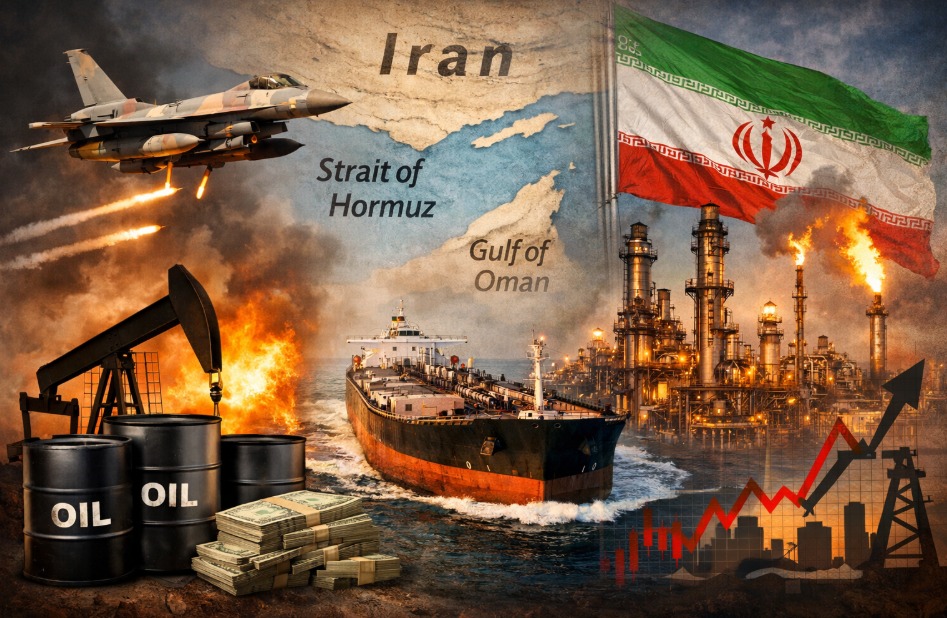
Global oil markets extended gains Tuesday as the escalating military conflict involving the United States, Israel, and Iran raised fresh concerns about potential disruptions to energy supplies from the Middle East — a region critical to the world economy and to U.S. fuel prices.
Crude benchmarks have surged sharply since the start of the week, reflecting growing fears that shipping through the Strait of Hormuz — one of the world’s most important oil chokepoints — could be severely curtailed.
Brent and WTI Post Third Straight Day of Gains
Brent crude, the international benchmark, rose to $79.44 a barrel, up $1.70, or 2.2%, in early trading Tuesday. On Monday, Brent briefly jumped as high as $82.37 — its highest level since January 2025 — before closing 6.7% higher.
U.S. West Texas Intermediate (WTI) crude gained $1.17, or 1.6%, to $72.40 a barrel. In the previous session, WTI hit its highest level since June 2025 before settling up 6.3%.
Both contracts are up roughly 8% to 9% since Monday, marking one of the sharpest short-term rallies this year.
Energy prices are closely watched in the United States, where higher crude costs often translate into rising gasoline and diesel prices, affecting consumers and businesses nationwide.
Strait of Hormuz at Center of Supply Concerns
The rally comes as the conflict between the U.S. and Israel against Iran widens, raising the possibility of prolonged instability across the Gulf region.
On Monday, Israel launched attacks in Lebanon, while Iran responded with strikes targeting energy infrastructure in Gulf countries and vessels transiting the Strait of Hormuz. Iranian state media reported that a senior Revolutionary Guards official declared the strait closed and warned that any ship attempting passage could be fired upon.
Roughly 20% of the world’s oil and liquefied natural gas flows through the Strait of Hormuz, making it one of the most strategically vital maritime routes in global trade. Any disruption there can have immediate ripple effects across international markets — from Asia to Europe to North America.
Shipping traffic through the strait has already slowed. Tankers and container ships are avoiding the area, and insurers have reportedly withdrawn coverage for vessels operating in the region. Freight and energy shipping rates have surged in response.
“With no quick de-escalation in sight, the Strait of Hormuz effectively closed and Iran showing a willingness to target energy infrastructure in the region, upside risks remain and they grow the longer the conflict drags on,” said Tony Sycamore, market analyst at IG.
Analysts Warn of Prolonged Price Volatility
Market analysts say traders are still assessing how far the conflict could escalate.
“The market continues to digest the risk of escalation in the Middle East,” analysts at ING said in a note Tuesday. While concerns about oil flows through Hormuz are significant, they added that a broader campaign targeting regional energy infrastructure would pose an even greater risk to supply and could result in prolonged production outages.
Israeli Prime Minister Benjamin Netanyahu said Monday that the war involving the U.S. and Israel against Iran may take “some time,” though he indicated it would not last for years.
Investment firm Bernstein raised its 2026 Brent crude forecast from $65 to $80 per barrel. However, analysts there warned that in a worst-case scenario involving extended conflict and severe supply disruptions, prices could spike to between $120 and $150 per barrel.
Such levels would likely intensify inflationary pressures globally and could complicate monetary policy decisions by central banks, including the Federal Reserve.
Refined Fuel Prices Also Jump
The impact is not limited to crude oil. Futures for refined petroleum products also moved higher, reflecting risks to processing facilities across the Middle East.
Saudi Arabia temporarily shut down its largest domestic oil refinery following a reported drone strike on Monday, further tightening supply expectations.
In U.S. trading, ultra-low-sulfur diesel futures rose 4.2% to $3.0207 per gallon after hitting a two-year high in the previous session. Gasoline futures climbed 1.7% to $2.4113 per gallon, following a 3.7% increase Monday.
In Europe, gasoil futures jumped 4.3% to $925 per metric ton after soaring 18% in the prior session.
For American consumers, sustained increases in diesel prices could affect shipping costs and supply chains, potentially feeding into higher prices for goods ranging from groceries to retail merchandise.
Outlook: Elevated Energy Prices Likely in Near Term
Energy markets are expected to remain volatile in the coming days as investors monitor military developments and potential threats to oil infrastructure and shipping lanes.
While no sustained supply outages have yet been confirmed, the risk premium embedded in oil prices is rising as long as tensions persist.
Unless there is a clear path toward de-escalation, analysts say crude prices are likely to remain elevated — and could climb further — underscoring how geopolitical instability in the Middle East continues to influence global energy markets and the U.S. economy.

Evan McKenzie is a contributor at Vaughantoday.ca, covering a wide range of topics including local news, politics, business, technology, sports, entertainment, and lifestyle. He focuses on clear, balanced reporting that helps readers stay informed about current events and issues that matter to their communities. His work aims to provide useful information, timely updates, and relevant stories presented in an accessible and reader-friendly way.