

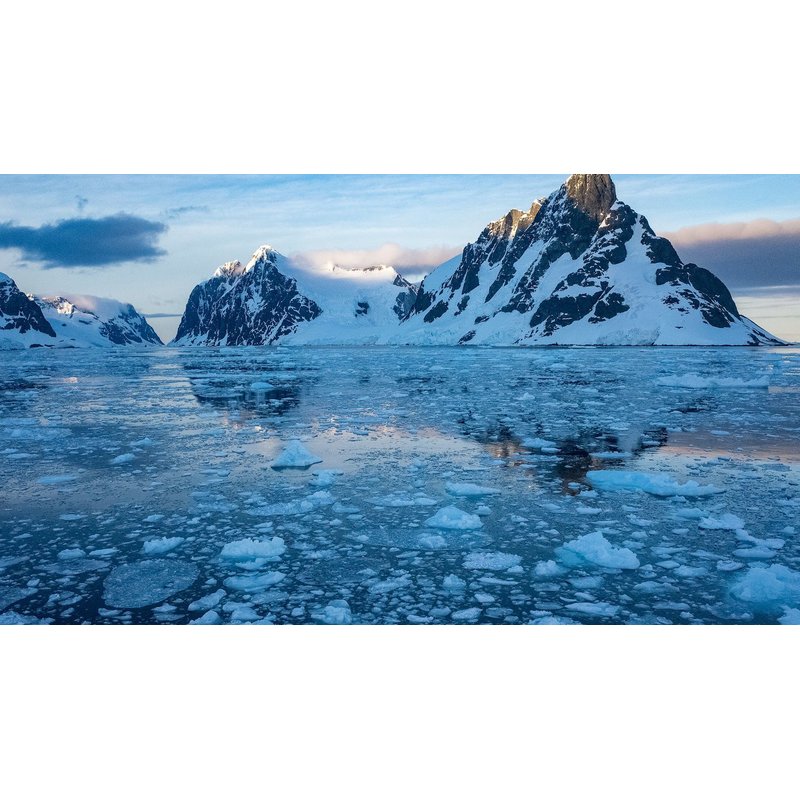
As the ice warms, large ice shelves weaken and melt water carves cracks in them. This leads to an increased “birth” (breaking of a slope or ice barrier) at the edges of the ice sheet, which accelerates into the ocean – and when it melts, it contributes to the rising waters. “Antarctica is as large as North America. There are more losses in summer than winter gains,” explains Natalia Gomez, Canada Chair for Research in Geodynamics of Ice Sheet and Sea Level Interactions.
The coldest continent on the planet is already losing feathers, or rather masses of ice, in an accelerated way. The result is a rise in sea level, the magnitude of which will depend on the extent of global warming.
The Paris Agreement aims to raise a maximum of two degrees above temperatures before the Industrial Revolution, in order to slow or halt global warming. But this 2-degree threshold remains theoretical. That’s why Professor Gomez and her colleagues tried to model this warming on the Antarctic ice sheets and the rising waters, according to the different scenarios described by the Paris Agreement.
their last studies, published in review nature In May – and that is before the last report of the Intergovernmental Panel on Climate Change, which is also trying To estimate the speed of rising sea levels – shows that even if they are limited to 2°C or less, Antarctic ice loss will continue throughout the century at a rate similar to what it is today. “It won’t stop Antarctic ice melt, but it can make a huge difference in avoiding a worst-case scenario. We are also able to make rapid change, as we’ve seen during the pandemic,” notes the researcher, who is also an associate professor of planetary and Earth sciences at McGill University.
If warming continues as it does today – and thus exceeds moderate forecasts with an increase of 1.5 or 2 °C to reach or exceed 3 °C, experts predict a point of no return as early as 2060: loss of ice patches – areas of ice less than 10 kilometers in size Combined with the thinning of the ice sheet is proving to be a dynamic process that will be difficult to reverse. Especially with the retreat of large areas of ice under water sensitive to climatic instability.
Which could lead to a sea level rise of several meters by 2300: Antarctica is the largest reservoir of land ice on our planet – equivalent to 57.9 meters of global sea level rise.
great contribution
Comments Luke Copeland, a professor in the Department of Geography, Environment and Geomatics from the University of Ottawa, who was not involved in this research.
Using an advanced model that takes into account the interactions between the atmosphere, oceans, ice cover and ice shelves, it is clear that Antarctica will contribute significantly to sea level rise over the next century and beyond, according to the person who also holds the research chair in glaciology.
“The exact amount of this contribution largely depends on the amount of warming. If by the end of the twenty-first century there is a rise in atmospheric temperature of 3°C above pre-industrial levels.NS century – our current trajectory – then sea-level rise from Antarctica will be about 50% higher than we would have if we limit the warming to two degrees.”
This suggests that relatively small changes in greenhouse gas emissions, and thus climate policies, could have important implications down the road. Prof. Copeland says that honoring the commitments made under the Paris Agreement “will significantly reduce sea-level rise over the coming decades and centuries”.
Photo: Daniel Inchev/Flickr

Sophie Laurent is a contributor to Vaughantoday.ca, covering a wide range of topics including local news, politics, business, technology, sports, entertainment, and lifestyle. She focuses on delivering clear, balanced reporting that helps readers stay informed about current events and issues that matter to their communities. Sophie is committed to presenting accurate information, practical insights, and relevant stories in a straightforward and reader-friendly manner, making complex topics accessible to a broad audience.