

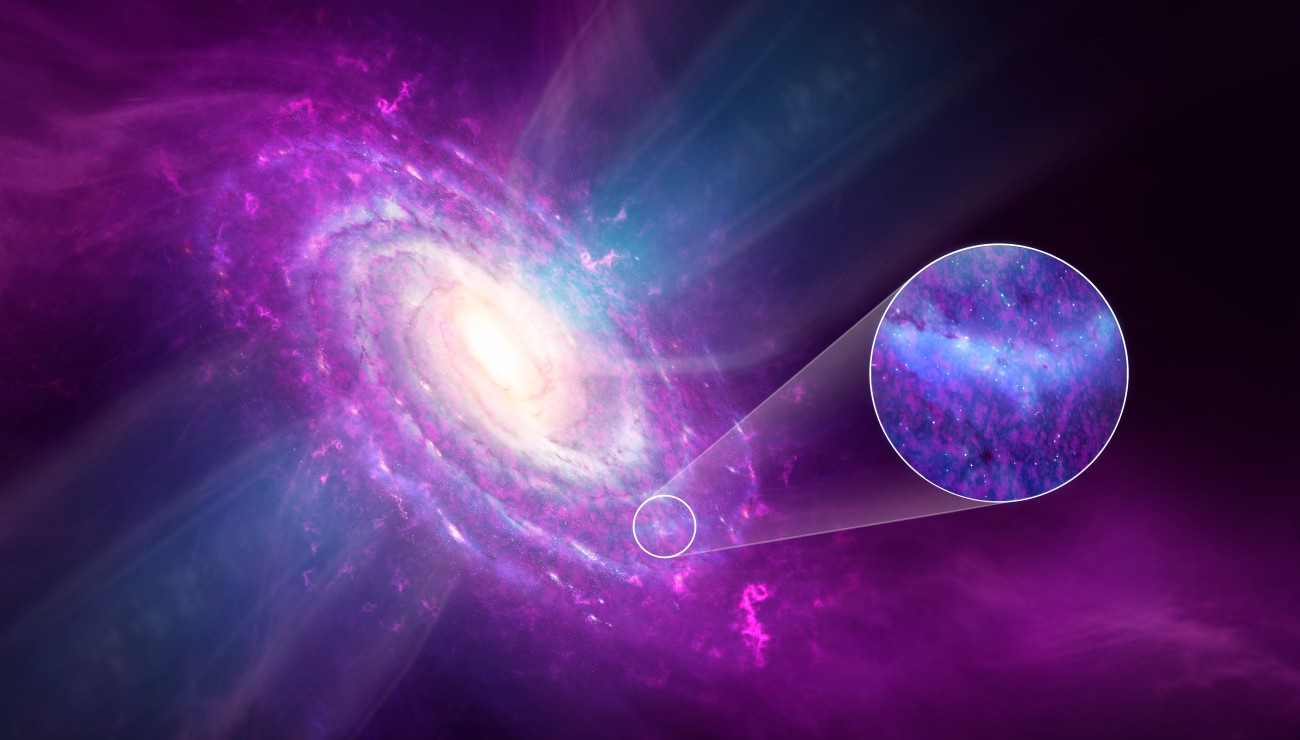
The Milky Way is mixed up badly? The models used so far considered that the various chemical elements that make up the galaxy are distributed there in a fairly harmonious way, and that the Sun is a very representative sample. In particular, the content of “metals,” elements heavier than hydrogen and helium, are involved in many astrophysical processes and are assumed to be fairly equal throughout the galaxy. But Annalisa De Cia, of the University of Geneva, and her colleagues, observed the proximity of many stars and noted the presence of minerals there in much more heterogeneous proportions than expected.
The Milky Way is constantly supplied with gas from intergalactic space: hydrogen and helium, the two lightest chemical elements. These elements condense into stars and fuse there, giving rise to heavier elements. As soon as the combustion of the star is complete, it explodes and expels part of the created substance around it. This mixture, which contains iron, carbon or silicon, enriches the formation of subsequent generations of stars or is found in the form of gas or dust in the cold regions of the galaxy.
In current models, the native gas composed of hydrogen, helium, metal-enriched gas, and dust is distributed in the Milky Way in a fairly homogeneous manner, with a mineral composition very close to the Sun, a content called “sun metallicity”. The concentration of metals will be slightly higher in the center of the galaxy, where the density of stars is higher.
Annalisa De Cia and her colleagues, including astronomers from the Institute of Astrophysics in Paris, evaluated this mineral content by observing gas near 25 stars within a radius of 3 kiloparsecs around the Sun (about 10,000 light-years). The presence of six chemical elements heavier than helium (silicon, titanium, chromium, iron, nickel, zinc) was measured by spectroscopy using a space telescope. Hubble and on VLT (Very Large Telescope), in Chile. This technique allows to break up the light to see traces of the elements that make up the objects it has passed, in this case, the gas clouds located between the stars and the observer. This measurement did not take dust into account, but the researchers developed a new method for evaluating the composition of this dust as well.
Their results contradict the idea of the Milky Way where different chemical species mix homogeneously. Heliometallism, far from being a standard, would only be achieved in one-third of the observed stellar environments. The mineral content is even as low as 17% of the sun’s metallic in some cases, and almost double in some areas. And this is regardless of the age of the stars, they are all in a region relatively close to the Sun. How do we explain such differences in a small region of the galaxy? When intergalactic gas (low metallic because it has not been in contact with stars) enters the disk of the Milky Way, the rotation and turbulence that can ensure a homogeneous mixture appears ineffective, and the variability remains alive.
This discovery raises questions about current knowledge about the formation and evolution of galaxies. Therefore, the models of evolution that made the simplistic hypothesis of a homogeneous chemical composition must be reviewed: stars, but also planets, can form at the same time with completely different chemical compositions.

Sophie Laurent is a contributor to Vaughantoday.ca, covering a wide range of topics including local news, politics, business, technology, sports, entertainment, and lifestyle. She focuses on delivering clear, balanced reporting that helps readers stay informed about current events and issues that matter to their communities. Sophie is committed to presenting accurate information, practical insights, and relevant stories in a straightforward and reader-friendly manner, making complex topics accessible to a broad audience.