

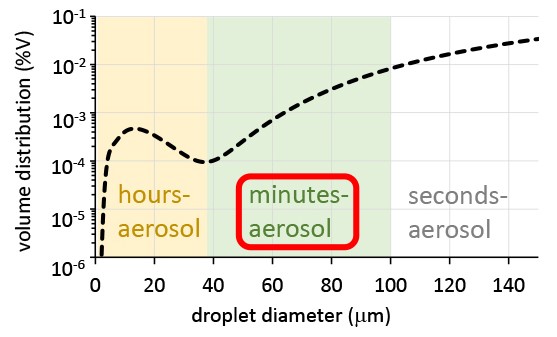

The most infectious droplets are those of medium size, 40-100 microns. They remain suspended for a shorter time than the smaller ones, but they carry a higher viral load. Its transmissibility is determined by the holding time that decreases with a lower temperature (Temperature is a physical quantity measured with a thermometer and …) and moreHumidity (Moisture is the presence of water or water vapor in the air or in a substance…). © Kevin Roger
The COVID-19 crisis has highlighted the importance of better understanding airborne transmission of the virus. This transmission is particularly driven by two distinct periods: how long the virus remains in a droplet that dries up and the time those droplets are suspended in the air. Several studies on this issue consider drops to consist ofWater (Water is a chemical compound found everywhere on Earth, essential to everyone…)but respiratory fluids are aqueous solutions of salts and proteins, which can modify these two distinct periods.
Researchers from the Chemical Engineering Laboratory (LGC, CNRS/Toulouse INP/Université Toulouse Paul Sabatier) found that some proteins, such as mucins, reduce suspension times, increase infection times and modify the effect of humidity and air temperature on these settings. The droplets most suitable for transmission are shown to be those between 40 and 100 μm in size. They just stayed on hold for a few Minutes (The basic form of the document: Law: Minute is the origin…)but represent a the sound (Volume, in the physical or mathematical sciences, is the quantity that measures the extension…) Important. Its suspension time can be reduced, and thus its ability to transmit viruses Purification (Filtration is a separation process that allows separation…) Or a constant renewal of air, a decrease in temperature or an increase in humidity.
Published in PNASThis study combines several experimental devices and numerical simulations, in which droplets are made saliva (Saliva is a biological fluid secreted by the salivary glands…) Human beings while viruses are harmless and target only bacteria (Bacteria (Bacteria) are prokaryotic unicellular organisms, characterized by …). L ‘evaporation (Evaporation is a gradual transition from a liquid state to a gaseous state. It is different…) distinguish saliva microscopy (Microscopic examination is the observation of a sample (placed in a microscopic preparation …) Raman, as well as by tracking Mass (The term mass is used to designate two quantities connected into one…). The viability of viruses during the drying of the droplets is measured by their placement the culture (UNESCO’s definition of culture is as follows [1] 🙂 With the host bacteria, which disappear in proportion to number (The notion of number in linguistics is addressed in the article “Number …) of the remaining viruses. The viability of viruses in dried saliva droplets appears to decrease, and then rise with increasing humidity, but this also leads to a reduction in droplet suspension time.
This study calls for better consideration of the origin of the droplets, as they show significant differences depending on whether or not they come from the lungs. throat (The larynx is an organ located at the level of the throat. It is located after the junction …) or the stuffy (The mouth (also called the buccal cavity or oral cavity) is the opening by …)Especially since viruses and their variants do not always accumulate in the same parts of the respiratory system. The newer SARS-CoV-2 variant is therefore more present in the upper respiratory tract, which produces larger and more infectious droplets.
This work was funded as part of the ANR RA-COVID Call for Projects.
References:
Assessment of suspension and infection times of aerosols carrying viruses involved in airborne transmission
Tania Merhi, Omar Atassi, Clemence Cotesier, Benjamin Lalanne, and Kevin Roger.
PNAS, 2022.
https://doi.org/10.1073/pnas.2204593119
Contact:
– Kevin Roger – Responsible for Research (Scientific research identifies in the first place all actions taken with a view to …) CNRS (The National Center for Scientific Research, better known by the acronym CNRS, is the largest…) Inside the Chemical Engineering Laboratory (LGC, CNRS / Toulouse INP / Univ. Toulouse Paul Sabatier)
[email protected]
– Telecommunications (Contact with man (communication within oneself, communication between people, etc.) INSIS – insis.comm [email protected]
Did you like this article? Would you like to support us? Share it on social networks with your friends and/or comment on it, this will encourage us to publish more similar topics!

Sophie Laurent is a contributor to Vaughantoday.ca, covering a wide range of topics including local news, politics, business, technology, sports, entertainment, and lifestyle. She focuses on delivering clear, balanced reporting that helps readers stay informed about current events and issues that matter to their communities. Sophie is committed to presenting accurate information, practical insights, and relevant stories in a straightforward and reader-friendly manner, making complex topics accessible to a broad audience.