

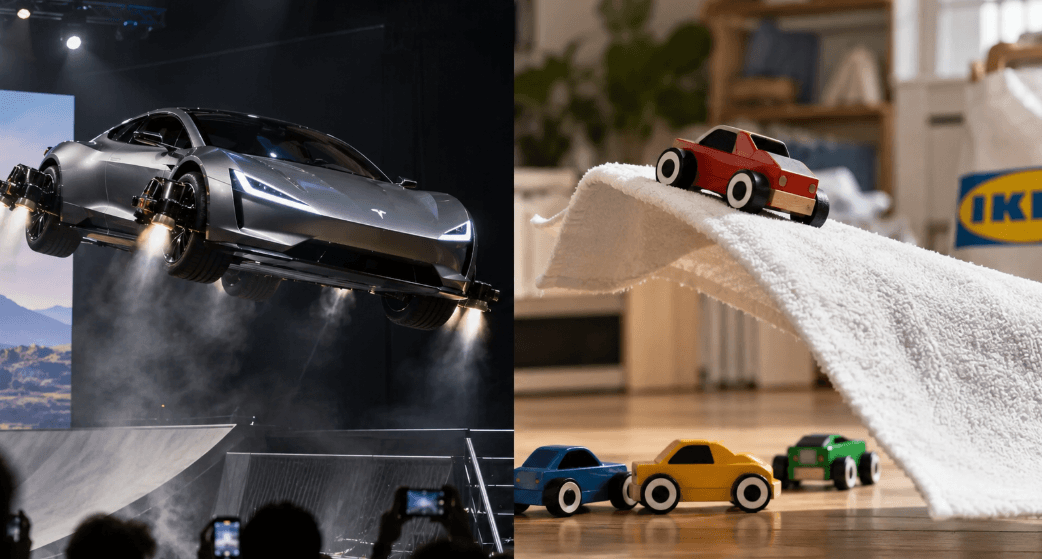
IKEA has joined the conversation surrounding Tesla’s latest flying car concept, using a playful social media campaign to offer what it describes as a safer and more affordable alternative. The Swedish furniture retailer’s Taiwan division responded to Tesla’s ambitious Roadster Rocket Edition demonstration by suggesting that a toy car and a bath towel could deliver a similar experience with a little imagination.
Tesla Unveils Flying Roadster Rocket Edition Concept
Tesla attracted attention this week after presenting a flying version of its Roadster Rocket Edition during a livestreamed demonstration. The concept vehicle was shown accelerating up a halfpipe, performing a kickflip and gliding back to the ground using a propulsion system involving SpaceXAI thrusters and compressed air.
The demonstration highlighted Tesla’s continued interest in combining automotive engineering with unconventional technologies. However, the presentation centred on a concept rather than a production-ready vehicle.
According to details surrounding the announcement, the Roadster Rocket Edition is not expected to enter production before 2028. Questions also remain about whether the vehicle would meet the regulatory requirements necessary for use on public roads.
High Reservation Costs and Uncertain Delivery Timeline
The proposed flying Roadster comes with significant financial commitments for prospective buyers.
Reservations are reportedly available by invitation only, with a deposit of approximately US$500,000 required to secure a place.
For Canadian consumers, that represents a substantial investment before accounting for currency conversion and any potential import-related costs.
The reservation agreement also reportedly provides no guarantee that customers will ultimately receive a vehicle.
Despite those uncertainties, Tesla has promoted the concept’s performance capabilities, including a claimed acceleration time of just 0.9 seconds from zero to 60 miles per hour, equivalent to approximately 97 kilometres per hour.
The combination of advanced technology, ambitious performance targets and an uncertain production schedule has generated discussion about the vehicle’s practical future.
IKEA Taiwan Responds With a Budget-Friendly Flying Car
Rather than competing with Tesla on engineering, IKEA Taiwan approached the flying car concept through humour and everyday household products.
In an Instagram post, the retailer presented its own interpretation of a flying vehicle using two existing products: a LILLABO toy car set and a BROKGLIM bath towel.
The four-piece LILLABO toy car set was listed at US$12.99 in the original coverage, making IKEA’s proposed alternative considerably less expensive than Tesla’s reservation deposit.
The campaign recreates the general idea of a vehicle moving through the air, relying on a creative arrangement of the toy car and towel rather than mechanical propulsion.
IKEA accompanied the post with the phrase “Real life, baby,” echoing language used in Tesla’s own social media promotion.
The retailer then added the words “Safe, affordable.”
The brief message served as a humorous comparison between an expensive experimental vehicle and inexpensive products already available to shoppers.
A Creative Take on Tesla’s Technology
The IKEA concept is not intended to function as an actual flying vehicle.
Unlike Tesla’s proposed propulsion technology, the LILLABO toy car does not contain a fan-powered suction system or other equipment capable of holding it against a suspended surface.
The visual arrangement also leaves open the practical question of how the towel could remain positioned in the air.
However, the campaign’s appeal comes from its simplicity rather than technical feasibility.
By encouraging viewers to imagine a toy car performing the same movements as Tesla’s Roadster, IKEA transforms a complex automotive demonstration into a familiar household scene.
The concept also draws on the role of imaginative play, particularly among children, who can recreate elaborate driving scenarios using basic toys and household objects.
IKEA Continues Its Tradition of Reactive Marketing
The flying car campaign follows IKEA’s established approach to responding quickly to popular culture, consumer trends and major public conversations.
The retailer has previously attracted attention through social media content that connects its furniture and household products with entertainment and internet trends.
Earlier in 2026, IKEA also responded to renewed public interest in wicker furniture with a campaign involving a wicker bench and references to actor Alexander Skarsgård.
Such campaigns demonstrate how established retailers can participate in conversations outside their traditional product categories without launching entirely new products.
In this case, IKEA used Tesla’s high-profile automotive announcement to highlight two relatively inexpensive items from its existing catalogue.
Why the Campaign Resonates Beyond Automotive Enthusiasts
The contrast between Tesla and IKEA provides the foundation for the campaign.
Tesla’s Roadster Rocket Edition represents an ambitious technological concept involving specialized propulsion equipment, exceptional performance claims and substantial financial commitments.
IKEA’s response focuses instead on affordability, accessibility and imagination.
For Canadian audiences familiar with IKEA’s furniture, home accessories and children’s products, the campaign illustrates how ordinary retail items can become part of broader discussions about technology and consumer culture.
It also demonstrates the effectiveness of timely marketing that uses humour rather than direct product comparisons.
Flying Car Debate Highlights Different Approaches to Innovation
Tesla’s flying Roadster concept continues to raise questions about production feasibility, road legality and the future of high-performance vehicles.
IKEA Taiwan’s response offers a lighter perspective on those ambitions, showing how a simple toy car and bath towel can become the centre of a widely relatable marketing idea.
While Tesla works toward a potential 2028 production timeline, IKEA’s alternative emphasizes a different kind of innovation: using familiar products and a little imagination to turn a major technology announcement into an accessible joke.

Evan McKenzie is a contributor at Vaughantoday.ca, covering a wide range of topics including local news, politics, business, technology, sports, entertainment, and lifestyle. He focuses on clear, balanced reporting that helps readers stay informed about current events and issues that matter to their communities. His work aims to provide useful information, timely updates, and relevant stories presented in an accessible and reader-friendly way.