

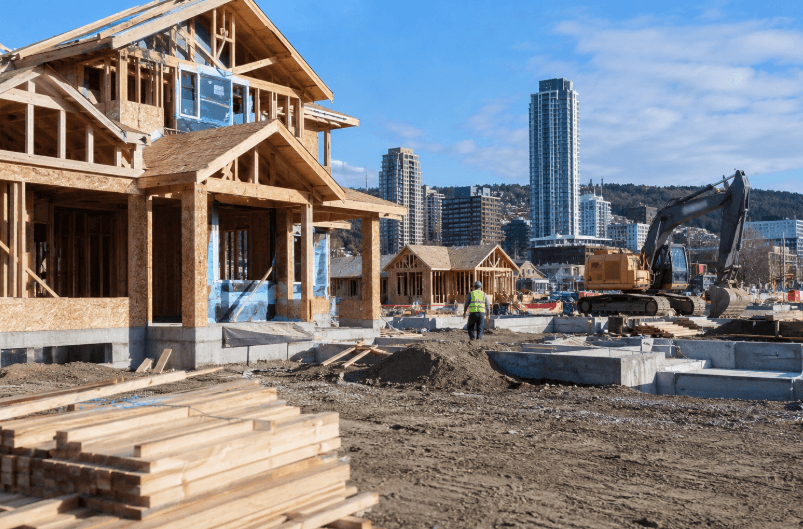
The governments of Canada and Ontario are committing up to $572 million to Hamilton for housing-enabling infrastructure as the city moves to eliminate residential development charges for three years, a measure officials estimate could help unlock more than 31,000 new homes.
The funding, announced on Aug. 26, will flow through the Development Charge Reduction Program (DCRP) and is tied to Hamilton eliminating development charges on all residential construction from March 30, 2026, through March 31, 2029.
Government estimates indicate removing the charges could lower new-home construction costs by as much as $100,442 per unit. Combined with savings of up to $130,000 from the removal of the HST on qualifying new homes, the measures could represent potential savings of up to $230,000.
Hamilton Development Charge Cut Targets More Than 31,000 Homes
Hamilton estimates that lower development costs, combined with new investment in infrastructure required to accommodate residential growth, could unlock construction of more than 31,000 homes.
The development charge elimination remains subject to approval by Hamilton City Council and must stay in place for three years.
“This is a historic investment in Hamilton’s future and one I have worked hard as Mayor to make happen. It represents the single largest investment in roads, water and wastewater infrastructure in our city’s history, and I welcome the support of our provincial and federal partners. We know Hamilton needs more housing. That means creating the conditions to get more homes built, support local construction and get people back to work, while making housing more affordable for Hamiltonians. By eliminating residential development charges for three years and investing in the infrastructure our growing communities need, we can get shovels in the ground, increase housing supply and reduce costs for people looking to call Hamilton home.”
Andrea Horwath, Mayor of Hamilton
Road, Water and Wastewater Projects Included
The $572-million allocation is expected to support several major infrastructure projects intended to accommodate population growth and residential construction.
Planned work includes widening and reconstructing Barton Street between Fruitland Road and Fifty Road into a five-lane multi-modal arterial road. Lewis Road between Highway 8 and Barton Street would also be reconstructed to an urban-standard multi-modal collector road.
Other projects include widening sections of Rymal Road south of Hamilton Mountain and reconstructing Garner Road between Wilson Street and Glancaster Road in Ancaster.
Water infrastructure investments include expansion of the Woodward water and wastewater treatment plant and capacity upgrades at the Greenhill Water Pumping Station.
“We’re making historic investments in Hamilton to lower costs for families, keep workers on the job and get more homes built faster. Today’s investment will support new transportation and housing infrastructure across the city, enabling the construction of tens of thousands of new homes. Congratulations to Mayor Horwath and Hamilton City Council for demonstrating incredible leadership and working with us to bring the dream of home ownership in reach for Hamilton families.”
The Honourable Doug Ford, Premier of Ontario
Canada-Ontario Partnership Backs Housing Infrastructure
The Hamilton commitment forms part of a broader federal-provincial infrastructure strategy. In March, Canada and Ontario agreed to a cost-matched structure providing a combined $8.8 billion over 10 years for infrastructure investment across the province.
Canada’s contribution is expected to flow through the Build Communities Strong Fund.
“Together, we’re building Ontario and Canada strong. By partnering with Ontario, the federal government is helping speed up housing construction by lowering up front costs and investing in housing-enabling infrastructure projects – building strong, resilient communities that boost housing supply and drive economic opportunities.”
The Honourable Wayne Long, Secretary of State (Canada Revenue Agency and Financial Institutions)
The DCRP prioritizes municipalities that reduce residential development charges by between 30 and 50 per cent or more and maintain those reductions for at least three years. Municipalities participating in the program must contribute at least 10 per cent of project costs.
Homebuilding Industry Welcomes Cost Reduction
Ontario’s building sector has argued that development charges have become a significant upfront expense when bringing new housing projects to market.
“This is exactly the kind of action Ontario’s housing market needs. Development charges have become one of the largest upfront costs of building a new home, and reducing them while investing directly in the infrastructure needed to support growth is a much more sustainable approach. Hamilton’s participation in the Development Charge Reduction Program will make a meaningful difference to project viability, housing affordability and the ability to get more shovels in the ground. We commend the governments of Ontario and Canada, and the City of Hamilton, for working together on a solution that lowers the cost of building while ensuring communities have the infrastructure they need to grow.”
Scott Andison, CEO, Ontario Home Builders’ Association
The funding remains conditional on several approvals, including the signing of the Canada-Ontario Build Communities Strong Fund bilateral agreement, federal review of project funding and a transfer payment agreement between Hamilton and Ontario.
If those conditions are completed and Hamilton maintains its development charge elimination, the program would provide one of the city’s largest infrastructure investments while attempting to address two closely linked challenges: increasing housing supply and expanding the roads, water and wastewater systems required to support that growth.

Evan McKenzie is a contributor at Vaughantoday.ca, covering a wide range of topics including local news, politics, business, technology, sports, entertainment, and lifestyle. He focuses on clear, balanced reporting that helps readers stay informed about current events and issues that matter to their communities. His work aims to provide useful information, timely updates, and relevant stories presented in an accessible and reader-friendly way.