

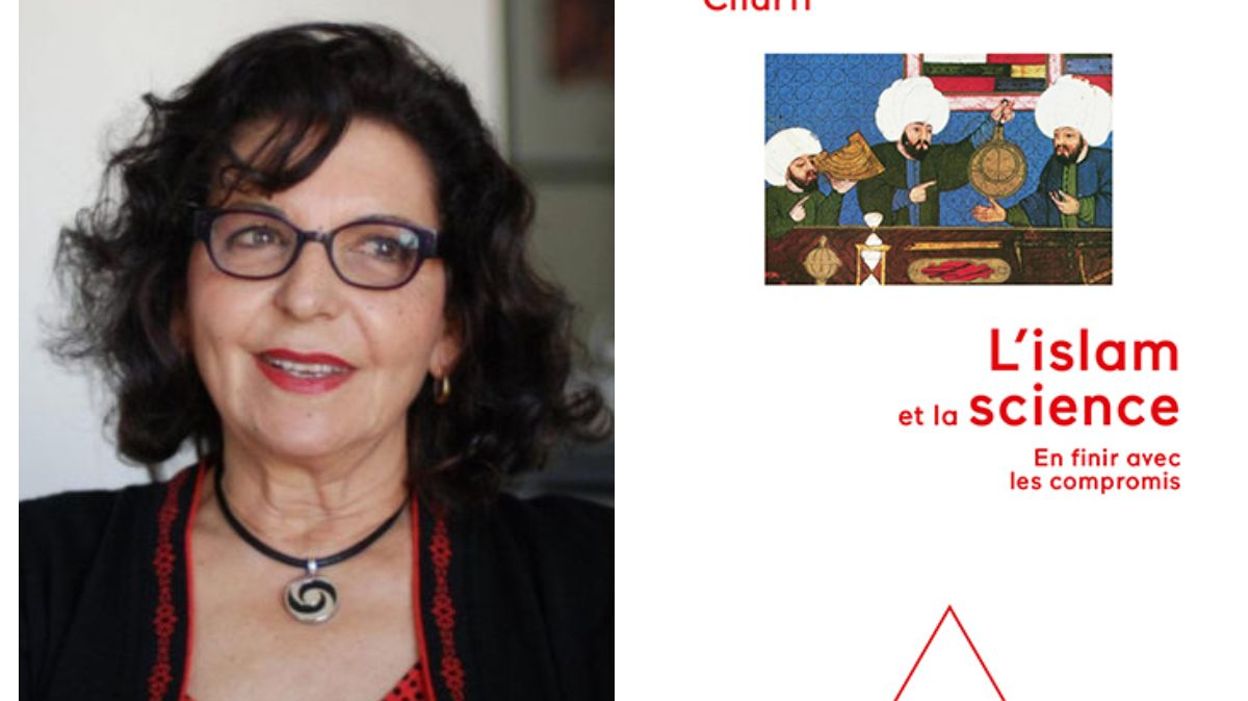
Can religion and science coexist in the land of Islam? Under what conditions? How not to confuse them, and how to reaffirm the independence of science? In his latest work, Islam and Science: Stop CompromisingTunisian physicist Faouzia Farida Charfi It tells the fascinating story of the relationship between Islam and science for more than a thousand years. It shows how Arabic science, once in a golden age, was challenged in the name of religion.
Islam and Science: Ending Concessions Written by Tunisian physicist Faouzia Charfi, published by Editions Odile Jacob.
Faouzia Farida Charfi He is talking about an Arab science, not an Islamic one. For her, the distinction is very important. Arabic linguistics is what is written in Arabic. Very quickly, the Arabic language became the language of science and very quickly, the Arabic flag became a world science.
“On the other hand, when we talk about Islamic sciences, we are referring to a science that Islam will enrich in some way, but it has nothing to do with it. I think putting a compiler of this kind into science is just as dangerous as Islamists say when they talk about modern science Western”.
In what context was Arabic science developed?
He stresses that the starting point is much more historical context than purely religious reason Faouzia Charfi. The Abbasid Empire settled and established Baghdad in the mid-eighth century, in this great Sassanid Empire that was awash with the culture of science and the translation of ancient texts. The new Caliph al-Mansur draws inspiration from these traditions to establish his authority.
Baghdad became a veritable multicultural city, with libraries, and scientific institutions, all with the contribution of Greek, Indian and Persian sciences. The translation request is linked to a real scientific activity.
Why did the Arab flag decline?
In 1050, the Seldjoukides Turks seized power. Their enemies are Shiites, but they are also rational. They want to erase other visions of Islam and create institutions of religious knowledge, and no longer scientific knowledge. Islamic law is taught there, and we are witnessing, after centuries of scientific development in all fields, a total transformation in the concept of knowledge, as he explains Faouzia Charfi.
“Science does not disappear completely. It will remain the unchallenged science that does not appeal to any perception of the world. It is a useful science: the astronomer is attached to the mosque and the doctor who works in the hospital to relieve men. There is no longer this perception of science for itself, as an answer, as an opening. It is An intellectual dryness begins at the level of science.”
Today, the rejection of modernity by political leaders is associated with a rejection of science. It means continuing to resort to these prejudices, to this religious reference. And by rejecting modernity, we are also rejecting the West.
The twentieth century saw the establishment of the Muslim Brotherhood movement in 1928. “It is a rejection of the West but also a rejection of the world heritage. They denounce the Western world that it had to separate from religion in order for science to advance. For them, the independence of science is Western thought. Hence the justification of the Western qualification applied to the word science.”
Quran of science
Faouzia Charfi Notes the decline of science education for religious reasons.
“In Tunisia, for example, Ben Ali wanted, to please the Islamists, that the theory of evolution be taught only in the departments of life and earth sciences and not in the mathematics department, where future engineers and future CEOs are. Know what Darwin means. There is a decline. Since 2011, The Islamists’ presence in power encouraged some teachers to ignore these classes.
In the Qur’an an invitation to knowledge, to question. You can have faith and be a scientist, like Georges Lemaitre, who was so attached to this separation, the physicist recalls.
“The Qur’an of Knowledge” It is developing dangerously on social networks. Students have behaviors is too much identity. This is the scientific view that dominates today. Useful science, through techniques, is very present in the countries of the Middle East, and it is never rejected in its most advanced applications.”
Secularism is the key
“What I care about is nurturing secularism, explaining what it is. It’s not an ideology. This separation between law and Islam, between science and Islam, this is what will really allow us to move forward. In Tunisia, the separation of family law and Islam has allowed women to be in all areas of life.”
For her, liberation passes through the status of a woman.
“The situation of Afghan women is very tragic. It is the Taliban’s association with Sharia law. However, in the nineteenth century, thinkers of the Islamic world wrote books in defense of the emancipation of women, in defense of the idea that she should be free, that she is not an inferior being, and that the veil also excludes her. . […] Hijab is a political sign, not a traditional sign.
In the Islamic world, women are much more involved in science than in Europe. In Tunisia, in engineering faculties, 40% of girls. There is no competition between males and females, as these are fairly new jobs in this country.
Listen here for the rest of the interview with Fouzia Charfi, talking about her hope for Tunisia

Sophie Laurent is a contributor to Vaughantoday.ca, covering a wide range of topics including local news, politics, business, technology, sports, entertainment, and lifestyle. She focuses on delivering clear, balanced reporting that helps readers stay informed about current events and issues that matter to their communities. Sophie is committed to presenting accurate information, practical insights, and relevant stories in a straightforward and reader-friendly manner, making complex topics accessible to a broad audience.