

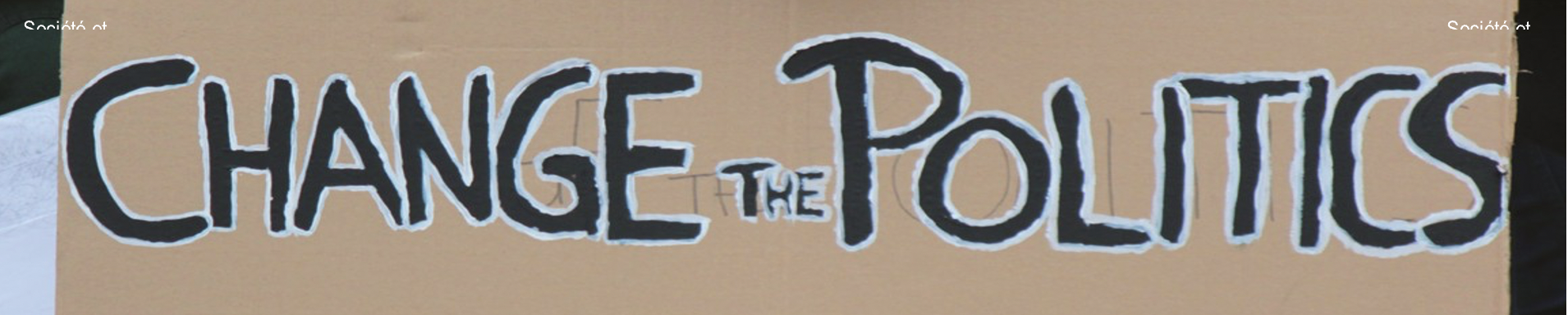
As climate scientists ring the alarm with such cruelty, their hands are bleeding and the bell makes a deafening noise, the political world is showing a calm worthy of the greatest of the Stoics, as it heads toward crisis. When discussing how to improve Quebec’s transport infrastructure, the environment minister himself declares that no environmental study can prevent the creation of a third link. So why if these studies and research often fall on deaf ears? Often a politician seems so willing to put facts aside to maintain his agenda that one is left to wonder what is the point of stubbornness in scientific approaches. Three professors from Laval University give us their perspective on the relationship between science and politics in order to shed light on the phenomenon, but opinions differ.
Written by Ludovic Dufour, Corporate Office Manager
For Patrick Provost, full professor in the Department of Microbiology, Infection and Immunology, the answer is simple. Governments simply don’t listen to science until it supports their position. Worse, it is often used to justify itself, that is, instead of making decisions based on scientific consensus first, we take in the appropriate scientific elements to legitimize the decisions.
The professor points out that scientific areas with positive economic impacts are more likely to be taken into account by politicians, and conversely, areas with harmful effects and even underfunding will be ignored. This trend is explained by the disproportionate influence that various pressure groups have on governments. He cites as an example the case of the increase in air nickel standards that “completely forget about the residents of Limoilo” in favor of economic interests.
Jean Dube, associate professor at the Graduate School of Land Administration and Regional Development, also mentioned the tendency of politicians to use science to justify themselves rather than starting by consulting scientists. However, he is of the opinion that the social sciences are more influenced than the pure sciences. While the latter has a certain status and is better
received by politicians, social sciences in his opinion are often considered mere opinions when their approach is no less scientific. The polarization of discussions is accused of being responsible for this underestimation of experience.
He also states that politicians have the advantage of having a direct forum with the population. Knowing the progress and positions of scholars is much more difficult than learning about recent political debates. Mr. Dube believes this is a means of exploration so that science is more present in the public debate. Promotion is not held in high regard by academia, “but it is of paramount importance. We may not be taking enough of this place,” he adds. Therefore, if the world wants to be heard, they must also find a place for themselves.
However, the full professor in the Department of Political Science, Jean-Frédéric Morin, has a more nuanced view than his colleagues. In fact, it opposes the linear model of the relationship between scientists and politicians who desire the former to be a model of rationality, free from all external influence, dispensed with truth, and the latter supposed to listen to these facts and, if they do not, they would be wrong. This model “is a type of caricature that needs some finer detail and made more complex in many ways.”
First, Mr. Moran reminds us that most scholars do not address themselves to politicians and that their studies are not intended for them. This research does not directly generate benefits of interest to governments or the private sector. However, this research is “essential to practical progress” that will come later. Experts pass on their knowledge and findings to other scientists.
Then he states that science is above all a process and not a distributor of truth. This approach, which “works a little berserk, a bit blind” also includes uncertainties and debates. In this context, it is easier for the political scientist to search for scientific elements that suit him more than others to justify his positions. Moreover, contrary to popular belief, science does not automatically depolarize debate. For example, a study of US congressional debates on acid rain concluded that “Members of Congress interpreted each of these interventions according to their pre-established preferences. The slightest nuance expressed by one scholar was amplified by members of Congress to support their view” (Morin and Orsini, 2015 ).
Mr. Morin also makes it clear that this tendency to retain scientific arguments consistent with our position exists not only among politicians, but also among the population. In fact, people with a good scientific culture, contrary to what one might think, are not those who most embrace the scientific consensus. Instead, studies show that these individuals are the most polarizing and also tend to retain only information that supports their point of view.
The professor also reminds us that science is not without bias. Although difficult to distinguish, they exist, because scholars are also a product of their society and the values conveyed in it affect them. In fact, we can demonstrate this phenomenon by noting that the origins of scientists have an impact on their way of prioritizing and defining environmental problems (Pavé et al., 1998). In fact, there is a certain power game at the international level, with Western countries producing more research, stifling other scientific opinions. “The prevailing scientific discourse and practice is no more global than it is politically neutral,” Mr. Morin wrote. (Morin and Orsini, 2015) adds: “Certain viewpoints, usually those of the weaker, are systematically marginalized or ignored.”
For him, science should listen to politics just as politics should listen to science. Not to mention manipulation, scientific research must still be framed by certain criteria. However, these criteria cannot be determined by the scientific approach rather it is the political scientist who plays this role. In short, science is as steeped in politics as the politics of science. One constructs and defines possibilities for the action of the other” (Morin and Orsini, 2015). In this sense, he does not necessarily want science to have a greater role or greater influence on the political sphere, but the dialogues between the two are more numerous. He also points out that understanding the sciences is better than Before the population can help depolarize discussions.
This point was taken up by Mr. Dube who asserted that polarization was detrimental to discussions, but also believed that politicians already had sufficient influence over scholars who, for their part, influenced politicians less. To compensate for this deficiency, he suggests that scholars take up more space in the public domain and make efforts to be more heard by the population.
Professor Provost notes with suspicion the convergence of science and politics, fearing that lobbyists will also influence research. It is preferable instead that independent scientific bodies advise the government, and that such decisions be based on the most recent studies. It also encourages politicians to communicate more about the scientific nature of their decision so that the population can better understand them.
While I wanted to clarify the discussion and offer solutions, and I must admit I find another excuse to reprimand politicians, I think this little show does nothing of the sort. On the one hand, we criticize the manipulation of science by the government and the capitalist economy, on the other hand we accuse the polarization and lack of seriousness given to the humanities, and finally we say to get rid of our linear view of human science. The relationship between science and politics and encourage cooperation between the two. Like things are often more complex than they might seem, and perhaps that’s what needs to be remembered from these few pages: problems and their solutions are never that simple.
references
J. Morin & Orsini (2015). Chapter 1. Science, Politics and Political Science. In: , J. Morin & A. Orsini (Editors), international environmental policy (pp. 27-48). Paris: Science Press.
Pave, J. Courtet, C. and Volatier, J. (1998) The environment: how the scientific community sees problems, INRA Environmental Mail, (pp. 109-114). Paris: National Institute for Agricultural Research.

Sophie Laurent is a contributor to Vaughantoday.ca, covering a wide range of topics including local news, politics, business, technology, sports, entertainment, and lifestyle. She focuses on delivering clear, balanced reporting that helps readers stay informed about current events and issues that matter to their communities. Sophie is committed to presenting accurate information, practical insights, and relevant stories in a straightforward and reader-friendly manner, making complex topics accessible to a broad audience.