

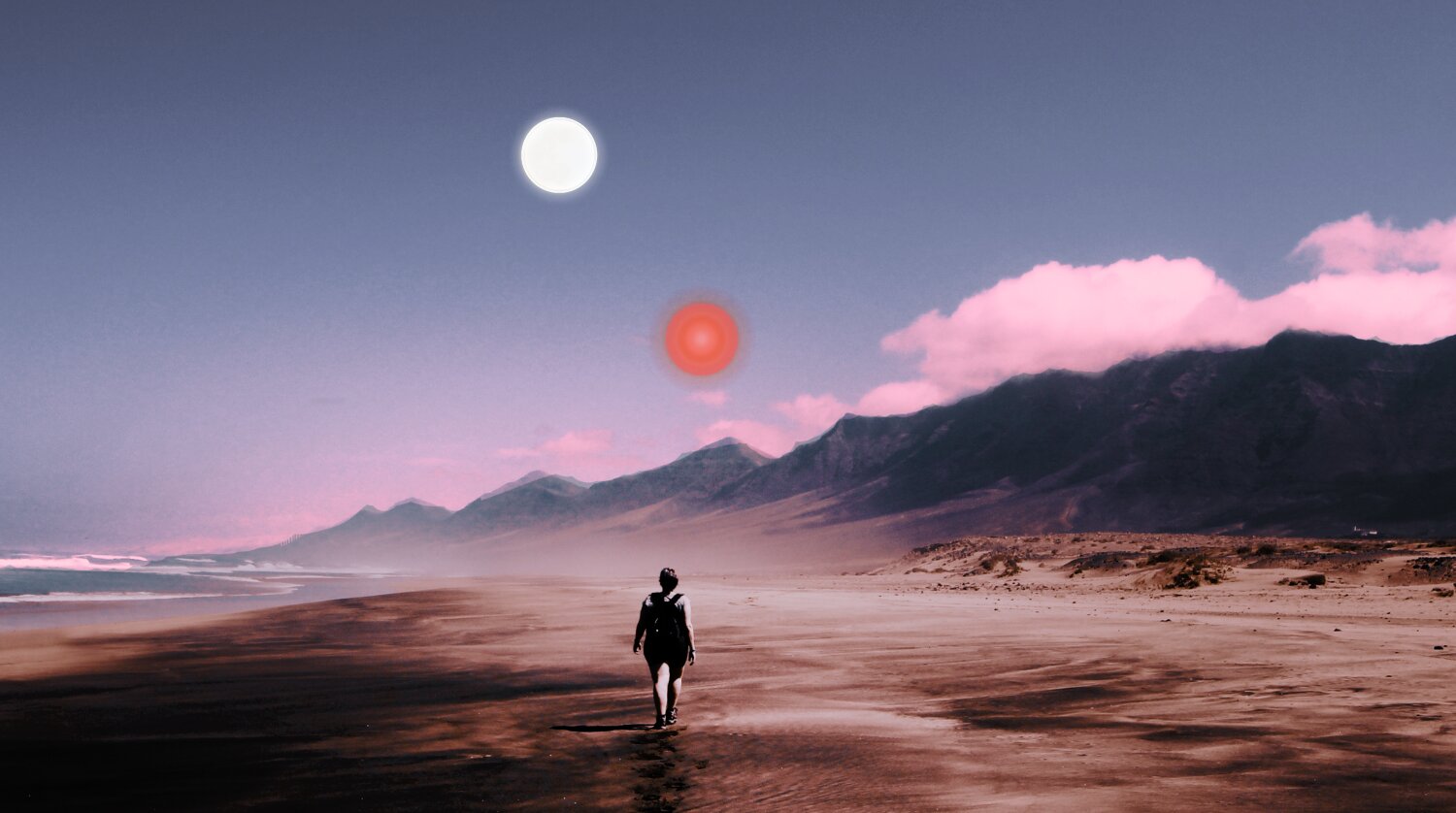
Image reworked from Canva's premium libraries — royalty-free. credit: Journal of Scientific Communications – JCOM
× Close
Image reworked from Canva's premium libraries — royalty-free. credit: Journal of Scientific Communications – JCOM
An astronomy lesson about binary stars could begin with a series of complex charts and data or with a clip from the Star Wars movie in which Luke Skywalker looks up into the sky of his home planet, Tatooine, and sees two suns rising. What will most easily awaken the interest of a sleepy high school class?
Science fiction has always captured our attention and, as many scientists claim, has often been a source of inspiration in their scientific careers. For this reason, it is sometimes used to communicate science to the public, and even to convey complex content. While this can be an effective method, it is essential to understand how actual science is represented through science fiction.
That's what the new paper is published In the Journal of Scientific Communications – JCOM He does so, using a quantitative methodology capable of analyzing a wide range of science fiction works (dealing specifically with exoplanets), showing that significant changes in scientific knowledge correspond to changes in science fiction literature as well.
Emma Johanna Boranen, a researcher at the St Andrews Center for Exoplanetary Science (University of St Andrews), along with her colleagues at the Center Emily Viner and Vi Anne Smith, and Christiane Helling, Director of the Institute for Space Research (IWF) at the University of St Andrews. The Austrian Academy of Sciences applied Bayesian network analysis to a corpus of 142 works of science fiction, including novels, films, television shows, podcasts, and video games.
For their research, scientists chose to study the representation of exoplanets, also called exoplanets. “It's everywhere in science fiction. It's everywhere. Most stories set in space will eventually have a setting on an exoplanet,” Buranen explains. “The other reason for using exoplanets is that there was a major shift in our scientific understanding in 1995 when the first exoplanet was discovered orbiting a sun-like star.”
The Bayesian network methodology allowed for a quantitative investigation of a topic – science fiction – usually analyzed qualitatively, often only one work being analyzed at a time.
In the virtual network, the properties of the exoplanets depicted in the selected works are represented as nodes in an interconnected network, allowing us to understand how each node affects the others. In practice, it can be determined whether a planet in a particular work, for example, is depicted as being favorable to life, and whether and how strongly that influences another trait.
Because the science fiction works analyzed were spread over a relatively wide time period, before and after 1995, Buranen and his colleagues were able to observe that after that date, the representation of exoplanets in science fiction changed.
“Traditionally in science fiction, there has been a high percentage of Earth-like planets that are habitable,” Buranen explains, and this is obviously sensitive given that these are cultural products created by humans for other humans. “But what has changed since the discovery of real exoplanets is that imaginary exoplanets are actually becoming less Earth-like.”
In fact, the large numbers of exoplanets observed by science so far contain an overwhelming majority of planets very different from our own, and rarely lie in what scientists know as the habitable zone, where conditions are more suitable for life as we know it. Buranen comments that this scientific reality has seeped into science fiction representation.
“I would speculate that science fiction authors are probably reading all these headlines about worlds covered in lava or where it rains diamonds, which is what you see in the media,” the researcher comments.
“I think science fiction responds to scientific discoveries. I think it kind of reflects what was happening in science at the time it was written,” Buranen concludes. “So I think it can be integrated into science communication in terms of providing a starting point. It can introduce concepts to people.”
more information:
Emma Johanna Buranen et al., Science Fiction Media Representations of Exoplanets: Depicting Changing Astronomical Discoveries, Journal of Scientific Communications (2024). doi: 10.22323/2.23010204

Sophie Laurent is a contributor to Vaughantoday.ca, covering a wide range of topics including local news, politics, business, technology, sports, entertainment, and lifestyle. She focuses on delivering clear, balanced reporting that helps readers stay informed about current events and issues that matter to their communities. Sophie is committed to presenting accurate information, practical insights, and relevant stories in a straightforward and reader-friendly manner, making complex topics accessible to a broad audience.