

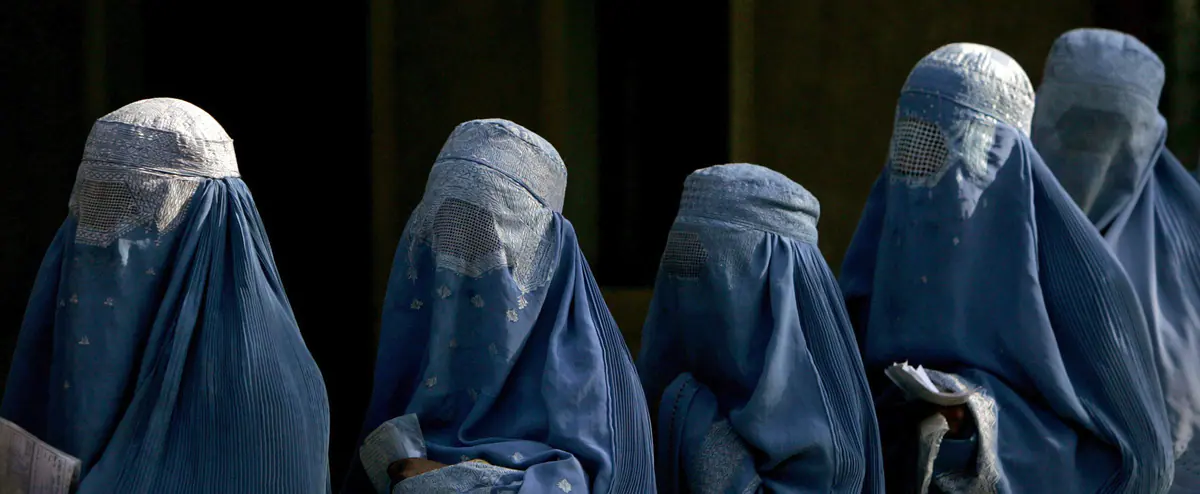
The Taliban have severely tightened restrictions on women’s freedom in Afghanistan, and on Saturday required them to wear the full veil, preferably the burqa, an announcement sharply criticized by feminist activists.
• Read also: Afghanistan: Supreme Leader urges world to recognize Taliban government
• Read also: Boycott Quebec, a country worthy of the Taliban
• Read also: ‘Don’t just think of the Ukrainians’: Afghans are calling for help
In a decree issued at a ceremony in Kabul, the supreme leader of the Taliban and Afghanistan, Hebatullah Akhundzadeh, ordered women to completely cover their bodies and faces in public, saying that the burqa, a network of full blue headscarves at eye level, was the best option for this.
Women are required to wear “the chadari (another name for the burqa), because it is a respectable tradition,” this decree indicates.
He said: “A woman who is neither young nor old should cover her face except her eyes in accordance with the recommendations of the Sharia to avoid any provocation when she meets a man” who is not a close family member. Add.
And if they have no reason to go out, it is better for them to stay at home.
This decree also lists the penalties for heads of families who do not require the full veil. The first offenders will be punished with a simple warning. On the third day, they will be sentenced to three days’ imprisonment, and on the fourth day they will be brought to justice.
In addition, any government employee who does not wear a full veil will be fired immediately.
A women’s rights activist who remained in Afghanistan, on the condition of anonymity, replied to AFP: “Islam never recommended Chadri.”
Rather than being progressive, the Taliban are regressing. “They behave the same as they did on their first diet, and they’ve been the same for 20 years,” she added.
fake promises
The United States has decried these new restrictions, “deeply concerned that they have undermined the rights of Afghan women and girls and the progress made in this area over the past 20 years,” according to a State Department spokesperson.
The United Nations also condemned this decision. She emphasized in a press release for the United Nations Assistance Mission in Afghanistan that this “contradicts the many assurances regarding the protection of human rights for all Afghans” that in recent years the representatives of the Taliban have made to the international community.
Since the Taliban’s return to power in August 2021, the Ministry for the Promotion of Virtue and the Prevention of Vice has issued several recommendations on how women should dress. But this is the first decree on this subject issued at the national level.
The Taliban had previously required women to wear at least a headscarf, a scarf that covered the head but revealed the face. But they strongly recommended wearing the burqa, which they made compulsory when they first came to power between 1996 and 2001.
Under their first regime, they denied women nearly all rights, according to their strict interpretation of Islamic law.
Agents from the Commission for the Promotion of Virtue and the Prevention of Vice lashed anyone who arrested him without a burqa.
After their return to power, after 20 years of occupation by the United States and its allies, which expelled them in 2001, the Taliban promised to be more flexible this time.
But they soon reneged on their promises.
Afghan women are now largely excluded from government jobs and are prohibited from traveling abroad or long distances within the country without a male family member accompanying them.
Complex international recognition
In March, two students closed girls’ high schools and colleges, just hours after their long-announced reopening. This unexpected position, which had no justification other than the statement that girls’ education should be carried out in accordance with the provisions of Islamic law, caused a scandal in the international community.
The Taliban also enforced segregation of women and men in Kabul’s public parks, with visiting days reserved for both genders.
Saturday’s decree may further complicate the Taliban’s quest for international recognition, which the international community has linked directly to respect for women’s rights.
It is an unexpected step backwards, and it will not help the Taliban gain international recognition. Pakistani analyst Imtiaz Gul told AFP that such initiatives would only escalate opposition.
Over the past two decades, Afghan women have gained new freedoms, returning to school or applying for jobs in all sectors of activity, even if the country remains socially conservative.
Women first tried to assert their rights by demonstrating in Kabul and in major cities after the Taliban returned to power.
But they brutally suppressed the movement, arresting many activists and detaining some of them, sometimes for several weeks.
The burqa is a traditional Afghani piece of clothing, widely worn in remote and conservative parts of the country. Even before the Taliban’s return to power, the vast majority of Afghan women were veiled, if only with a loose headscarf.

Lucas Tremblay is a contributor at Vaughantoday.ca, covering a wide range of topics including local news, politics, business, technology, sports, entertainment, and lifestyle. He focuses on delivering clear, accurate reporting and useful information that helps readers stay informed about current events and issues affecting their communities. Lucas is committed to presenting relevant stories in a straightforward and accessible way, providing balanced coverage that keeps readers connected to the latest developments.