

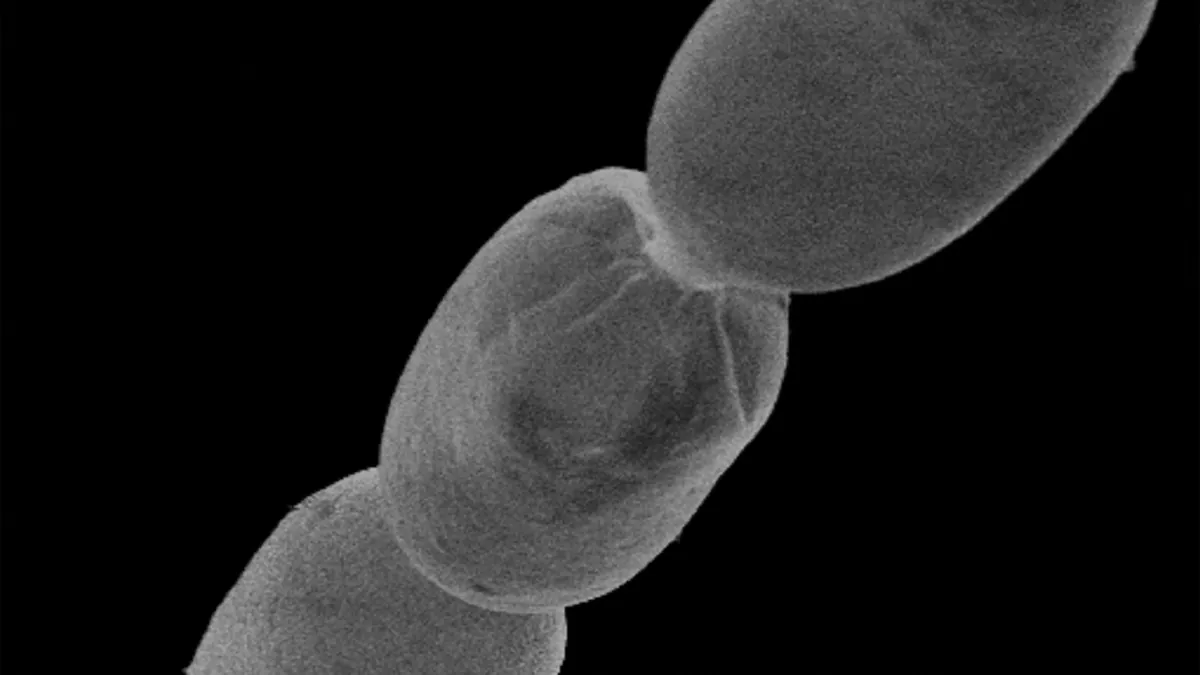
It can be picked up with tweezers: The world’s largest bacteria, 5,000 times larger than its peers and with a more complex structure, has been discovered in Guadeloupe, according to a study published Thursday in the journal Science.
Measuring two centimeters, ‘Thiomargarita magnifica’ looks like an ‘blink’ and rocks microbiology codes, as described by AFP Olivier Gros, professor of biology at the University of the West Indies, co-author of the study.
In his laboratory on the Fouillol campus, in Pointe-à-Pitre, the researcher proudly displays a test tube containing tiny white threads. When the average size of the bacteria is 2 to 5 micrometers, “it can be seen with the naked eye, and I can take it with tweezers!”
A researcher noticed the presence of the microbe in Guadeloupe for the first time in 2009.

France Press agency
“At first I thought it was nothing but a germ, because something couldn’t be two centimeters.”
Very quickly, cellular characterization techniques combined with electron microscopy show that it is nevertheless indeed a bacterial organism. But with such a size, says Professor Gross, “we had no confirmation that it was a single cell” – bacteria are a single-celled microorganism.
A biologist from the same lab reveals that it belongs to the family Thiomargarita, an already known bacterial genus that uses sulfides for its development.
Professor Gross explains that work by a researcher at the National Center for Scientific Research in Paris indicates that we are dealing with “one cell and the same cell”.
Convinced of their discovery, the team attempted to publish for the first time in a scientific journal, but that failed. “We were told: it is interesting, but we lack the information to make us believe you,” the biologist recalls, and the evidence is not strong enough in terms of a photo.
Enter Jean-Marie Voland, a young postdoctoral student from the University of the West Indies, who will become the first author of the study published in the journal Science. After failing to get a job as a teacher and researcher in Guadeloupe, the 30-year-old traveled to the United States, where he was recruited by Berkeley University. Going there, he was thinking of studying the “amazing bacteria” he was already familiar with.

France Press agency
He said to himself, “It would be like meeting a man on Mount Everest.” In the fall of 2018, he received the first package that Professor Gross sent to the Institute of Genome Sequencing at Lawrence Berkeley National Laboratory, which is operated by the university.
The challenge was mainly technical: to succeed in presenting an image of the bacteria as a whole, thanks to “3D microscopic analyses, at higher magnification”. In the American laboratory, the researcher possessed advanced technologies. Not forgetting the great financial support and “access to researchers who are experts in genome sequencing,” the scientist admitted, calling this US-Guadeloupe collaboration a “success story.”
His 3D images finally make it possible to prove that the entire strand is indeed a single cell.
In addition to their “giantness”, bacteria also turned out to be “more complex” than their counterparts: the researcher is witnessing a “completely unexpected” discovery, which “shakes up a great deal of knowledge in microbiology.”
“While normally in bacteria, the DNA floats freely in the cell, and in these organisms it is compressed into tiny structures called dots, a type of small, membrane-enclosed sac that isolates the DNA from the rest of the cell,” develops Jean-Marie Voland.
This division of DNA – the carrying molecule of genetic information – is “a characteristic of human, animal, and plant cells … not bacteria at all.”
Future research should determine whether these properties are specific to Thiomargarita magnifica or if they are present in other types of bacteria, according to Olivier Gros.
“This bacterial giant calls into question many of the established rules of microbiology” and “provides us the opportunity to observe and understand how complexity arises in living bacteria,” Jean-Marie Volland is excited.

Sophie Laurent is a contributor to Vaughantoday.ca, covering a wide range of topics including local news, politics, business, technology, sports, entertainment, and lifestyle. She focuses on delivering clear, balanced reporting that helps readers stay informed about current events and issues that matter to their communities. Sophie is committed to presenting accurate information, practical insights, and relevant stories in a straightforward and reader-friendly manner, making complex topics accessible to a broad audience.