

This clandestine campaign, active since 2017, aims to influence social media users who live in Central Asia, Iran, Afghanistan and the Middle East. Using fake accounts impersonating local media and local residents, the campaign sought to stoke resentment toward Russia, Iran and China. Almost half of the accounts targeted the Iranian population.
The researchers, who work for social media analytics firm Graphika, as well as Stanford University’s Internet Observatory, think The largest pro-Western social media influence operation analyzed by open source intelligence researchers (open source)
.
In all, the team analyzed nearly 300,000 tweets from 146 fake Twitter accounts, as well as 39 fake accounts, 16 pages, two Facebook groups, and 26 Instagram accounts. The researchers also found fake accounts linked on other Russian-language social networks. According to their analysis, all these fake accounts acted in a coordinated manner.
Meta, the company that owns Facebook, Instagram, and Twitter has taken down the entire network and claimed that these fake accounts were operated from the United States. Neither these companies nor the researchers can say for sure who is behind this campaign.
However, researchers note that an archived copy of one of the fake accounts shows that it indicated in 2021 that it belonged to the US Central Command, which is responsible for military operations in the Middle East and Central Asia, among others.
The network even used AI-generated images to create more realistic fake profiles. These accounts published articles from fake local media sites, cartoons, and petitions with a pro-Western message.
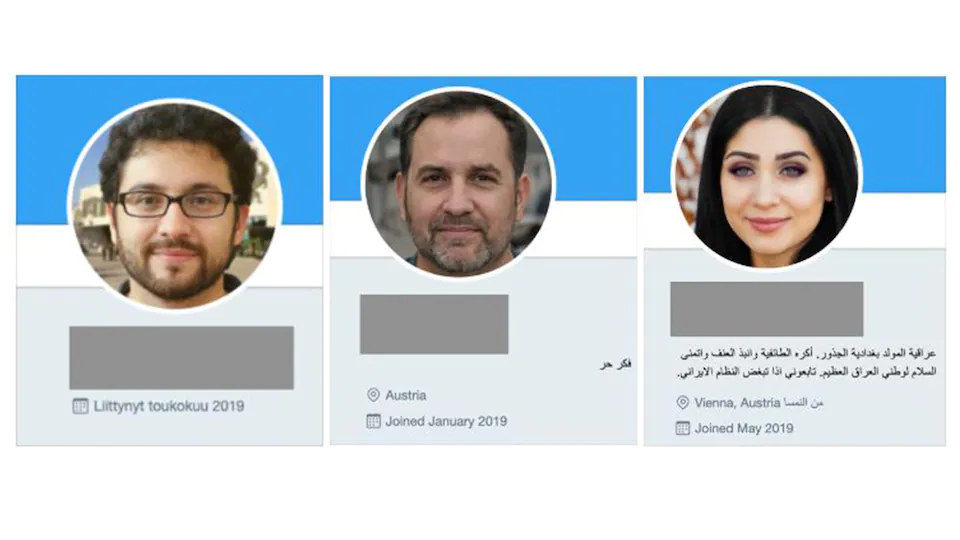
Some of the fake profiles belonging to the network are targeting the Middle East. Profile pictures were created using artificial intelligence.
Photo: Graphica/Stanford University
Soon after the Russian invasion of Ukraine began, many of these sought to portray Russia as an aggressor and highlight the alleged atrocities committed by Russian soldiers.
To date, almost all research on influence processes has focused on activities related to authoritarian regimes. Our report provides one of the first looks at a secret pro-American social media operation
Judge Shelby Grossman, one of the report’s authors and a researcher at the Stanford Internet Observatory.
She and her colleagues note that the quality of the campaign is relatively low. Some texts, for example, have been translated from English into Russian in an approximate manner. The posts of these fake accounts generated little enthusiasm among the target population. The average tweet associated with this campaign received 0.49 likes and 0.02 retweets, notes Ms. Grossman.
This campaign reminds us of the foreign intervention campaigns that have been deployed in recent years from Russia where IranMs. Grossman adds. The use of fake accounts to spread messages or to increase the spread of hashtags on social networks reminds us of influence operations emanating from these countries.
but, This pro-American campaign did not seek to exacerbate political and cultural divisions [au sein des populations visées] Nor to generate participation within or overlapping communities, unlike what we saw with influence campaigns linked to Russia
The researcher explains.
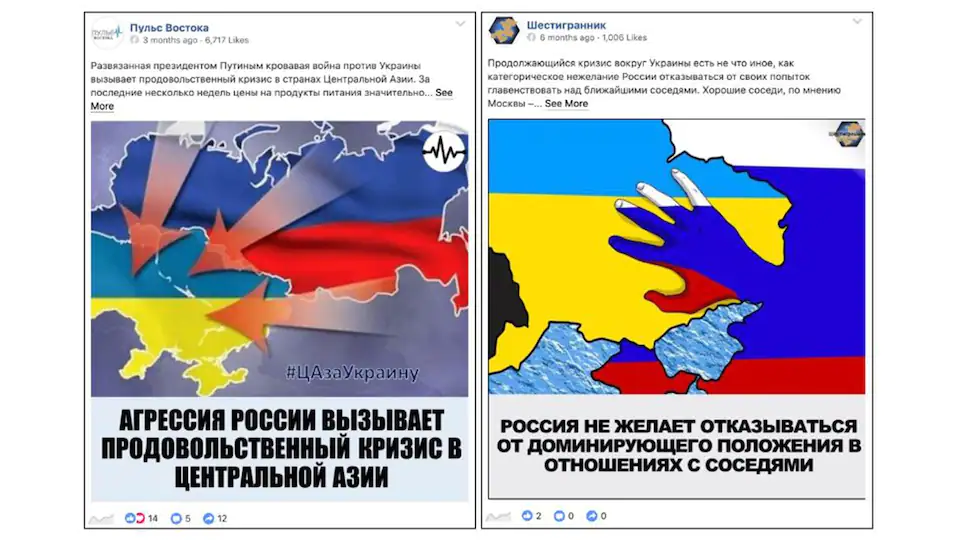
Two anti-Russian posts published by the Central Asian Fake Account Network.
Photo: Graphica/Stanford University
However, it is alarming that the actor behind these accounts appears to have created fake characters to secretly spread these opinions.
Ms. Grossman adds.
Tactic already used
Although it’s impossible to know if the US government is hiding behind this network, it’s entirely possible that that is the case, estimates Alexis Rapin, a resident researcher at UQAM’s Raoul Dandurand Chair in Multidimensional Conflict Observatory.
Mr. Rabin notes that the US military launched a similar campaign in 2011 called Ernst VoisOn social networks in Iraq and Afghanistan. There, too, results have been mixed, he says.
Maybe it didn’t quite come out of nowhere. He says there have been similar projects in recent years. There is no question that the US government is behind this.
But Alexis Rabin notes that it is possible that one or more interest groups in the United States may have acted independently to lead this initiative.
If the US government is hiding behind this operation, Mr. Rabin considers it likely a reaction to the campaigns of intervention by the enemies of the United States in recent years.
” This suggests that the United States may have come to the conclusion that it should be more active, permanently occupy the informational terrain, and somehow try to direct the narratives upstream so as not to leave greater latitude to its opponents. »
Mr. Rabin explains that information warfare falls along a spectrum. At the bottom of the scale are public relations and diplomacy; In the middle there is propaganda. And at the top there are more harmful activities, such as misinformation.
There, we seem to be somewhere between the middle and high end of the spectrum. We are still careful not to spread completely false information, completely fake news, but we are still trying to discredit the opponent a little.
Mr. Rabin concludes.


Lucas Tremblay is a contributor at Vaughantoday.ca, covering a wide range of topics including local news, politics, business, technology, sports, entertainment, and lifestyle. He focuses on delivering clear, accurate reporting and useful information that helps readers stay informed about current events and issues affecting their communities. Lucas is committed to presenting relevant stories in a straightforward and accessible way, providing balanced coverage that keeps readers connected to the latest developments.