

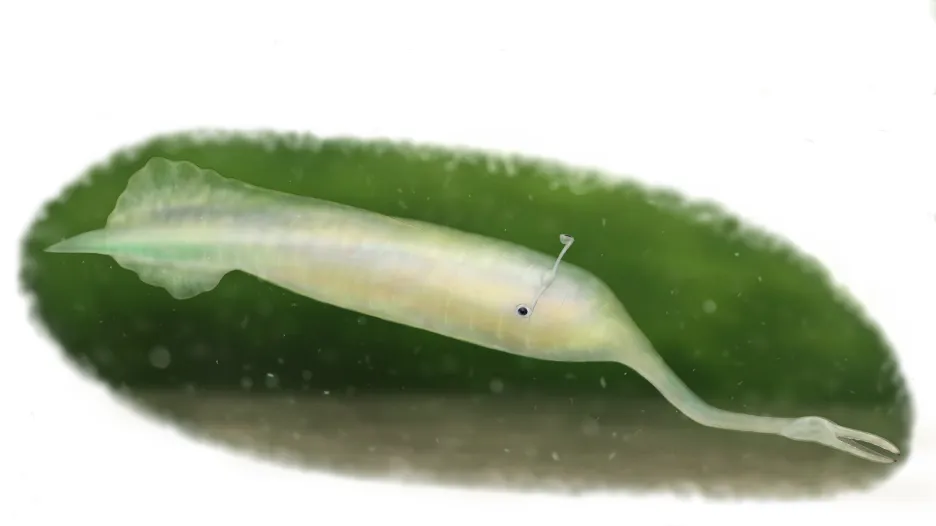
A team of Japanese scientists came forward to answer this fossil puzzle. Based on analysis with the help of cutting edge 3D imaging technology, they say it is not a vertebrate. However, they are unable to identify the type of invertebrate.
Monster story
This creature has occupied scientific interest since the 1950s. At the time, Francis Tully was dabbling in his hobby of collecting fossils at a site known as Mazon Creek Lagerstätte in Illinois and discovered a “thing” that was later named after him: Tully’s monster.
This creature is about fifteen centimeters long and appears to have lived in a prehistoric ocean 300 million years ago, long before the dinosaurs appeared. And unlike the bones of dinosaurs or the hard-shelled creatures often found as fossils, Tully’s beast had a soft body.
Mazon Creek Lagerstätte is one of the few places in the world where the conditions were right to capture in detail the footprints of these marine animals in the mud from the sea floor before they had time to disintegrate. That alone makes this creature unique, otherwise science knows very little about “soft” creatures.
Scientists: The vertebrate hypothesis is untenable
Now “we think the mystery of whether they are invertebrates or vertebrates has been solved,” he said. Tomoyuki MikamiAt the time of the study he was a doctoral student at the Graduate School of Science at the University of Tokyo and is currently a researcher at the National Museum of Nature and Science.
Based on the overwhelming evidence, the vertebrate hypothesis of the Tolley monster is untenable. Importantly, the Tolley monster had a split in the head region protruding from its body. This trait is not known in any lineage of vertebrates—suggesting that it was related to invertebrates. “.
The team studied more than 150 of these fossilized creatures and over 70 other animal fossils from Amazon Creek. Using a 3D laser scanner, the researchers created 3D color maps of the fossils, which showed through color differences the tiny irregularities that occurred on their surface — which cannot be seen with the naked eye or under a microscope.
X-ray computed tomography (which uses X-rays to create cross-sections of an object so that a 3D model can be created) has also been used to look at its “torso”—a strange elongated organ located inside the head. This 3D data showed that features previously thought to be evidence of vertebrates are in fact nothing of the sort.
Unknown proportions
Although scientists are now convinced, based on this study, that Tully’s monster is not a vertebrate, they still don’t know where to go with it. There are many options. It could be a representative of cephalopods, like today’s lanceolates, but also a protomouth, which means it is a relative of modern roundworms or earthworms.

Natalie Sinclair is a contributor at Vaughantoday.ca, covering a wide range of topics including local news, politics, business, technology, sports, entertainment, and lifestyle. She focuses on delivering clear, accurate reporting and useful information that helps readers stay informed about current events and issues that matter to their communities. Her work highlights timely developments, relevant stories, and practical insights in a professional and reader-friendly manner.