

- Drafting
- BBC News World

photo credit, Getty Images
Since we were children, when we want to draw a picture of the sky, we do not hesitate much to choose the color of the sun: we always paint it yellow.
If we wanted it to be more colorful, we might add some orange and red rays.
And if what we show is sunrise or sunset, we may paint the sun and the sky a little orange or red.
However, the closest star to us and the center of our planetary system is not yellow, orange or red.
It’s all these colors together and more.
And like any glowing object, the royal star emits light in a continuous spectrum of colours.
If you look at it with a prism, you can see that sunlight is divided into red, orange, yellow, green, blue, indigo and purple, that is, all colors in the visible spectrum.
In other words, the sun has the same colors as the rainbow!
In fact, rainbows are nothing more and nothing less than sunlight passing through water droplets in the atmosphere that act like tiny prisms.
However, before we start drawing a multicolored happy sun, we must make it clear that it would not be entirely correct to say that it is multicolored.

photo credit, Getty Images
This is because when the light of all these colors emitted by the sun are mixed together, you get light of only one color, and you’d be surprised to know what it is.
Look at the clouds that reflect sunlight. They are neither yellow nor multicolored. It’s white, because it’s the color that the sun really emits.
Why do we see it yellow?
Each color in the solar spectrum has a different wavelength.
At one end is red, which has the longest wave. The waves are getting shorter…from orange, yellow, green, blue and indigo to purple, which has the shortest wave.
Short wave photons, or color particles, are more scattered and fizzy than long wavelengths.
However, since light travels through space without resistance, there is nothing that can distort photons.
Therefore, if we look at the Sun from space, the photons simultaneously reach our optical cortex. It is the part of the brain responsible for processing visual information, and the result is that we see white light.
This is considered the “true” color of the sun.
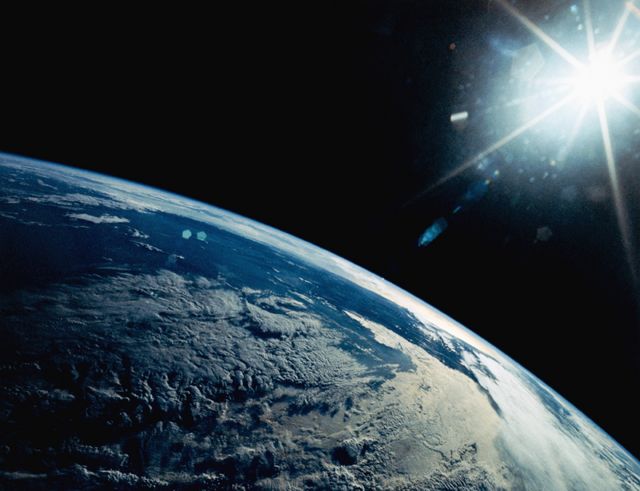
photo credit, Getty Images
From space, the sun is seen in its true color: white.
In contrast, when sunlight passes through Earth’s atmosphere, certain particles in the air distort photons of shorter waves, causing photons of longer waves to reach us sooner.
“The atmosphere blocks the most active part of the light spectrum, which corresponds to the ultraviolet and the blue zone,” explains Angel Molina, author of the astronomical broadcast website El Diario del Astrónomo.
“So, like a hot bulb, by removing some of the cooler colors from the light, the result we see from the ground is a warmer color, leaning more toward yellow,” he asserts.
But why do we see the sun in this yellow color and not in the longer wave colors like red and orange?
Uruguayan astronomer Gonzalo Tancredi, professor at the University of the Republic, told BBC Mundo that by absorbing short-wave colours, from purple to green, the predominant color is yellow in the middle of the spectrum.
green sun?
Tancredi also explained why many websites claim that the sun is actually green.
“If you plot a graph of the solar spectrum, it looks like a big mountain and the top is the green,” he explains.
In other words, although human eyes cannot distinguish the colors of solar radiation, if we observe them with special instruments that allow this distinction, we will see that the green radiation is the most intense (although with a very slight difference).
These details help explain why we see the yellow sun from Earth, the astronomer explains.
“If you remove the blue part and the short wave part of that mountain, the top turns yellow,” he explains.
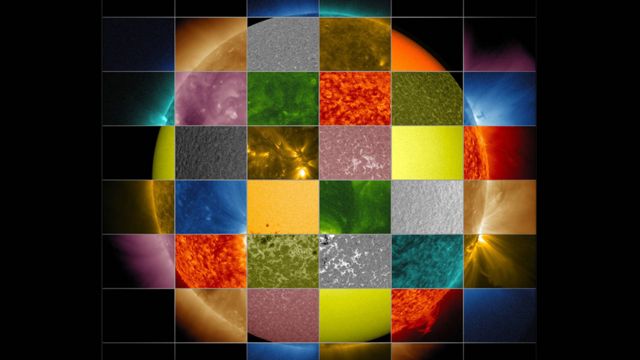
photo credit, NASA/SDO/Goddard Space Flight Center
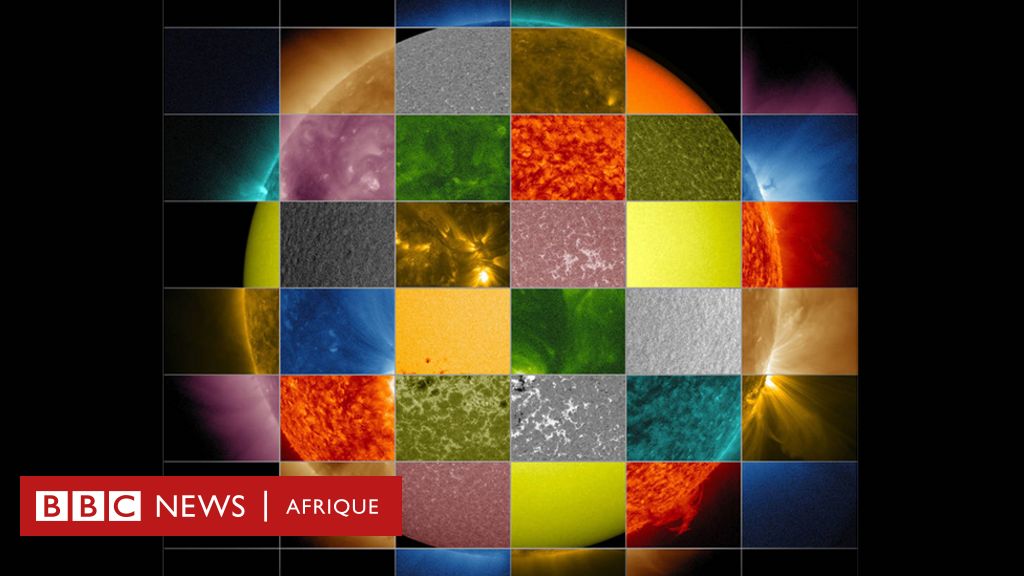
This NASA mosaic of the Sun from portions of images taken at different wavelengths shows a variety of colors emitted by the Sun (which, as a whole, is seen by the human eye as white).
A reddish sunset?
We already know why we see the yellow sun, even though it radiates white light. But why does he seem to change color when he wakes up in the morning and sleeps in the afternoon?
Everyone who has watched the sunrise or sunset will witness the amazing colors emanating from our star, which colors the sky in orange and red.
This is, again, an optical illusion caused by the interaction between sunlight and Earth’s atmosphere.
Indeed, during sunrise or sunset, the sun is closer to the horizon, and its light passes through a greater number of atmospheric particles, so blocking bluish colors is more important.
This phenomenon, which “colors” our sky in different colors depending on the angle of the sun relative to the Earth, has a name: Rayleigh scattering.
Its most dramatic effect is seen at dawn and dusk, when we see colors more strongly with longer waves: red and orange.

photo credit, EyeWire, Inc.
We hope this note taught you something interesting about our brilliant star.
Of course, we cannot end without reminding you that you should never look directly at the sun, even through telescopes or binoculars, as this can cause irreparable damage to your vision and may even lead to blindness.

Sophie Laurent is a contributor to Vaughantoday.ca, covering a wide range of topics including local news, politics, business, technology, sports, entertainment, and lifestyle. She focuses on delivering clear, balanced reporting that helps readers stay informed about current events and issues that matter to their communities. Sophie is committed to presenting accurate information, practical insights, and relevant stories in a straightforward and reader-friendly manner, making complex topics accessible to a broad audience.