

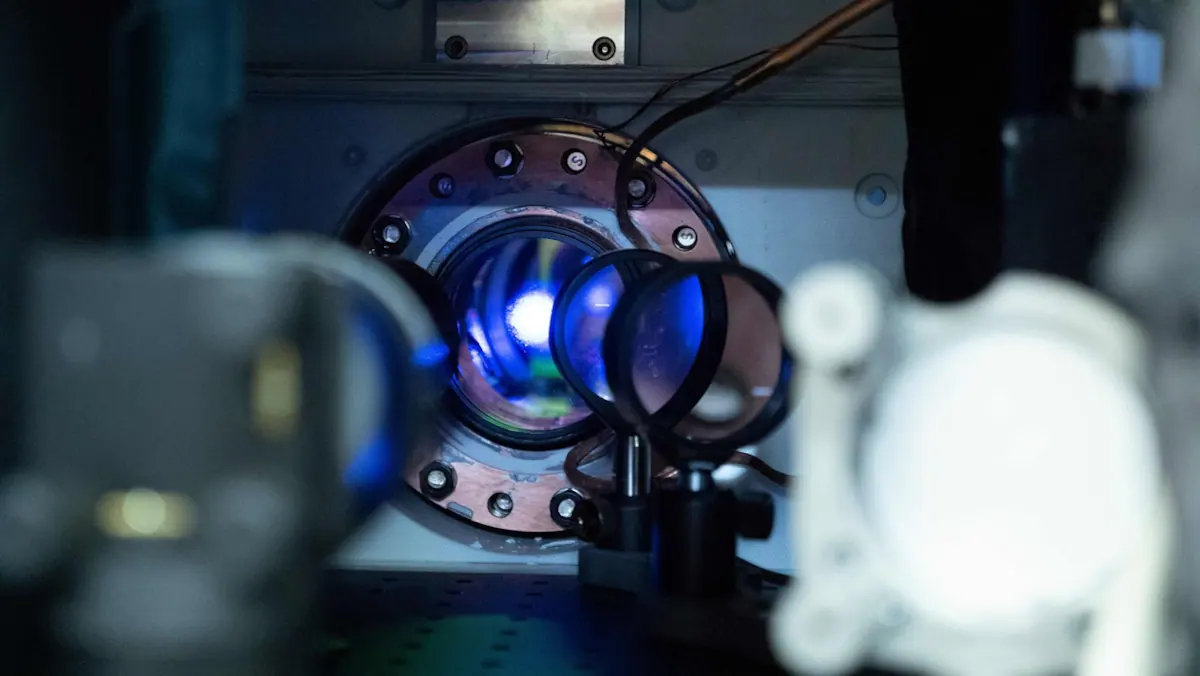
Scientists have succeeded in observing Einstein’s general theory of relativity on the smallest scale ever tried, by proving that the two clocks ticked off very slightly when they were separated by only a fraction of a millimeter.
• Read also: Black holes: “Gateway to Hell” raises man’s questions
• Read also: Einstein manuscript breaks records at auction
According to Jun Ye of the University of Boulder in Colorado, it is “by far” the most accurate watch ever developed. And it could pave the way for new discoveries in quantum mechanics, which governs the subatomic world.
The researcher and his colleagues published their results Wednesday in the prestigious journal Nature, describing technical advances that have enabled them to create an object 50 times more accurate than their previous watch, which already broke the accuracy record in 2010.
Einstein’s general theory of relativity, according to which the gravitational field of a very large object distorts spacetime, dates back to 1915. According to this theory, time slows down as one approaches an important mass.
But this was not verified until a long time later thanks to the invention of atomic clocks, which measure time by detecting the passage of atoms to a higher energy state, when exposed to a certain frequency.
In 1976, one of the experiments involved sending a clock into space, which was found to be 1 second faster every 73 years than its counterpart on Earth.
Since then, clocks have become more accurate, and therefore better at detecting the effects of relativity.
A decade ago, Jun Ye’s team broke a record by noticing the time difference when their watch was raised 33cm up.
Jun Ye’s breakthrough was working with so-called “optical grid” clocks, using lasers to trap atoms in certain ways. This technique prevents them from falling due to gravity or movement which could cause a loss of accuracy.
Inside the new watch are 100,000 atoms of strontium, sandwiched in several layers, with a total height of one millimeter.
The clock is so accurate that when this group was divided into two halves, scientists were able to detect the time differences between the upper and lower halves.
At this level of sensitivity, the watches act as sensors.
“Time and place are linked,” Jun Ye told AFP. “And with such an accurate measurement of time, you can see how space changes in real time – the Earth is a living, dynamic body.”
Such clocks can, for example, make it possible, in volcanic regions, to distinguish subsurface hard rocks from lava, and thus help predict volcanic eruptions.
Or study how global warming is causing glaciers to melt and sea levels to rise.
But what excites Jun Yi most is the role these clocks can play in physics.
Today’s clock can detect a time difference of more than 200 micrometers – but lowering that number to 20 could explore the quantum world, and help fill in some theoretical gaps.
If relativity explains beautifully how large objects such as planets or galaxies behave, it is incompatible with quantum mechanics, which deals with very small things.
The intersection of the two fields could make it possible to take another step towards a “theory of everything” capable of explaining all the physical phenomena of the universe.

Lucas Tremblay is a contributor at Vaughantoday.ca, covering a wide range of topics including local news, politics, business, technology, sports, entertainment, and lifestyle. He focuses on delivering clear, accurate reporting and useful information that helps readers stay informed about current events and issues affecting their communities. Lucas is committed to presenting relevant stories in a straightforward and accessible way, providing balanced coverage that keeps readers connected to the latest developments.