

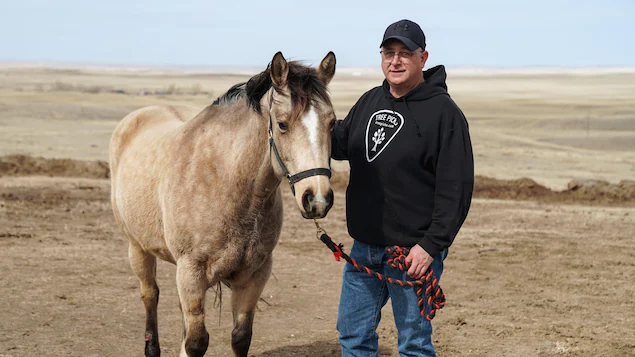
The wind is blowing hard over Martin Gendron’s stable in southeastern Alberta. In the middle of nowhere, 30 minutes from Medicine Hat, a Quebec social worker conducts a therapy riding session with Jason McKechearn.
For 90 minutes, this veteran will talk to blossoma quarter horse 9 years old, will pet her and walk around with her while doing breathing exercises.
For 30 years, Jason MacKiachern suffered from Post Traumatic Stress Disorder (PTSD) due to the many dangerous missions he was involved in in Cambodia and Bosnia.
As a combat engineer soldier, [son] The task was to secure the advance of the infantry [et] To detect coins or mines
he explains.
Living with your past
My feelings are very unstable. I often think about the past. The horse lives in the present. It helps me stay focused and feel better
He said.
After years without care, he began treatment with a psychiatrist before discovering equine-assisted therapies, on the advice of veterans.

Martin Gendron is also a research assistant at the University of Alberta.
Photo: Radio Canada/Axel Tardio
Go see a psychiatrist, sit in an office and talk [m’]It helps me, but this method helps me more
admits Jason McKeachern, a 50-year-old retiree, quit to take care of himself.
His guide Martin Gendron has been working with horses for seven years. It helps about fifty people improve their well-being. One in four clients is an expert or first responder.
With PTSD, you are always in a state of stress trying to defend yourself, fight and survive
he explains. With horses, we make a file Switch [une transition] For the parasympathetic nervous system that promotes relaxation and healing.
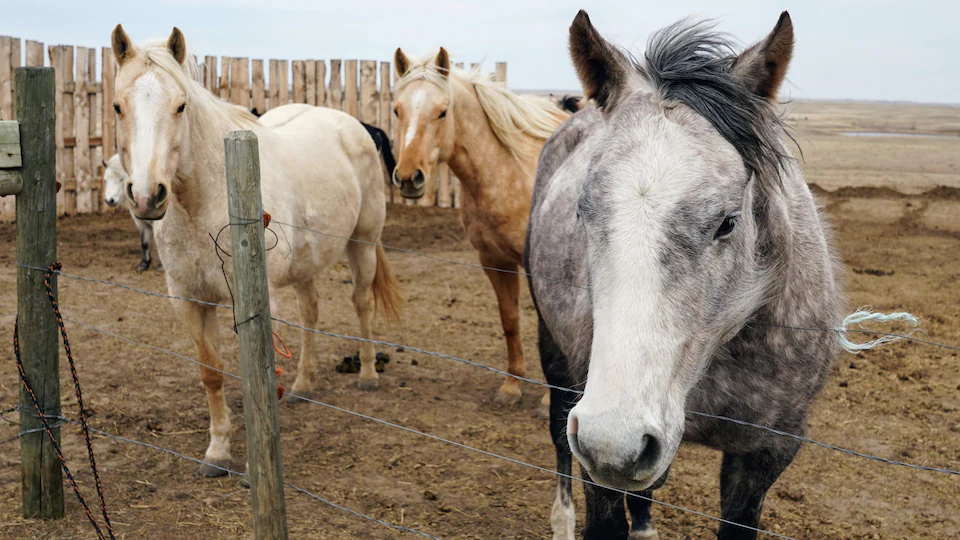
Martin Gendron has five horses. At the beginning of each session, the client enters his can to choose the person with whom the relationship will be most natural for that day.
Photo: Radio Canada/Axel Tardio
animals that calm down
Horses are more prey than predators, they are a good companion for psychological care exercises.
The social worker says they don’t tolerate much negativity. We humans keep it inside of us. By working with them, we put our energy on them, and they are able to release it for us.
More and more people are interested in this complementary therapeutic approach, according to Martin Gendron. There are many retired military personnel in the area
He said.
According to Veterans Affairs Canada, 1 in 10 veterans is in Alberta. As of March 2021, Canada had 39,651 veterans with a mental health condition receiving disability benefits, a 63% increase in six years.
What does science say?
Martin Gendron admits it: There is not enough scientific research
Demonstrate the effectiveness of equine treatments and facilitated wellness sessions with horses.
One of the latest studies is nonetheless optimistic. A team of researchers from Boston College and Suffolk University, among others, published one in 2017.
By observing three children aged 10 to 12 years considered to be carriers of complex trauma, the authors concluded that equine therapy has numerous benefits for their mental health. Among other things, they noted a decrease in anxiety, complaints, and behavioral disorganization.
Martin Gendron, a research assistant at the University of Alberta, hopes to advance the science in this area with studies that will be announced soon.

Natalie Sinclair is a contributor at Vaughantoday.ca, covering a wide range of topics including local news, politics, business, technology, sports, entertainment, and lifestyle. She focuses on delivering clear, accurate reporting and useful information that helps readers stay informed about current events and issues that matter to their communities. Her work highlights timely developments, relevant stories, and practical insights in a professional and reader-friendly manner.