

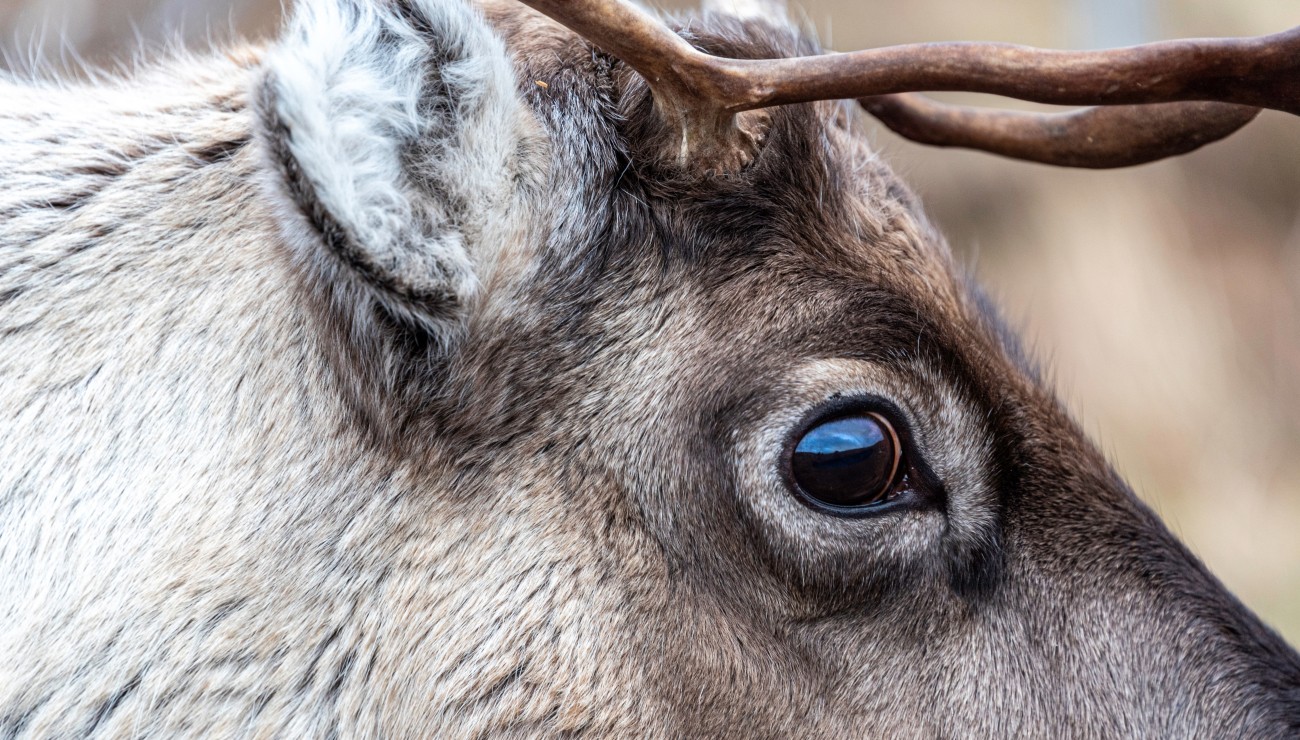
The emblem of the most beautiful tales, the reindeer is not only appreciated for its distinctive relationship with Santa Claus, or for its majestic horns or ringed palette meant to impress its rivals during the breeding season. They are also particularly adapted to their arctic environment where winter temperatures drop to -50°C and daylight becomes very weak. Its thick fur protects it from extreme temperatures while its crescent-shaped hooves allow it to move easily across snowy landscapes. But how do reindeer adapt to the dim lighting of long periods of winter twilight? Robert Fosbury and Glenn Jeffrey of University College London found that his dark, expressive eyes feature physical changes with the seasons, making him able to see clearly during long twilights.
In polar habitats, auroras can last for more than a third of the day. Therefore, animals that live in these environments must get used to hunting, feeding, or seeking shelter when it is very dark. But twilight has a peculiarity that distinguishes it from daytime: it contains almost exclusively blue light, with very little green, orange or yellow.
In this darkness, our eyes continue to function thanks to the rods, the photoreceptor cells in the retina that ensure we see shades of gray and black. But reindeer eyes have an added advantage: a special tissue that acts like a “mirror” behind the retina. This tissue is called tapetum lucidum (“bright carpet”), increases the amount of light captured thanks to the reflection of the incident light. As this mirror scatters some light laterally, the reindeer sees a brighter but slightly blurry image. Despite this loss of sharpness, they have a good perception of visual contrasts. This allows them, for example, to distinguish black spots of lichen on the ground, their main source of food, or to identify a predator in the area.
By comparing the eye systems of cadavers with those of living specimens, the researchers also observed skeletal remodeling of the cadavers Tabitum seasonally. The latter consists of very fine fibers of collagen, the most abundant protein in animals, which gives tissues mechanical resistance to stretching. . level TabitumThese fibers are stacked in a hollow hexagonal structure and washed into a liquid that fills the spaces between them. In the summer, the fibers are contained in a large amount of fluid, which tends to diverge from each other. On the other hand, in winter, the structure loses half its volume, the space in the hexagonal shape decreases, then the fibers are tightened and arranged among themselves. Decreased fibrous fluid volume, and thus fiber spacing in Tabitum Winter therefore causes a shift in the spectrum of light wavelengths that this rug can reflect: mainly towards a deep blue! This phenomenon may be explained by a change in pressure in the eyes of animals. In fact, intraocular pressure increases dramatically in winter because the pupil is constantly dilated in low light conditions, preventing eye drainage. According to the researchers, such an adaptation will not be limited to reindeer: a similar system may exist in many species subject to the Arctic environment, as it presents a significant evolutionary advantage.

Evan McKenzie is a contributor at Vaughantoday.ca, covering a wide range of topics including local news, politics, business, technology, sports, entertainment, and lifestyle. He focuses on clear, balanced reporting that helps readers stay informed about current events and issues that matter to their communities. His work aims to provide useful information, timely updates, and relevant stories presented in an accessible and reader-friendly way.