

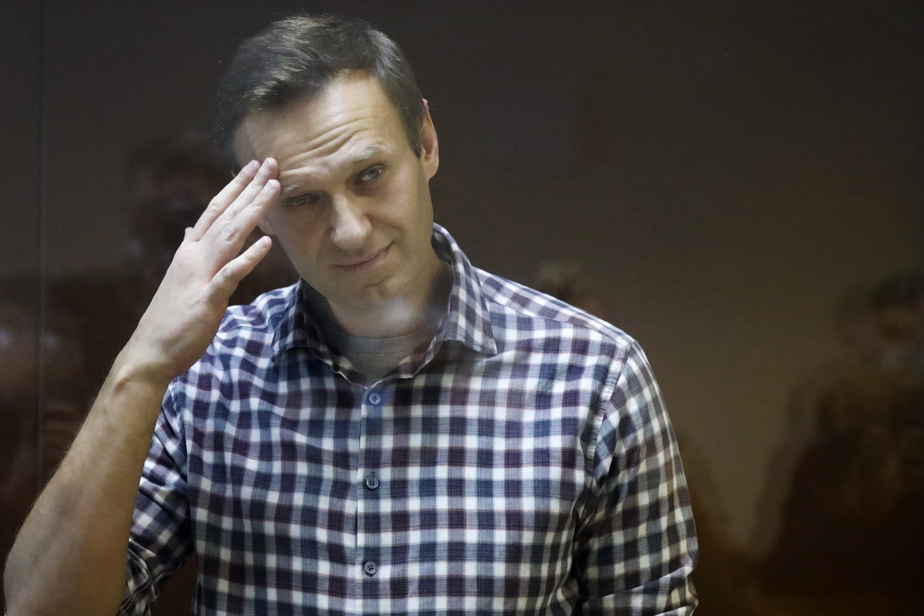
(Moscow) Russian opponent Alexei Navalny announced, on Friday, that he will end his hunger strike, which he has been following for three weeks, to denounce his conditions of detention, which raised concerns about his health and Western Russian tensions.

The day before, doctors close to the Kremlin critic, including his personal physician, urged him to end his hunger strike “immediately”, saying they feared he would die or “cause great harm” to his health.
“I have started to end my hunger strike,” wrote the 44-year-old dissident in a post on his Instagram account.
Mr Navalny stopped eating 24 days ago, on March 31, accusing the prison administration of preventing him from seeing a doctor while he was suffering from a double herniated disc, according to his lawyer.
Before his hunger strike, the most famous anti-corruption activist and Kremlin opponent also complained of a loss of sensitivity in his legs and hands, which he said could be a result of the poisoning he was subjected to. Last summer, which the Kremlin accused of. .
According to him, his jailers tortured him with sleep deprivation, and woke him up every hour during the night.
‘Big support’
One of his close aides, Leonid Volkov, speaking on social media Thursday evening, announced that Mr. Navalny was finally examined this week in a civilian hospital and that his medical file had been transferred to his doctors.
“The doctors I fully believe in announced yesterday that we have achieved enough to end my hunger strike,” wrote Mr. Navalny on Friday.
“Thanks to the tremendous support from good people across the country and abroad, we have made great strides. Two months ago we ridiculed my requests for medical help.”
However, he still claims that the doctor identifies the causes of his loss of sensitivity in the extremities: “I want to understand what it is and how it is treated.”
On Thursday, five doctors, including his personal physician Anastasia Vasilieva, asked after reviewing his file that he was feeding due to “symptoms of kidney failure, acute neurological symptoms and severe hyponatremia.” Which, in their opinion, could lead to serious injury. consequences.
At the end of last week, they had already estimated that his death could intervene at any time.
Internal and external pressures
And according to Mr. Navalny’s camp, he was finally able to meet doctors outside the prison system thanks to the pressure put on power by the demonstrations of his supporters that gathered thousands of people on Wednesday evening. On the same day Vladimir Putin gave his annual address to the nation.
These gatherings, which were smaller than they were in January at the time of his arrest, were also subjected to less brutal repression, although they resulted in more than 1,900 arrests.
The Navalny case in recent months has fueled Russian-Western tensions, with Washington and the European Union denouncing his poisoning, and Moscow’s refusal to investigate it, imprison him, and then treat him in prison.
The West also threatened Russia with consequences if the opponent died in prison.
Moscow rejected all of these criticisms.
Mr. Volkov welcomed Thursday Vladimir Putin’s authority “still interacting with internal and external pressures.”
Alexei Navalny was arrested upon his return from Germany in January, after five months of convalescence to recover from poisoning with the nerve gas Novichok.
At the end of February, he was sentenced to two and a half years in prison for fraud dating back to 2014, which he denounced as a politician.
Then the opponent was transferred to a concentration camp in the Vladimir region, about 100 kilometers from Moscow.
He was transferred to a hospital for tuberculosis patients in the same area at the end of last week, and then transferred to a civilian hospital in Vladimir, according to his lawyer.

Lucas Tremblay is a contributor at Vaughantoday.ca, covering a wide range of topics including local news, politics, business, technology, sports, entertainment, and lifestyle. He focuses on delivering clear, accurate reporting and useful information that helps readers stay informed about current events and issues affecting their communities. Lucas is committed to presenting relevant stories in a straightforward and accessible way, providing balanced coverage that keeps readers connected to the latest developments.