


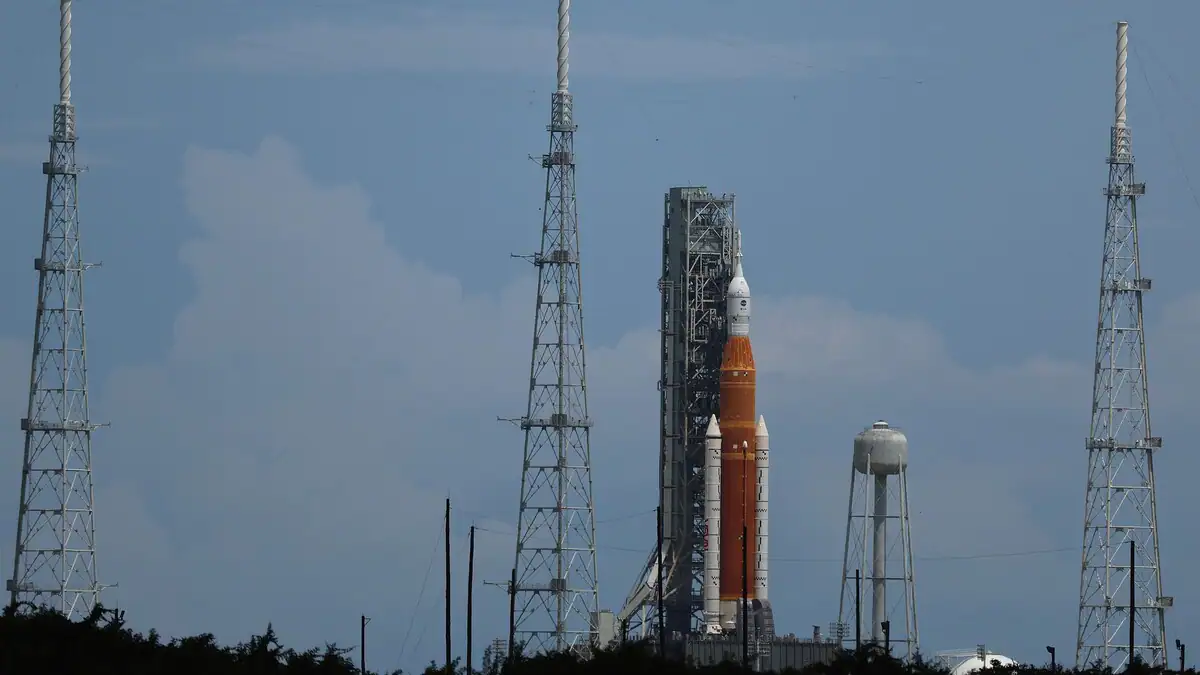
NASA’s latest rocket, the most powerful in the world, was scheduled to blast off for the first time Monday from Florida to the moon, but the operations to fill the rocket with its fuel gave the space agency’s teams a rough time, a few hours. before launch.
The tanks started filling up with a delay of about an hour, due to the high risk of lightning strikes in the middle of the night.
Operations were to last several hours, until the rocket was filled with more than three million liters of hydrogen and super-cold liquid oxygen.
But around 3:00 a.m. local time, a possible leak was detected while filling the main stage with hydrogen, causing a pause. After testing, streaming has finally resumed, with teams at the site continuing to closely monitor the situation.
NASA hopes to make up for the accumulated delay. Take off is scheduled for 8:33 a.m. from Launch Pad 39B at the Kennedy Space Center.
The shooting window stretches for more than two hours, thus leaving some room for maneuver. But if the weather is 80% suitable for setting off on time, it should deteriorate gradually during the morning.
From a height of 98 meters, the orange and white SLS rocket will not be able to take off in the event of rain or thunderstorms.
Fifty years after the last Apollo flight, the Artemis 1 mission should mark the launch of the American program to return to the Moon, which is supposed to allow humanity to reach Mars on the same ship.
An unmanned Orion capsule will be launched into lunar orbit, to verify that the craft is safe for future astronauts – including the first woman and first person of color to walk on the moon.
“This mission holds the dreams and hopes of many people,” NASA Administrator Bill Nelson said this weekend before adding, “We are now the Artemis generation.”
Mark of the Era, NASA’s first female launch director, Charlie Blackwell Thompson, will present the final “launch.” Women account for 30% of the workforce in the launch room – versus just one for Apollo 11.
Two minutes after takeoff, the boosters will return to the Atlantic. After eight minutes, the main stage breaks in turn. Then, about an hour and a half later, a final upper-stage thrust will set the capsule on its way to the moon, which will take several days to arrive.
Between 100,000 and 200,000 people are expected to attend the parade, including United States Vice President Kamala Harris.
In the event of cancellation, the next possible take-off date is September 2.
The main goal of the mission is to test the capsule’s heat shield, which will return to Earth’s atmosphere at a speed of 40,000 km/h, a temperature half the temperature of the Sun’s surface.
Instead of astronauts, mannequins were placed on board, which are equipped with sensors that record vibrations and radiation levels. Small satellites will also be deployed to study the moon or even an asteroid.
The capsule will venture up to 64,000 kilometers behind the moon, farther than any other habitable spacecraft to date.
A complete failure of the mission would be devastating for a rocket with a huge budget (4.1 billion per launch, according to a public review) and several years late (ordered by the US Congress in 2010 for an initial takeoff date in 2017).
“What we’re starting with this takeoff on Monday is not a short-distance sprint, but a long-distance marathon, to bring the solar system, and beyond, back into our domain,” Associate Director Bhavya Lal said confidently. .
After this first mission, Artemis 2 will carry astronauts to the Moon in 2024, without landing there. Honor dedicated to the crew of Artemis 3, in 2025 at the earliest. Then NASA wants to launch about one mission each year.
The goal: to establish a permanent human presence on the Moon, with the establishment of a space station in orbit around it (gateway), and a base on its surface.
There, humanity must learn to live in deep space and develop all the technologies necessary for a round trip to Mars.
A multi-year journey that could take place “in the late 1930s,” according to Bill Nelson.
But before that, going to the Moon is also strategic, countering the ambitions of competing nations, particularly China.
“We want to go to the south pole (of the moon, editor’s note), which is where the resources are,” particularly water in the form of ice, Mr. Nelson explained on NBC. “We don’t want China to go there and say ‘This is our land’,” he said.
