


According to this non-profit organization, about 50 major coastal cities are expected to implement adaptation measures Unprecedented
To prevent rising water levels from flooding the most densely populated areas of its lands and making its inhabitants vulnerable to bad weather.
Asia, which includes nine of the 10 major cities most at risk, will be the most affected region in the world, but all continents will be affected except for Australia and Antarctica. Some islets may disappear almost completely.
This most pessimistic scenario, driven by 4°C of global warming, would cause sea levels to rise by an average of 8.9 meters and would have an impact on about 1 billion people.
However, if the world could achieve the higher goal set by the Paris Agreement by limiting global warming to two degrees Celsius compared to the pre-industrial era, the consequences would be almost halved. The sea level will rise by 4.7 metres, threatening the land where about 500 million people currently live.
However, the world is not on its way to limiting global warming to less than 2°C. Based on current emissions, the Earth’s temperature is expected to reach and even exceed 3°C by the year 2100.
Once carbon dioxide (CO .) is emitted2) remained in the atmosphere for centuries. Carbon already in the atmosphere is currently warming the planet by 1.1°C, which means that even without net emissions after 2020, average global sea level is expected to rise by about 1.9 meters over the centuries.
About 5% of the world’s population currently lives on land below the level that would be reached at high tide as a result of carbon dioxide already accumulating in the atmosphere by human activity.
, explained toFrance Press agency Ben Strauss, Chairman of Climate Central and lead author of an article on the topic at Environmental Research Letters.
Meanwhile, the 1.5°C limit, the most ambitious in the Paris Agreement, which countries around the world will try to maintain at the COP26 summit in Glasgow next month, is translating into a long-term rise with an average water level of 2.9 metres.
In Glasgow until the end of this decade we have a choice to either help or betray the next 100 generations.
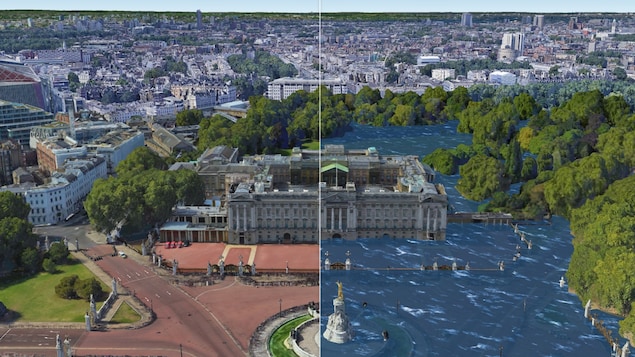
The Climate Central team has also attempted to clarify the consequences associated with these different scenarios of rising waters by providing images of historical places that have been flooded in one form or another. (A new window)according to the intensity of global warming.
Museums, cathedrals, temples and famous public places around the world will be especially at risk of being partially or completely submerged.
The image below shows, for example, the effect of sea level rise on the Legislative Assembly of British Columbia, located in Victoria. The inevitable scenario of warming to 1.1 °C is shown on the left. On the right it reaches 3 ° C.
