

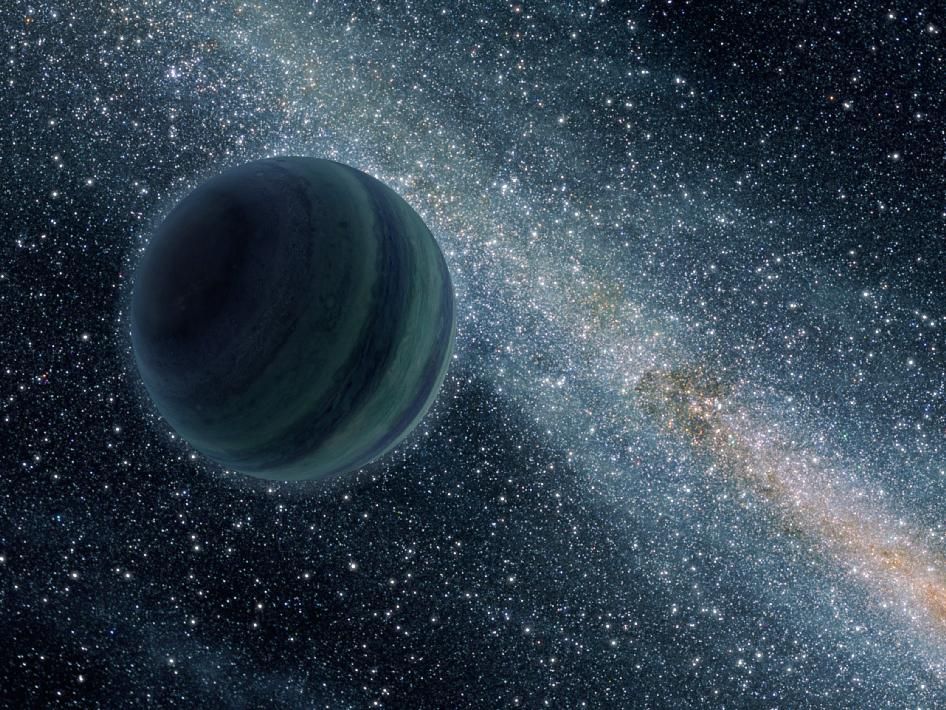
Nearly 5 years after its withdrawal, NASA’s Kepler Space Telescope continues to surprise us with amazing discoveries. A team of researchers studied the signals of filtered microlensing lenses captured by the telescope, which indicate the presence of planets floating in deep space, 4 of which have a mass similar to that of Earth. Although these signals are hard to spot, researchers seem to have gotten their hands on rare planets unrelated to a host star, roaming the galaxy.
Kepler discovered potential floating planets
NASA’s Kepler space telescope was launched on March 6, 2009, and has discovered more than 2,600 exoplanets as of 2018. latest discovery Described in the review Monthly Notices of the Royal Astronomical Society by study co-authors Ian MacDonald and Eamonn Kearns of the University of Manchester. The research team reported detecting 27 microlens signals of short duration ranging from 1 hour to 10 days.
During campaign 9 of the K2 mission, the Kepler space telescope observed a dense field of millions of stars near the center of our galaxy every 30 minutes, searching for rare gravitational lensing events.
Gravitational microlensing is a phenomenon that occurs when a faint foreground star crosses an observer’s line of sight toward a distant star. The light of a distant star undergoes slight fluctuation, as the object passes in front of it.
The gravitational microlensing method involves finding planets that emit little or no light using light from a distant star. The star’s light is altered by the presence of a huge lens, which is either a star or a planet. Then it becomes temporarily brighter. The probability of gravitational microlensing is one in a million. This method makes it possible to study thousands of stars simultaneously.
The researchers used data collected by the telescope between late April and early July 2016. They observed 22 previously known events, observed from Earth, and discovered 5 new candidates. The relatively short duration of 4 of these new signals indicates that they could be free-floating objects with a mass similar to that of Earth. The researchers hypothesized that these planets were associated with a host star before they were expelled from their star systems.
Floating planets are difficult to detect because they do not orbit a host star. The Kepler space telescope was not originally designed to find planets using the microlensing method, nor to observe particularly dense fields of stars.
Kepler telescope passes wand to other telescopes to search for ‘floating’ planets
If Kepler provides possible evidence of floating planets, that should confirm the next generation of telescopes designed to find signals from tiny lenses. NASA’s Roman Space Telescope, named after Nancy Grace Roman, the “mother” of the Hubble telescope, will be tasked with confirming the existence and nature of floating planets. It is expected to launch in mid-2020. Likewise, the European Space Agency’s Euclid mission has been optimized to search for microlensing signals.
New discoveries like Kepler’s could dramatically change our understanding of how planets form and prove that these signals are ultimately not as rare and elusive as previously thought.
Resources
I’m MacDonald, E. Kearns, Kepler K2 9 campaign – I. Candidate short-duration events from the First Planetary Precision Lens Space Survey, Monthly Notices of the Royal Astronomical Society, 2021, https://doi.org/10.1093/mnras/stab1377

Sophie Laurent is a contributor to Vaughantoday.ca, covering a wide range of topics including local news, politics, business, technology, sports, entertainment, and lifestyle. She focuses on delivering clear, balanced reporting that helps readers stay informed about current events and issues that matter to their communities. Sophie is committed to presenting accurate information, practical insights, and relevant stories in a straightforward and reader-friendly manner, making complex topics accessible to a broad audience.