

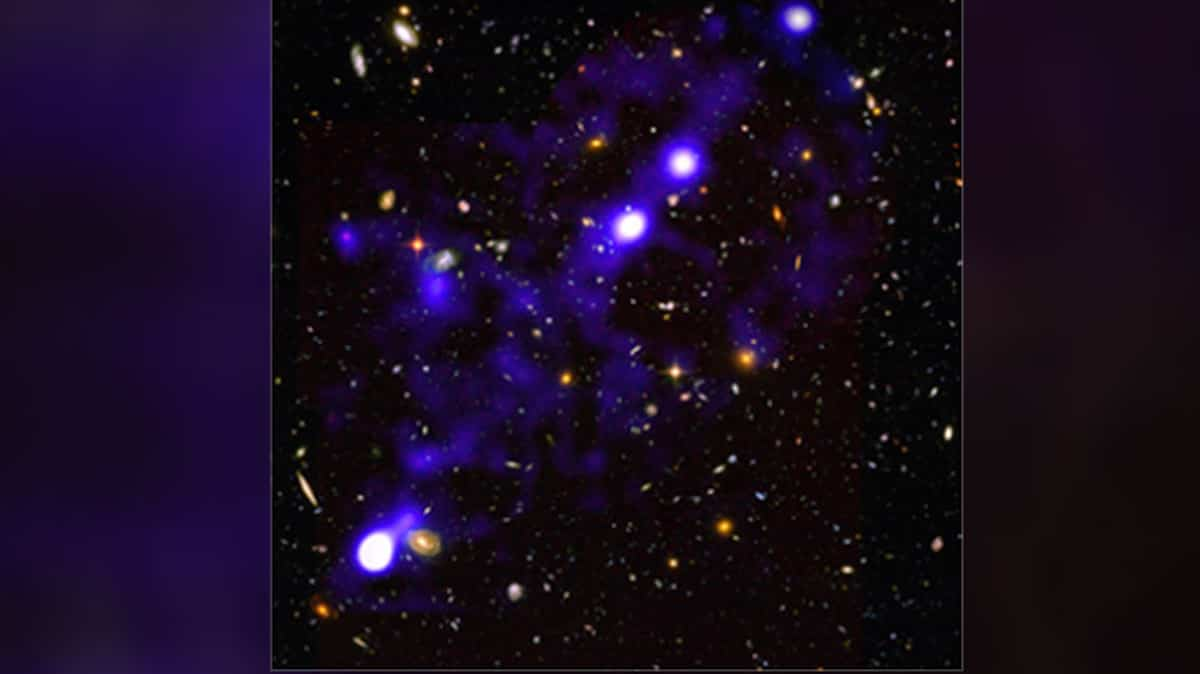
A study published Thursday shows that scientists have mapped for the first time a galactic wind, the gas reservoir of a galaxy, and thus spotted a portion of its “missing” matter.
• Read also: A $1.1 million contract to buy a Canadian space telescope
• Read also: Debris from a SpaceX rocket lights up US skies
“Galaxies are rarely passive islands of stars,” astrophysicist Nicholas Bosch says, in an interview with AFP, but rather dynamic structures whose formation and evolution are difficult to study.
It made understanding more difficult because, according to the theory, galaxies consist primarily of mysterious dark matter, of unknown and therefore invisible nature, and only about 16% of baryon matter, that is, atoms and molecules of the visible universe.
As if that weren’t enough, observing galaxies only reveals 20% of this baryonic matter. The rest – the “lost” matter – would be pushed back into space by the galactic wind, a nebula of gas and dust caused by the explosion of stars within the galaxy.
An international team led by researchers from the Lyon Center for Research in Astrophysics (Cral) has mapped the Lost Matter Nebula using the Moses Spectrograph, along with the European Southern Observatory’s Very Large Telescope (VLT) installed in the Chilean Atacama Desert.
“It is as if we are witnessing an iceberg for the first time,” comments Nicholas Boshy, researcher at Cral and co-author of the study published in the prestigious British journal MNRAS, with its lead author, Johannes Zabel, from the Department of Astronomy from St. Mary’s University of Canada.
Researchers have already noticed nebulae in galaxies, but they were much more diffuse. This time, observation of Gal1, a fairly young galaxy about a billion years old, revealed “a cloud of gas produced by this galactic wind, which escapes on either side of the galactic disk, by two asymmetric cones.”
This continuous cloud, huge in size, extends 80,000 light-years from Gal1’s center. For comparison, our Milky Way galaxy is about 100,000 light-years in diameter.
Despite its size, this gaseous nebula is only “about 10 to 20% of the mass of the galaxy,” notes Mr. Bushy. It serves as a reservoir of matter, from which the galaxy springs to fuel the formation of its stars.
And part of the cloud will return to the galactic disk to form these stars, some of which eventually explode, sending matter back into the nebula, and so forth.
Scientists were able to create a “map” of this nebula, providing information on its size and mass, thanks to a happy combination of circumstances and the wonderful Muse instrument.
The wide field spectrometer provides a three-dimensional image, in which two dimensions of optics are added to analyze the light, which makes it possible to detect the presence of elemental elements.
In this case, the quasar – a particularly bright object in the universe – serves, in its proximity to the Gal1 galaxy, as a “beacon”, betraying the presence of magnesium. “We then discovered this same element in the galaxy, and thus discovered the presence of the gas associated with it,” Boschi says. Moreover, observation of gaseous cones became possible, only because the galaxy was rendered almost laterally for observation.
Astronomers were already aware of this type of nebula in the nearby universe, thus recently referring to a CNRS press release. But one would have assumed they existed only for small, still-forming galaxies, such as Gal1, captured when the universe, the farthest, was seven billion years old, about half its current age.
The researchers will now be observing many more galaxies, “to understand why there is a cloud in Gal1 while others don’t, and what conditions favor its presence,” according to Mr. Bush.

Evan McKenzie is a contributor at Vaughantoday.ca, covering a wide range of topics including local news, politics, business, technology, sports, entertainment, and lifestyle. He focuses on clear, balanced reporting that helps readers stay informed about current events and issues that matter to their communities. His work aims to provide useful information, timely updates, and relevant stories presented in an accessible and reader-friendly way.