

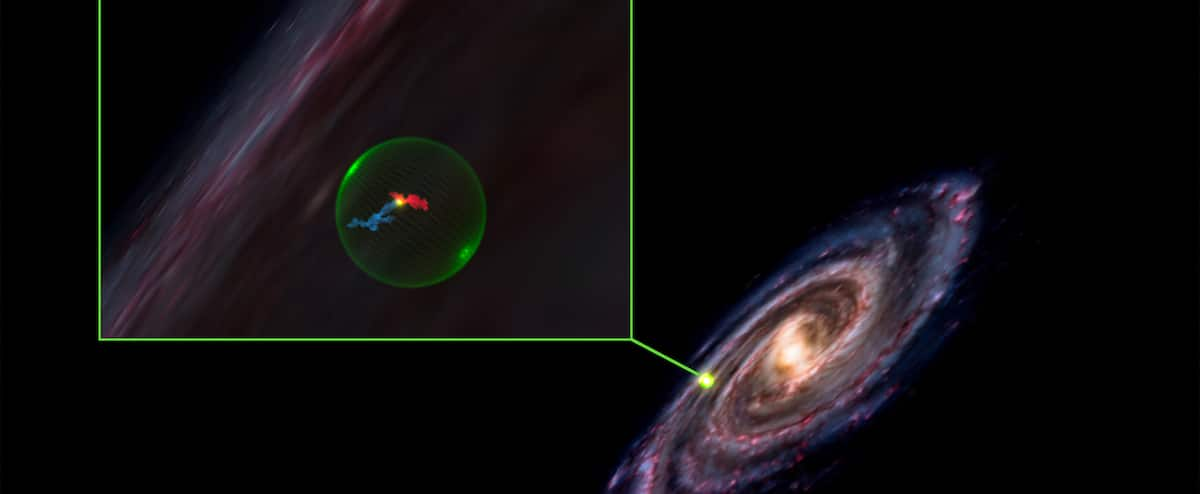
Astronomers in the Milky Way have discovered a giant cavity surrounded by two nebulae, the clouds of Perseus and Taurus, that appeared after at least one giant star exploded, according to a study published Wednesday.
• Read also – PHANGS-MUSE Catalog: Unpublished Images of Young Star Galaxies
The molecular clouds of Perseus and Taurus, as they are called, have been studied for a long time, due to their proximity to the Earth (between 500 and 1000 light years), which is a straw on the scale of our Milky Way, which has a diameter of 80,000 light years.
But also because it harbors star nurseries, which were formed thanks to the mixture of molecular gas and dust that make up these clouds. Finally, because these nebulae seemed to be connected by some kind of thread. Then the note was ignored due to their distance from our planet.
“The funny thing about these two clouds is that we find that they are well connected, not in the way we imagine, but through a giant gap,” researcher Shmuel Bialy of the Harvard-Smithsonian Center for Astrophysics told AFP.
State-of-the-art computing and imaging
This is the first time that scientists have been able to design a 3D map of such a structure, called the “Per-Tau Shell”, with the help of advanced computational and imaging techniques, especially a map of molecular gases with the largest area, drawn using data from the European Gaia space telescope.
One has to imagine “a kind of sphere with an empty interior”, according to Mr. Bialy, a “super bubble” as he calls it, about 500 light-years in diameter (about 4.7 million billion kilometers), whose outer shell would be formed partly by the Perseus and Taurus clouds .
The interior of the cavity contains little dust, “but at a very low density compared to that of clouds,” astrophysicist and physicist Torsten Enslin, assistant professor at Germany’s Max Planck Institute for Astrophysics, told AFP.
The study, which appears in Astrophysical Journal Letters, was co-authored with lead author Shmuel Bialy. He’s one of the scientists who, in 2019 and 2020, made the first 3D map of dust clouds close to our sun. This is thanks to data from Gaia on the location and characteristics of more than 5 million stars in this solar “suburb”.
And M Bialy’s colleague, Kathryn Zucker, a postdoctoral fellow and astrophysicist, signed on to a second study on the topic Wednesday to explain how scientists have used this map well, aided by algorithms developed in part under his direction.
“This is the first time we’ve been able to use real, not simulated, 3D views to compare theory with observation, and estimate which theories work best” to explain where this giant cavity and clouds settled on its surface came from, she said in a statement. From the Center for Astrophysics.
“We think it’s because of a supernova explosion, a huge explosion that pushed these gases and formed these clouds,” says Bialy, whose study suggests a multiple supernova scenario. According to this theory, one or more stars exploded at the end of their lives and gradually pushed most of the gas they bathed in back to form this cavity, between 6 and 22 million years ago.
“We are now observing the cavity in its final stage, where it has already slowed down (dilated), and allowed clouds to form” for Perseus and Taurus, says Mr. Bialy. He now intends to focus on the younger groups of stars appearing there.
As for Professor Enslin, he expects to “discover many other structures” such as those at Bir Tau. “This bubble is probably one of many,” he explains, adding that despite its size, it takes up little space in the 3D map produced by his department. It remains to be explored and baptized…
See also…

Evan McKenzie is a contributor at Vaughantoday.ca, covering a wide range of topics including local news, politics, business, technology, sports, entertainment, and lifestyle. He focuses on clear, balanced reporting that helps readers stay informed about current events and issues that matter to their communities. His work aims to provide useful information, timely updates, and relevant stories presented in an accessible and reader-friendly way.