

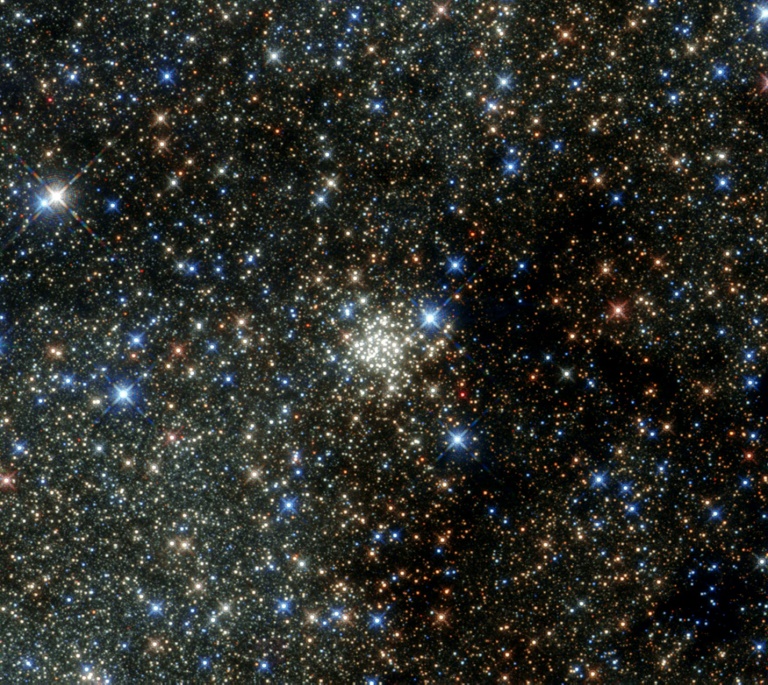
The James Webb Space Telescope (JWST) will lift the veil a little more than the first light of the cosmic dawn, when the first stars and galaxies that filled the universe appeared.
It will take its place from Hubble, which observes space primarily in the visible light field, by venturing into the wavelength that escapes the eye: the mid-infrared.
In astronomy, the farther one sees, the longer one sees. Where particles of sunlight take eight minutes to reach Earth’s eye, the James Webb Dome aims to capture light from the first galaxies more than 13.4 billion years ago.
Those that appeared in the young universe, less than 400 million years after the Big Bang.
But with expansion, this light travels more and more to reach the observer, thus “blushing.”
When the sound of a moving object fades away, the light wave extends and passes from the visible frequency to the naked eye to the infrared.
Launched in 1990, Hubble reached a limit of 13.4 billion years, with the discovery of the galaxy GN-z11, a paltry little spot but also “a surprise, with a brightness we didn’t expect at such a distance.” Its “discoverer”, astrophysicist Pascal Auch told AFP.
JWST will provide “more accurate images, with a sensitivity 100 times greater, which will allow us to explore this era in extraordinary detail.” He’s betting that “many, many galaxies, but less luminous” will then be revealed.
– turn on the light –
Using his infrared ability, James Webb will see not only ancient objects but also interstellar dust clouds that absorb starlight and hide it from Hubble’s view.
This “invisible light makes it possible to see what is hidden in the clouds, the birth of stars and galaxies,” explains David Elbaz, an astrophysicist at the French Atomic Energy Commission.
The French Atomic Energy Commission (CEA) is the main contractor for the Mirim imager, which, along with the NASA MRS spectrometer, will study these structures in the mid-infrared, and will also be able to “see the signature of atoms in distant galaxies,” El-Baz adds.
The stakes are high: to help explain a key stage in the evolution of the universe, when, as Mr. Ochs says, “we turned on the light, when the first stars began to form.” In other words, “cosmic dawn”.
Shortly after the Big Bang flash, the universe entered a “dark age,” a neutral gas bath composed mostly of hydrogen and helium, without light.
The theory wants this gas to condense in the “wells” of dark matter, a mysterious, undetectable substance whose existence is merely theoretical – to give birth to the first stars. These stars, which will multiply by the snowball effect, will begin to ionize, that is, the electric charge of the neutral gas of the universe. A process called “reionization,” which will bring the universe out of its obscurity to make it “transparent.”
However, “we don’t know when the first galaxies formed,” notes astrophysicist Françoise Coombes, simulations that put the motion between 100 and 200 million years after the Big Bang.
“The theory is that all the little galaxies will re-ionize the universe, because there are so many of them, and what we’ll be checking with James Webb is to see if there are enough of them for that,” explains Professor Coombs.
However, no one imagines observing the first stars. These “third populations” stars are called, these giant stars of perhaps 100 to 1,000 solar masses, with exceptional temperatures and short lifetimes, will begin to ionize the neutral gas of the universe.
To study this phenomenon is to study the formation of galaxies.
The hope is that we’ll see “the first galaxies bearing the second generation of stars, which probably teach us things about the first,” says Nicole Nisvadba, an astronomer at the Lagrange Laboratory at the Riviera Observatory. Before you simply add, “I don’t know, ask us in five years.”

Evan McKenzie is a contributor at Vaughantoday.ca, covering a wide range of topics including local news, politics, business, technology, sports, entertainment, and lifestyle. He focuses on clear, balanced reporting that helps readers stay informed about current events and issues that matter to their communities. His work aims to provide useful information, timely updates, and relevant stories presented in an accessible and reader-friendly way.