

The shape of a thing tells us a lot about its nature. It reflects, for example, the mechanisms of its formation: the moon in the sky forms a circle caused by the symmetry properties of the gravitational force. The shape of a physical object also tells us about its history: we know that there was water on Mars by observing the now-dry meandering riverbeds. Finally, the shape of an organism or one of its parts tells us about its function: the shape of a bird’s beak thus tells us about its diet.
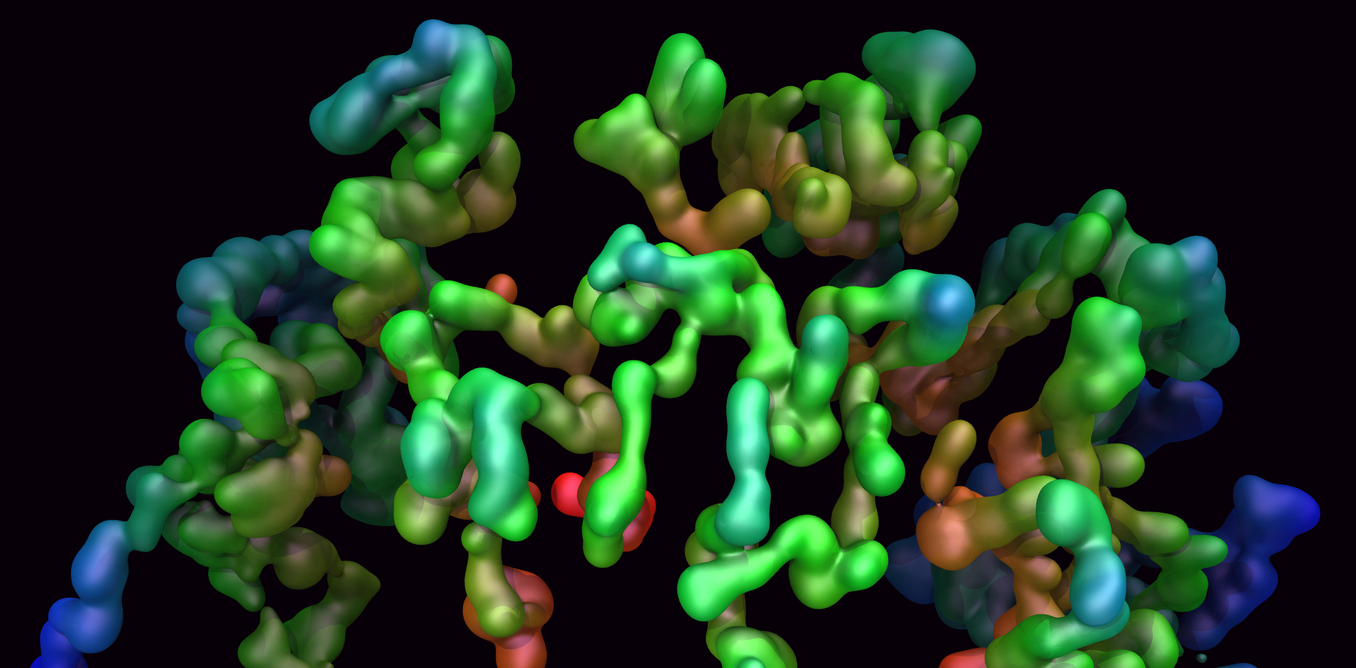
The figure shown here blurs the paths. Is it natural or synthetic? Is it a physical or biological body? Is it an abstract form or a man-made artifact? Let’s clear the puzzle right away: It’s actually a file A representation of the physical structure of one of our chromosomesobtained through mathematics and computer science from measurements made on real chromosomes.
Each of our chromosomes consists of a DNA molecule folded back on itself, like an irregular ball of thread. It is impossible to observe this sphere under a microscope in a living cell: the visualization techniques available at this scale (much less than a micron, millionths of a meter) require a preparation that will damage the cell and modify its shape. chromosome.
However, there is an indirect method available, which makes it possible to determine the areas of the thread that are in contact with each other in the ball. The experiment consists of immobilizing the chromosomes with a chemical product that welds the contact areas. The chromosome is then cut to isolate these regions. Finally, the sequence Billions of these regions make it possible to find the position of contacts along the DNA molecule. In the end, we get a table of numbers describing the frequency of contact between different regions of the chromosome, taken from two to two.
From this table – technically a 2D matrix – a combination of network theory, geometry, and algebra should be used to reveal the average 3D structure of a chromosome using a calculator. Thus, the image is not a photograph of the chromosome, but a digital reconstruction based on real data from living cells. The artificial colors add information: in red are regions of the DNA molecule that contain active genes used to make the proteins that encode them, in green and blue are regions that contain inactive genes that are not exploited by the cells studied whose information is here.
The surprising result revealed the spatial separation within the cell, between active genes (in the center) and inactive ones (at the periphery of the chromosome). A breakup that has since been confirmed before direct experiences. In addition to its scientific interest, this image sends us a reflection of ourselves and asks us what constitutes our individuality: our chromosomes.

Sophie Laurent is a contributor to Vaughantoday.ca, covering a wide range of topics including local news, politics, business, technology, sports, entertainment, and lifestyle. She focuses on delivering clear, balanced reporting that helps readers stay informed about current events and issues that matter to their communities. Sophie is committed to presenting accurate information, practical insights, and relevant stories in a straightforward and reader-friendly manner, making complex topics accessible to a broad audience.