

What is the difference between a superconductor and a semiconductor?
Semiconductors and superconductors are materials that allow electric current to flow through them. So they are electrical conductors, but there are fundamental differences between them.
>> Read also: Three-layer graphene at a magic angle: a unique superconductor with unprecedented properties
A semiconductor is an electrical conductor that has an electrical conductivity value between the values of the insulator and the conductor. In other words, a semiconductor has a moderate electrical conductivity and is sensitive to temperature changes, magnetic fields, and any impurities present in the material.
In semiconductors, elements are crystals whose atoms are arranged in a 3D shape with covalent bonds between each atom. It finds applications in designing diodes, transistors, or integrated circuits.
There are many semiconductor materials in the form of single crystals such as silicon, germanium, tin, selenium, or even tellurium. While being designed, the semiconductor can consist of a combination of several elements such as gallium arsenide containing arsenic and gallium.
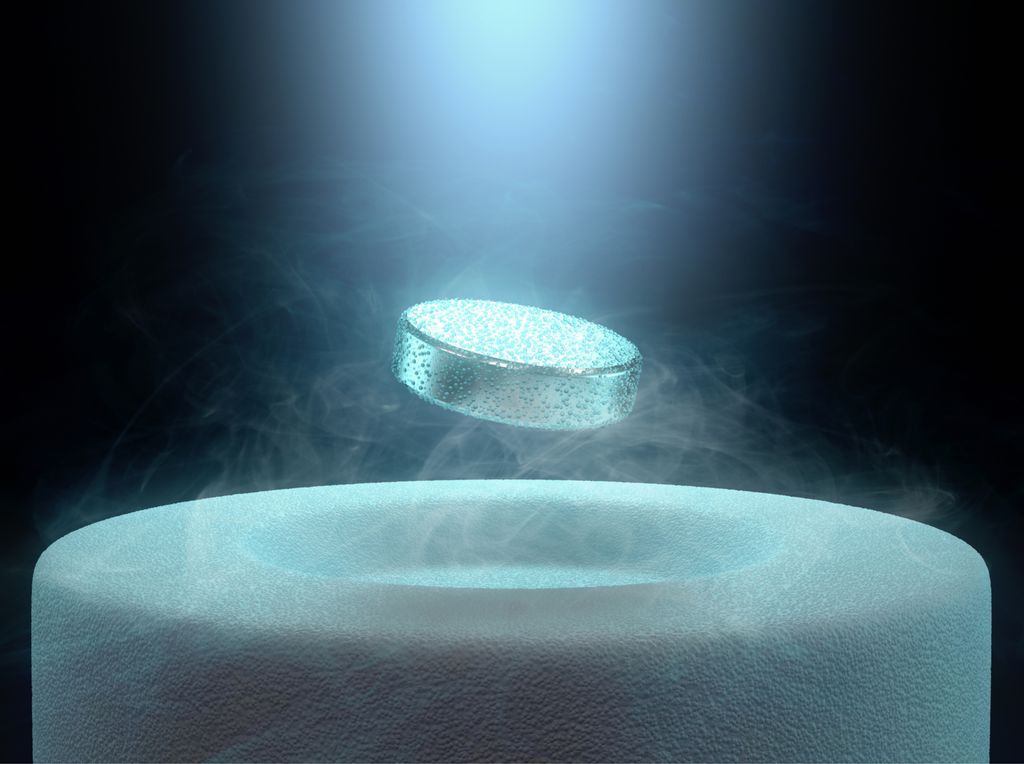
a superconductor It is an electrical conductor that has an electrical conductivity value greater than the electrical conductivity value of the conductor. Often, a superconductor is a chemical element or mixture of elements that becomes almost completely impervious to the passage of electricity when cooled to a certain temperature. Thus, a superconductor allows electricity to pass through without energy loss. That is why the electric current passing through a superconductor is called supercurrent.
This loss in electrical resistance at a given temperature is called the critical temperature, or Tc. There are Type 1 and Type 2 superconductors. Type 1 materials are “classic” conductors at room temperature and become superconductors when cooled below Tc. Type 2 materials conduct poor current or not at all at room temperature and become superconductors when the temperature drops below Tc.
Ultra-thin superconducting diode

© Shutterstock
Data centers can be the primary beneficiaries of this unidirectional superconductor, thus limiting their power loss.
Diodes are electronic components in which electricity must flow in only one direction. This is the reason why manufacturers use semiconductor materials. However, the use of this type of material leads to energy loss. Therefore, superconductors without resistance are never used in their manufacture.
Researchers from the University of Technology in the Netherlands and their German colleague from Max Planck Institute They have just created for the first time a diode based on a superconducting material that allows electricity and thus electrons to flow in one direction.
They used a material containing a combined electric field called niobium-3bromine-8, sandwiched between two layers of a superconducting material. The whole can be thought of as a two-dimensional system such that its thickness does not exceed its atomic thickness.
The researchers realized that when the flow of electrons crosses the sandwich in one direction, there is no resistance and therefore no energy loss. On the other hand, in the other direction, resistance is felt. This somewhat unexpected discovery was not expected by scientists at all and researchers still do not understand the exact performance of this system!
>> Read also: Superconductivity: the hope of hydrates
Energy saving and interesting practical applications
This unexpected discovery paves the way for many practical applications, particularly in data processing centers for large groups like Google for example, which sometimes have hundreds or even thousands of computer servers alone consuming between 10% and 20% of global electricity production. Unfortunately, much of this electricity is lost in the form of heat produced by the electrical resistors of the transistors that power these servers.
Using this new type of superconductor could allow these servers to use much less electricity because they offer no resistance and therefore no heat loss. This also means that these large data storage centers can severely limit their use of cooling systems that also use energy. In addition to significant energy savings, the use of this unidirectional superconductor will allow processing information much faster than current systems.
This diode is also the open door to major advances in the field of quantum computing. This new diode incorporates the Josephson effect which allows electrons to cross a distance between two superconductors via the tunneling effect.
The team’s work doesn’t stop there. They now want to build a superconducting transistor. They need to find new materials to do this, because the current diode operates at -271°C and still requires a lot of energy to go down and maintain that temperature.
>> Read also: 15°C: Finally a superconductor at room temperature!
Source: Wu, H., Wang, Y., Xu, Y. et al.Josephson field-free diode in a heterogeneous van der Waals structure. temper nature604, 653-656 (2022), https://doi.org/10.1038/s41586-022-04504-8

Sophie Laurent is a contributor to Vaughantoday.ca, covering a wide range of topics including local news, politics, business, technology, sports, entertainment, and lifestyle. She focuses on delivering clear, balanced reporting that helps readers stay informed about current events and issues that matter to their communities. Sophie is committed to presenting accurate information, practical insights, and relevant stories in a straightforward and reader-friendly manner, making complex topics accessible to a broad audience.