

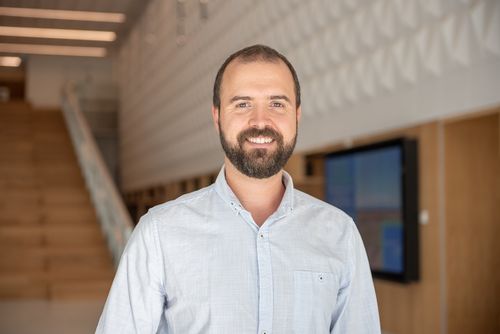
His Excellency. That’s what Alexandre Castongue, a new professor at the University of Montreal’s School of Nursing Sciences, wanted to study when he began his academic career.
Over the years, this idea has been refined to lead to health. “I thought to myself that if I studied in a field related to health, I would contribute in one way or another to the improvement of the human condition and to lessening the distress of people living in certain circumstances,” explains the professor, with his luminous gaze.
Because of this conviction, he first obtained a BA in Psychology from UdeM, and then a PhD in the same discipline from the University of Quebec at Trois-Rivieres (UQTR). He then became interested in the motivational factors that influence physical activity in patients with type 2 diabetes.
He then carried his altruistic streak to a postdoctoral training in nursing sciences at UQTR, where he designed mobile tools to help students and women with gestational diabetes adopt and maintain healthy lifestyles. He then took a position at the National Institute of Public Health in Quebec to work on cognitive health and aging from a preventive perspective.
Finally, complete his second Postdoctoral Fellowship, this time with renowned Professor Guy Barry, HEC Montréal, Connected Health Research Chair. This experience allows him to establish relationships with many famous researchers while making use of all his knowledge and his fields of intervention. “Jay Barry has allowed me to thrive as a scholar,” he says, acknowledging the central role Mr. Barry played in his professional development.
All of his puzzle pieces come together: his need to be useful to society, his interest in technology and his desire to contribute to the health and well-being of the population.
On the road to digital health
Alexandre Castonguay presents himself today as a proud contributor to promoting digital health at UdeM’s School of Nursing. He is interested in the role of digital technologies, including telemedicine, patient portals, robotics, and artificial intelligence in improving the quality, continuity and efficiency of healthcare.
In addition to my concern for people’s quality of life, I hate waste. And digital tools make it possible to optimize resources. Nursing is an area where the gains to be made are enormous, particularly in a context where the population is aging and the need for home care is growing. Nursing staff are called upon to devote a significant amount of time and energy to travel and administrative or documentation tasks, at the expense of time spent with patients.”
In this regard, Mr. Castongoy states that information technologies offer many innovative solutions that are now essential tools for managing patient appointments and medication, as well as staff travel. Thus, the accessibility and quality of care are improved, as well as the well-being of employees, whose most mechanical tasks are performed by automated systems.
“Digital health isn’t just important, it’s essential,” he says. The healthcare environment is already heavily influenced by information technologies and will continue to be. It is a dream come true to have the opportunity to prepare nursing students for this.”
Moreover, this is one of the assignments Alexandre Castongue has given himself in his new role as Professor: to guide his commitments in research, teaching and at the faculty level to prepare students for the digital revolution in health, but also to inspire them to the next generation of nurses today and tomorrow.

Sophie Laurent is a contributor to Vaughantoday.ca, covering a wide range of topics including local news, politics, business, technology, sports, entertainment, and lifestyle. She focuses on delivering clear, balanced reporting that helps readers stay informed about current events and issues that matter to their communities. Sophie is committed to presenting accurate information, practical insights, and relevant stories in a straightforward and reader-friendly manner, making complex topics accessible to a broad audience.