

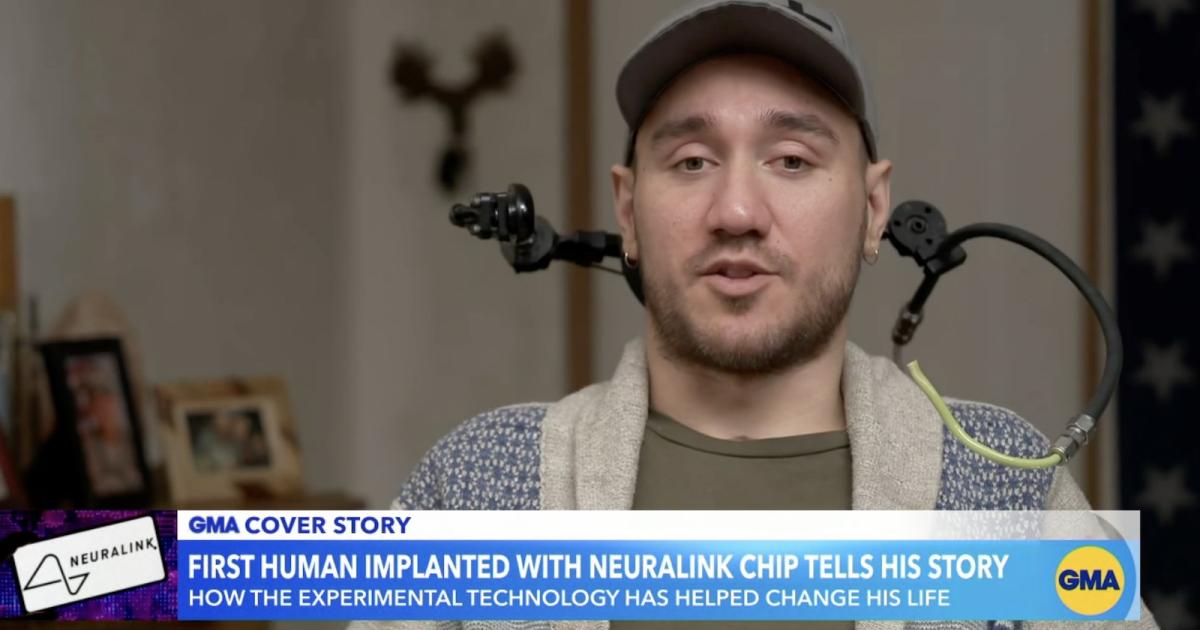
“I just want everyone to be on this journey with me,” says Noland Arbaugh, 30, excitedly. In an interview with ABC News On May 17 and another Published on May 22 by The New York Times.
Neuralink initially reported encouraging progress, which the patient confirmed in his interview: thanks to this implant, the size of a coin, he was gradually able to learn how to move a computer mouse, to the point of being able to play a video game.
Subscribe to our newsletter!
So you don’t miss any scientific news and know all about our efforts to fight fake news and misinformation!
However, in early May, the company admitted that since the end of January, 85% of the flexible wires that allowed the implant to communicate with the brain to record and transmit its commands had gradually “slipped” out of the brain. Engineers were initially able to reprogram the system to continue responding to certain commands, but the patient could no longer get the mouse to “click” on an item and had to learn how to direct another tool that appeared on the screen.
He told the journalist that Neuralink would have advised him not to do so timesto undergo a second surgery to replace the wires correctly.
The original surgical intervention was announced on January 29 with a simple message from Elon Musk on X. Since that date no studies or scientific data of any kind have been published; The rare information came from the company itself. It also did not respond to journalists’ requests for interviews.
On the other hand, a few months ago, in September 2023, Magazine report Wired It raised alarm: Documents obtained from the University of California revealed that at least 12 monkeys subjected to this same experiment since 2018 – or one in five – had to be euthanized. These documents spoke of brain swelling (or cerebral edema), partial paralysis, loss of coordination, and self-injurious behavior. One necropsy report reported a cerebral hemorrhage in one animal, while another described a partially “detached” implant.
Thus, the failure of the current transplant tends to confirm experts’ fears that this can be achieved Brain-computer interface More complicated than expected. The brain is not stationary when we move, and it has multiple defense mechanisms against “intruders.”
Neuralink claims to have been licensed by the US agency responsible for approving treatments (FDA) to test the same implant on other patients.
Remember that this is not the first transplant. Other companies We have worked there for several years. The first clinical trial of such an implant, Brain portalIt even dates back to 2004. In theory, such an implant would allow paralyzed people to regain a little independence, by controlling a computer remotely, or by communicating: for example, in An experiment conducted in 2021 At Stanford University in California, researchers were able to decipher a man’s brain signals when they asked him to think about words written in pencil, allowing the computer to translate some of those words that appeared on the screen.

Sophie Laurent is a contributor to Vaughantoday.ca, covering a wide range of topics including local news, politics, business, technology, sports, entertainment, and lifestyle. She focuses on delivering clear, balanced reporting that helps readers stay informed about current events and issues that matter to their communities. Sophie is committed to presenting accurate information, practical insights, and relevant stories in a straightforward and reader-friendly manner, making complex topics accessible to a broad audience.