

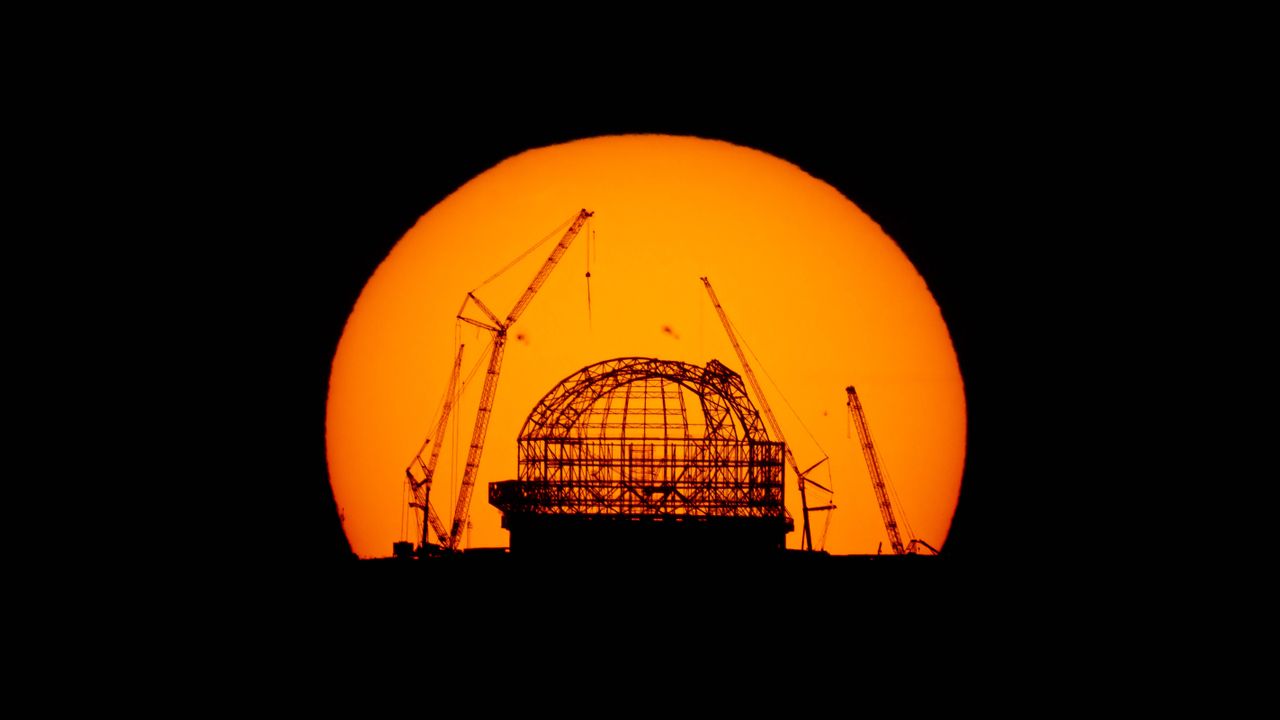
Have you ever heard of these scientific innovations of enormous dimensions? From a telescope higher than Notre Dame Cathedral? A particle collider located 200 meters below our feet? Or a spacecraft capable of detecting gravitational waves that are undetectable on Earth? The film “Les Echos” explores these huge projects that will soon see the light of day.
Imagine the weight of the Eiffel Tower. Now imagine that weight is lighter than a giant telescope, the largest in Europe, which is expected to be completed in 2028. Located in the Atacama Desert in Chile, the eye of this optical telescope will be able to capture 100 million times more light than the human eye. In the category of mega-constructions, there is also the Future Circular Collider (FCC) project, a 91-kilometre-long underground tunnel dedicated to the study of matter, which still has to be validated by the European Organization for Nuclear Research (CERN).
In this series, Les Echos takes you to the LISA meeting, for the Laser Spatial Interferometer Antenna, a European space interferometer scheduled to launch in 2035, which will be able to detect gravitational waves inaudible from Earth. Another project, already started in 2020, is: drilling a bubble in the middle of a mountain in Japan, to build a detector for neutrinos, these “ghost” cosmic particles that pass through matter.

Sophie Laurent is a contributor to Vaughantoday.ca, covering a wide range of topics including local news, politics, business, technology, sports, entertainment, and lifestyle. She focuses on delivering clear, balanced reporting that helps readers stay informed about current events and issues that matter to their communities. Sophie is committed to presenting accurate information, practical insights, and relevant stories in a straightforward and reader-friendly manner, making complex topics accessible to a broad audience.