Close Menu
    Facebook X (Twitter) Instagram
    Trending
    • Hauser’s Marks 45 Years With Province-Wide Customer Celebration and Renewed Focus on Community Care
    • Young drivers face elevated collision risks after consuming edible cannabis, new CAA-funded study finds
    • Salvation Army Thrift Store Marks 40th Ontario Location with Peterborough Opening
    • Early Blast of Winter Prompts Safety Warnings from Ontario Road Authorities
    • HONOR Takes Home Two TIME Best Inventions 2025 Awards for Smartphone Breakthroughs
    • Toronto Set to Host Largest LEGO® Fan Event in Canadian History
    • Hank Azaria and Caitlin Morrison Champion Mental Health Through Music at Toronto’s Koerner Hall
    • Bricks in the Six to Build Canada’s Largest-Ever LEGO® Fan Event This November
    Facebook X (Twitter) Instagram YouTube
    Vaughan TodayVaughan Today
    • Home
    • Top News
    • World
    • Banking
    • Explore Canada
    • How to
    • Solutions
    • Contact Form
    Vaughan TodayVaughan Today
    Home»science»Ants sniffing: cancer screening – Le Journal du Week-end
    science

    Ants sniffing: cancer screening – Le Journal du Week-end

    Maria GillBy Maria GillMarch 13, 2022No Comments2 Mins Read
    Ants sniffing: cancer screening – Le Journal du Week-end
    Share
    Facebook Twitter LinkedIn Pinterest Email

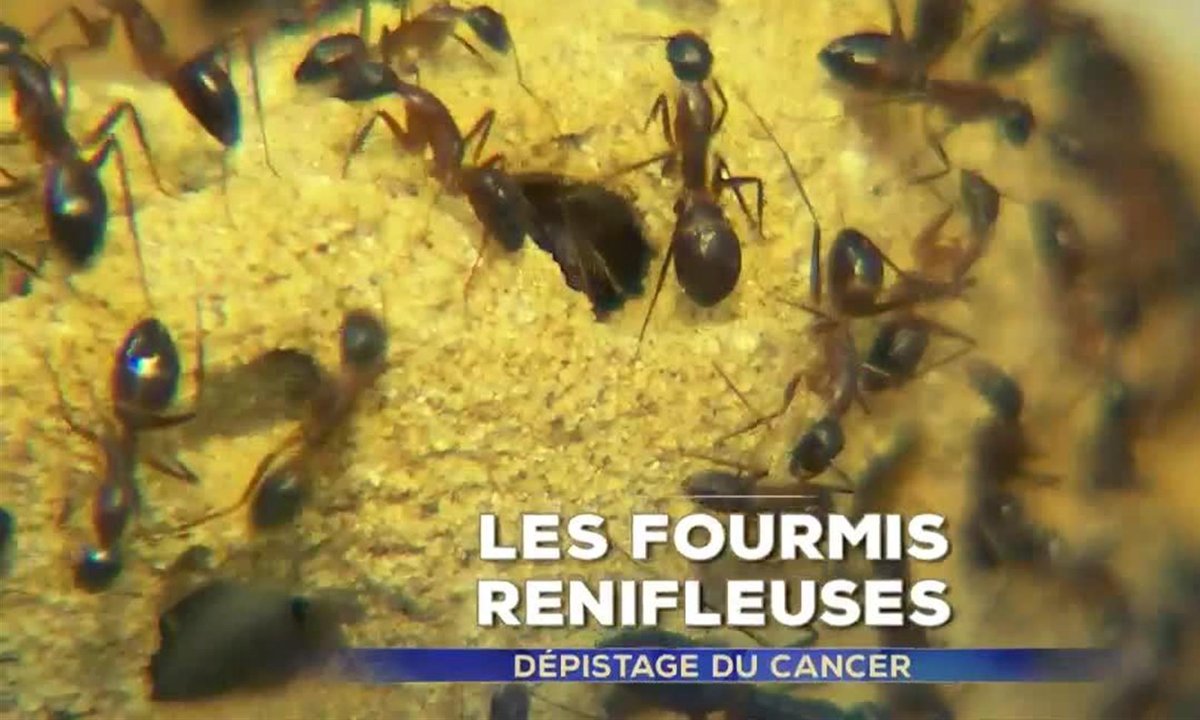
    The experience was already conclusive with dogs, able to identify the presence of cancer cells just by smell. But Baptiste Beckert, the Laboratory of Experimental and Comparative Behavioral Sciences at the Sorbonne University in Paris, is betting on an entirely different animal that also has an unparalleled sense of smell, the ants. He raises thousands of them in his lab and takes care of one species in particular. “It is a species called Formica fusca. It is a species found throughout the Northern Hemisphere. This genus of ants has been described as possessing the most important cognitive abilities among ants,” the scientist learns. In front of our cameras, a researcher is teaching ants to smell the cells of cancer patients. You will feed the ant what you love, sugar. Once it’s released into the arena, “and after a while, you’ll come across the reward by chance. Underneath it, we have the scent we want it to learn. And it will associate that scent very quickly with the reward,” he explains. . Renewing the experiment two to three times, it was no longer a coincidence. The ant perceives the smell directly, even without the presence of sugars. But we must continue to search. And in a few years, the ant could become a means of early detection before MRI or mammography is performed. Another advantage of the ant is that it learns very quickly. Scent recognition takes less than an hour, compared to several months for dogs. TF1 | Reporting by C. Pyle, J. Clouseau, and E. Dubusc

    Share. Facebook Twitter Pinterest LinkedIn WhatsApp Reddit Tumblr Email
    Maria Gill

    "Subtly charming problem solver. Extreme tv enthusiast. Web scholar. Evil beer expert. Music nerd. Food junkie."

    Related Posts

    Rare Earth Metals: Essential Uses and the Global Supply Chain

    October 4, 2025

    200 meteorites found on Earth could be linked to Martian craters, allowing new insight into Mars’ history

    August 28, 2024

    Antibiotics that reduce the risk of stomach cancer

    August 26, 2024
    Facebook X (Twitter) Instagram Pinterest
    © 2025 ThemeSphere. Designed by ThemeSphere.

    Type above and press Enter to search. Press Esc to cancel.