


- Research and tools contribute to Quebec
The Institute for Research in Exoplanet Research (iREx) is one of the largest astrophysics research centers in Canada. It includes about sixty members, most of whom are astrophysicists, researchers and students from the Universities of Montreal, McGill, Laval, Bishop’s University and the Montreal Planetarium.
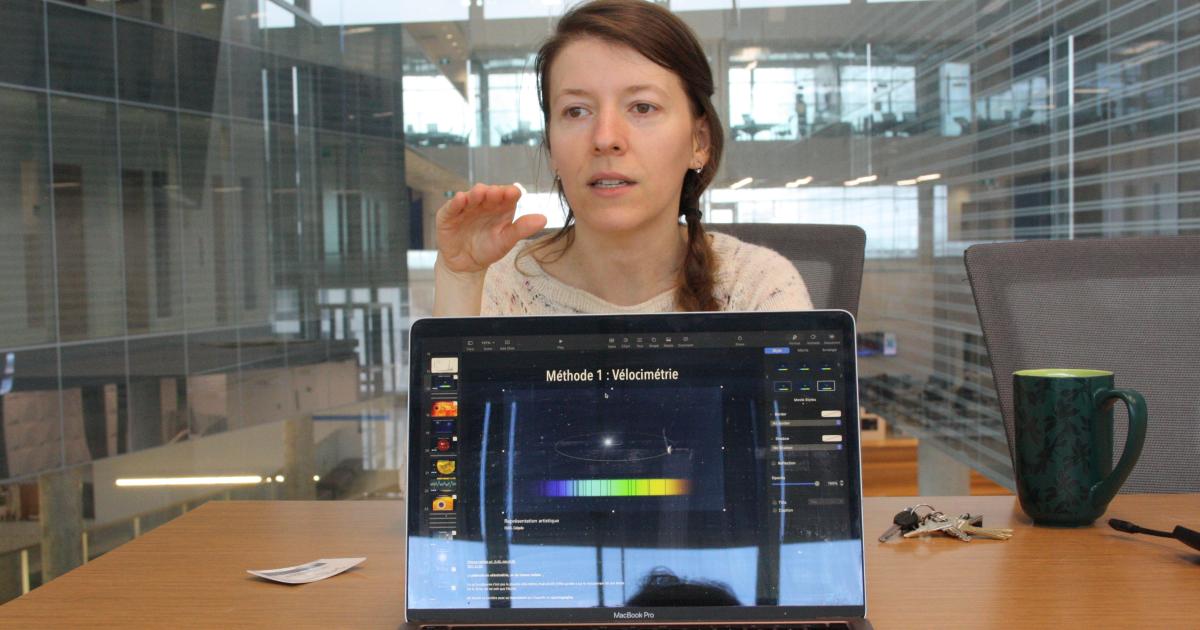
One of iREx’s most important accomplishments is designing some of the tools that enable discoveries in astrophysics. Frédéric Baron, an astrophysicist and head of detection equipment at iREx, and Charles Cadieux, a doctoral student in astrophysics, talk about this enthusiastically. These instruments are used around the world, including a fiber spectrograph installed at the Haute-Provence Observatory in France. Closer to us is the Mont-Mégantic Observatory, the first of its size in eastern North AmericaWith its 1.6 meter mirror, it contains several high-level instruments including the PESTO instrument (Planets outside the solar system in transit and occultation), Create iREx and N researchersShFifthSh Cameras. This instrument examines exoplanet candidates, M-type dwarf stars, which are slightly smaller than our Sun, and studies stars.
Subscribe to our newsletter!
So you don’t miss any scientific news and know all about our efforts to fight fake news and misinformation!
Doctoral student Charles Cadieux used data from the PESTO instrument in important research on the exoplanet TOI-1452b. His work led to an important scientific article published in 2022 in the scientific journal American Astronomical Society. The exoplanet TOI-1452b is a subject of study among the classes of super-rocky planets and mini-Neptunes whose atmosphere is larger and composed of hydrogen. Pistoux and the Mont-Mégantic Observatory have played an important role in the more in-depth examination of exoplanets. The investigation will continue with the James Webb Space Telescope. The exoplanet was initially discovered a few years ago by another instrument on the TESS probe. It is on the list of stars to be observed with the James Webb Space Telescope.
During the interview, Frédéric Baron revealed for the first time that a second instrument will be installed at the Mont-Mégantic telescope under the name From. “It will be added to the PESTO instrument, already permanently installed in the 1.6-meter telescope that detects and characterizes exoplanets by planetary transits. VROOMM’s observing technology is to detect exoplanets at radial velocity in the telescope’s optics.. This type of instrument works well in observatories such as the Mont-Mégantic Observatories. First use of the new tool From It is scheduled for 2029.
Charles Cadieux’s ultimate research goal Rather, it is finding and developing a new planet outside the solar system with a moderate climate and a size similar to Earth.. He is excited to use the new tool From, At the Mont-Mégantic Observatory, where he will be a doctoral student in a year. So we see that iREx scientists and the new instruments from the Mont-Mégantic Observatory contribute to the study of exoplanets in a very proactive way.
The following article will focus on the activities of the University of Toronto, another center for exoplanet research, and the David Dunlop Observatory.
This report was prepared thanks to the financial support of the Excellence Grants from the Association of Independent Journalists of Quebec
