


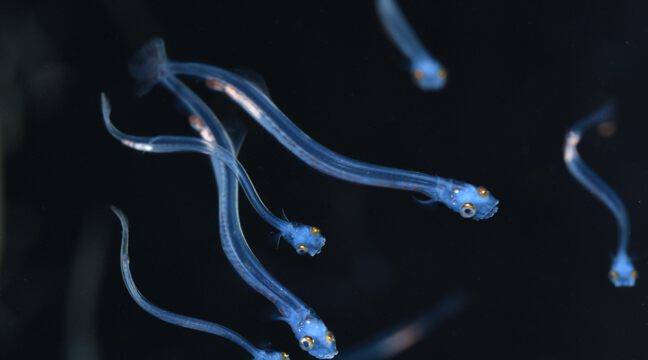
The above larvae are larvae Atlantic herringIt is about a month old and has an average measurement of 2cm. Like most fish larvae, it has a mostly transparent body and is devoid of scales.
The larval stage is a critical period for replenishing the fish stock. During this period, the mortality rate is very high, mainly due to predation (a small number of individuals reach adulthood).
Especially during this stage the body and organs of the fish develop, from the opening of the mouth to the growth of all the fins. Therefore, larvae are more sensitive to changes in the environment in which they develop than adults. However, in the context of climate change, it becomes necessary to know whether the larvae are able to survive and develop properly in relation to the different scenarios developed by the scientific work of the Intergovernmental Panel on Climate Change (IPCC) for oceans in 2100.
 Herring larva (Clupea harengus) 30 days after hatching © Dugornay Olivier / Ifremer
experimental nursery
In an attempt to answer this question, larvae are reared in an experimental environment from birth until the end of the larval period (CoCKtAIL-IFREMER-AWI . Project). This means that parameters of the environment (physical or biological) in which the larvae grow are controlled in order to be able to describe the exact effect of one or more of the combined parameters.
Here, herring larvae are reared under so-called control conditions, which reflect the current environment, and under conditions in which the water temperature and acidity increases to mimic future ocean conditions. Breeding allows direct access to the larvae and by comparing individuals according to their breeding environment, it is possible to understand the effects of climate change on their function, development and survival rate.
This study is concerned with a group of herring that breeds in winter along the coasts of Normandy and Nord-Pas-de-Calais and represents an important economic resource. If herring is important to humans, it also has an essential place in the food web because it serves as food for fish, birds, and other marine mammals. The future of herring in the face of climate change thus raises critical environmental, social and economic issues.
This analysis was written by Léa Joly, a doctoral student in fish larval biology and ecology, and Carolina Giraldo, a marine ecology researcher (both at the French Research Institute for the Exploitation of the Sea – Evermer).
The original article was published on the website of Conversation.

