


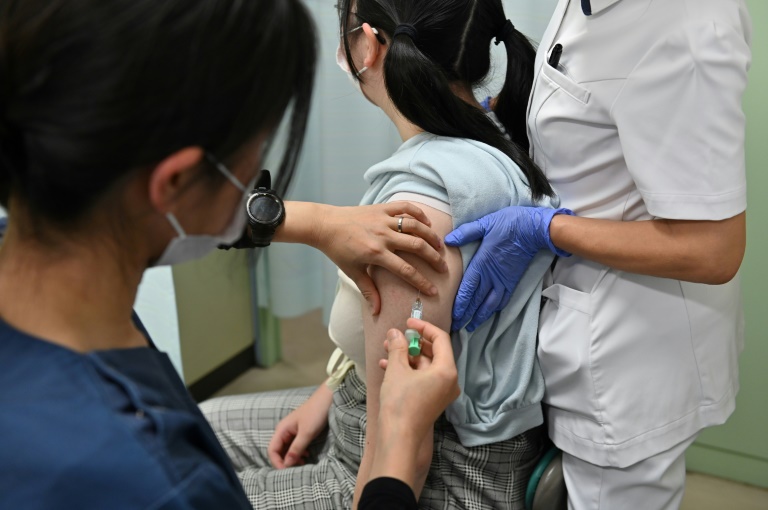
Japan will once again actively promote cervical cancer vaccination, which its advocates say could save thousands of lives, after a long pause linked to a media campaign over alleged harmful effects.
This government recommendation returns from April, after eight years of suspension, that vaccination against human papillomas (HPV), and sexually transmitted diseases, some of which can lead to cervical cancer in women, should be reintroduced.
The HPV vaccination rate has fallen to 1% in Japan from 70% in 2013.
“Finally, we will be able to protect the lives of young women,” but “the past eight years will cost a lot of lives,” notes Junko Mihara, a former actress turned parliamentarian and cervical cancer survivor there. About ten years.
At the time, the revelation of her cancer was shocking to the entertainment world in Japan, and she had to hide her illness so she could stay on stage, she remembers in an AFP interview.
Once in politics, she became a staunch advocate of HPV vaccination and served as deputy health minister.
Each year in Japan, about 10,000 women develop cervical cancer and nearly 3,000 die from it.
– Evidence of efficacy –
According to a large study published last year in the medical scientific journal The Lancet, the incidence of cervical cancer among young women in the UK has decreased significantly since the introduction of the country’s national vaccination program in the late 2000s.
Japan approved the HPV vaccine in 2009 and it became free for girls ages 12-16 in April 2013.
But only two months later, the government stopped recommending it due to doubts about a possible causal link between its injection and “chronic pain” reported by vaccinated people.
The vaccine was taken in loathing by the Japanese media that doubled down on articles suggesting it could be dangerous. Most of the country’s political leaders and scientific experts have been silent in the face of criticism that hasn’t helped matters.
Also abroad, in the United States or France for example, vaccinations against HPV aroused the mistrust of part of the population and led to legal action.
In Japan, it has been freely available since 2013, but without municipalities sending notifications to those affected.
– ‘I wasn’t afraid’ –
“The Ministry of Health prefers public opinion rather than scientific evidence,” denounced the obstetrician-gynecologist Kanako Inaba, who heads an organization that provides information on these vaccines.
As more data becomes available about their safety and efficacy, HPV vaccines have been rehabilitated in Japanese public opinion in recent years.
“I was not afraid,” Otako Kawakami, a 20-year-old student who received a booster dose of the HPV vaccine last year, told AFP.
“Scientific work supports safety (for this product, editor’s note) and I made my decision based on this data,” the young woman explains. Now share information on this topic on social networks to raise awareness among young people.
“I get messages on Instagram from girls telling me that they are now considering getting vaccinated. It makes me so happy.”
However, there are still opponents of HPV vaccines in Japan, including women who believe they have had chronic pain or fatigue since the injection. Trials are still ongoing.
Representative Junko Mihara said providing accurate information will be crucial to reviving HPV vaccination in Japan. “I don’t want young people to experience what I went through.”
