


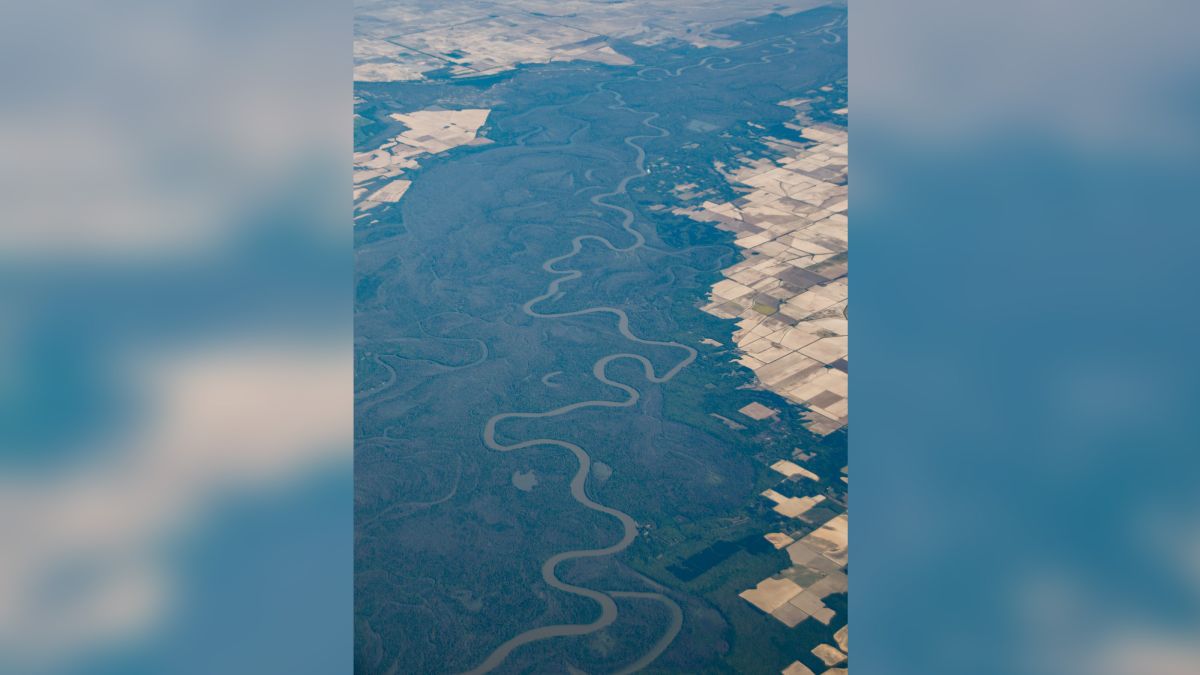
A third of the rivers of the United States have changed dramatically over the past 36 years, turning from blue to yellow and green, revealing stunning new images.
The researchers analyzed 235,000 satellite images – taken over a 34-year period between 1984 and 2018 – from NASA and the USGS (USGS) program. Changing shapes can be viewed in a file Interactive map.
More than half of the satellite images showed rivers with a predominant yellowish hue, while more than a third of the images were mostly green. Only 8% of the river photos were blue.
“Most rivers change gradually and are not noticeable to the human eye,” lead author John Gardner, a postdoctoral researcher at the University of North Carolina’s Global Hydrology Laboratory, told Live Science. “But areas that are changing the fastest can be human-made.”
Related: Rainbow Rivers: See amazing maps of the world’s waterways
Rivers can appear as shades of blue, green, yellow, or other colors depending on the amount of suspended sediment, algae, pollution, or organic matter dissolved in the water. As a general rule, river water turns green as more algae thrive, or when the water holds less sediment. Rivers tend to turn yellow when they carry more sediment.
“Sediments and algae are both important, but too much or too little of either can be disruptive,” said Gardner.
Evaluate trends
In all, researchers collected 16 million measurements over a 34-year period on 67,000 miles (108,000 km) of rivers in the United States that were more than 197 feet (60 meters) wide. This allowed them to track important trends in color change over time.
More than half of the rivers, or 55%, have varied over time, but with no apparent trend over time. A third color change in that time period, and only 12% had a stable color.
In the north and west, the rivers tend to become greener, while the eastern regions of the United States tend toward the yellow rivers. Large waterways, such as the Ohio Basin and the Upper Mississippi Basin, have also moved blue and green.
“The big trends to yellow or green can be disconcerting,” Gardner said, but added that “it depends on the individual river.”
Just as leaves turn red and gold in autumn, rivers can also change color with the seasons, thanks to changes in precipitation, snowmelt, and other factors that alter river flow.
Satellite images have revealed hot spots where human influences, such as dams, reservoirs, agriculture and urban development, may alter the color of some rivers.
But these changes are not necessarily permanent.
“You can see these trends completely turn back in the other direction, especially if the change is happening due to poor local governance that can be easily fixed,” Gardner said.
Monitor the health of the river
Although river color cannot give accurate numbers of water quality or ecosystem health, it is a good alternative to both of these. Thanks to satellite imagery, it is easier for scientists to measure the color than water quality.
“It’s a very simple scale that integrates a lot of things,” Gardner said. “But it can be used to identify areas that are changing very quickly.”
From there, he said, scientists can figure out the cause of the change.
More research is now needed to determine how accurately river color can determine the health of the ecosystem and which changes are significant to watch.
The researchers’ results were published December 6 in the journal Geophysical Research Letters.
Originally published on Live Science.
