


Zoom link to share this coffee will be available here a few days before coffee.
Image ©
The mission of researchers is to advance knowledge in a globalized context in all disciplines. They must explain, explain and teach new developments in the sciences in the context of already acquired knowledge, even if that means questioning it, but these tasks often stop at their peers who evaluate their publications, their teams that include PhD students as well as their university’s teaching.
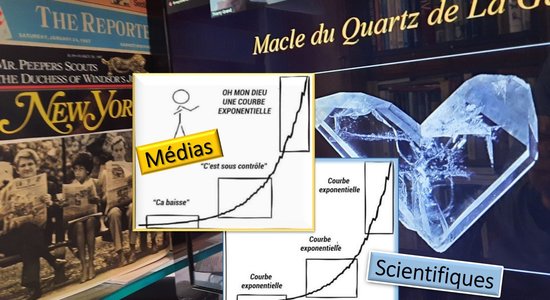
The mission of the scientific or public media is to give the public access to major developments in the sciences that affect societal, political, economic and cultural spheres: it is the media, and to provide access to them without distortion, without obscuring the questions asked. Thus some media (public broadcasts, newspapers, through in-depth articles and blogs, or rare scholarly journals, …) do their job, while misleading information, discussions mixing fake news and excessive interpretations, … often pervade our TV screens. As in our social media, …
Also, despite significant advances in vaccines, the heavily publicized displays of Covid-19 presenting “experts” on conflicts on our screens are leading to increased mistrust in scientific institutions and not allowing us to report issues. Time and uncertainty are specific to the scientific method. Additionally, some mandarins in the service of lobbyists or seniors go out of their field of expertise to assert falsehoods or false theories that are unfounded.
On the one hand, better scientific communication is provided by a few brilliant young researchers who present the foundations and developments of research, relying on their educational qualities and on physical and digital communication and teaching support. Innovative, accessible to all audiences (fablabs, videos, MOOCs, blogs, comics, fun exercises, etc.).
Thus, scholars want to present and discuss their work without bias, even if some fall into the trap of “mediation”, while the mainstream media prefer to present firm beliefs and facts for the benefit of a wider audience than the research exhibition. Which raises the question.
The Café will deal with the difficulties and obstacles to scientific mediation, but also with new avenues presented by our speakers who wish to convey scientific developments, without distorting them, to a wide audience.
Amplifiers
Supervisor : Emmanuel Burott (CSCAG)
