

Close Menu
    Facebook X (Twitter) Instagram
    Trending
    • Hauser’s Marks 45 Years With Province-Wide Customer Celebration and Renewed Focus on Community Care
    • Young drivers face elevated collision risks after consuming edible cannabis, new CAA-funded study finds
    • Salvation Army Thrift Store Marks 40th Ontario Location with Peterborough Opening
    • Early Blast of Winter Prompts Safety Warnings from Ontario Road Authorities
    • HONOR Takes Home Two TIME Best Inventions 2025 Awards for Smartphone Breakthroughs
    • Toronto Set to Host Largest LEGO® Fan Event in Canadian History
    • Hank Azaria and Caitlin Morrison Champion Mental Health Through Music at Toronto’s Koerner Hall
    • Bricks in the Six to Build Canada’s Largest-Ever LEGO® Fan Event This November
    Facebook X (Twitter) Instagram YouTube
    Vaughan TodayVaughan Today
    • Home
    • Top News
    • World
    • Banking
    • Explore Canada
    • How to
    • Solutions
    • Contact Form
    Vaughan TodayVaughan Today
    Home»science»Six incredible pictures of galaxy collision
    science

    Six incredible pictures of galaxy collision

    Maria GillBy Maria GillJanuary 15, 2021No Comments3 Mins Read
    Six incredible pictures of galaxy collision
    Share
    Facebook Twitter LinkedIn Pinterest Email

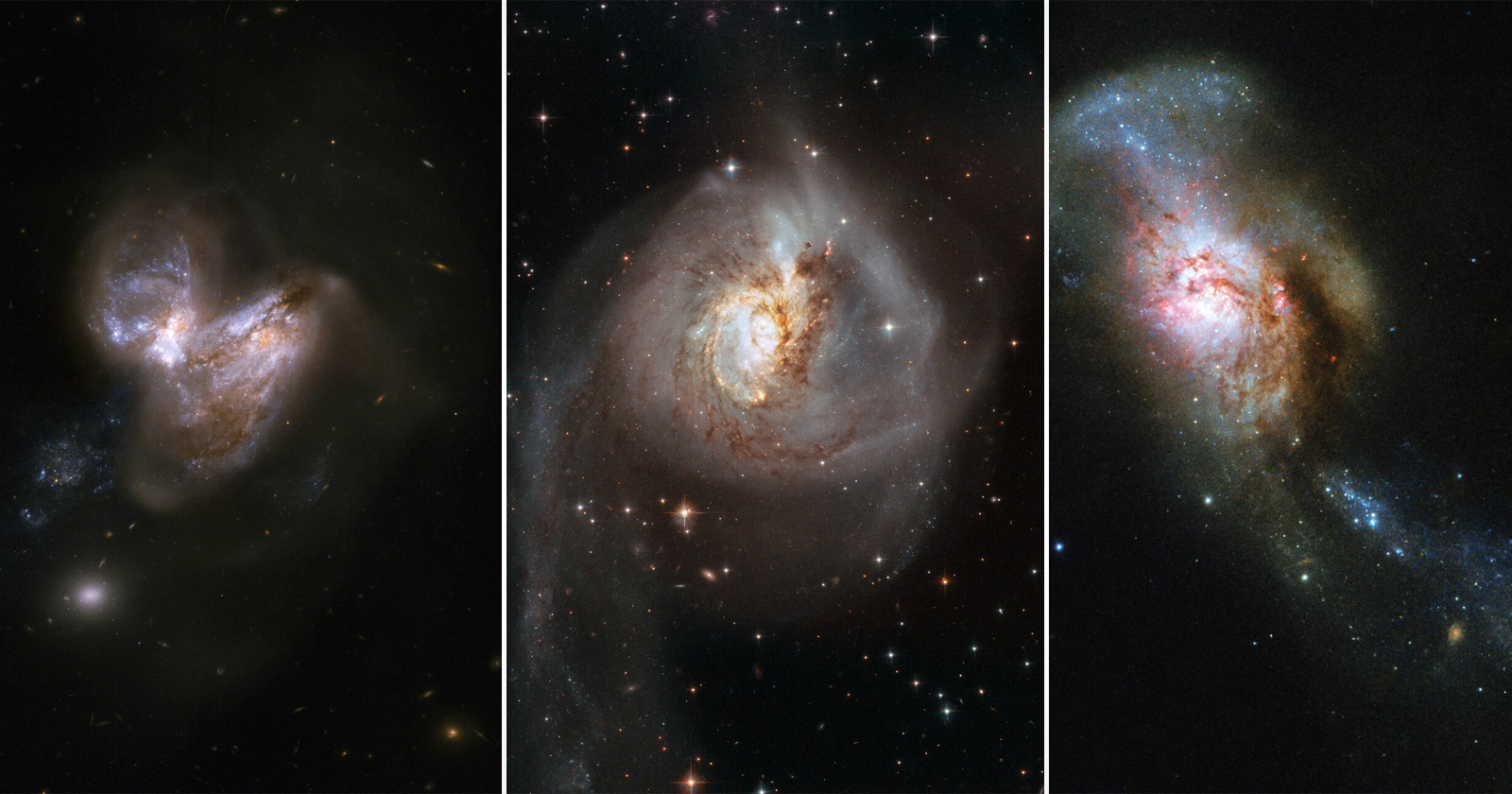
    As part of celebrating the new year, he owns the NASA / ESA Hubble Space Telescope Published Six different galaxy mergers. These rare astronomical phenomena were captured as part of a recent survey to investigate the rate of new star formations.

    As part of the release, NASA / ESA explains that these rare merger events show galaxies undergoing drastic changes in their stellar appearance and content.

    “These systems are excellent laboratories for tracking the formation of stellar clusters under extreme physical conditions,” the organization wrote. The Milky Way galaxy typically forms star clusters with masses equal to 10,000 times the mass of our sun. This is not comparable to the mass of stellar clusters that form in the collision of galaxies, which can reach millions of times the mass of our sun.
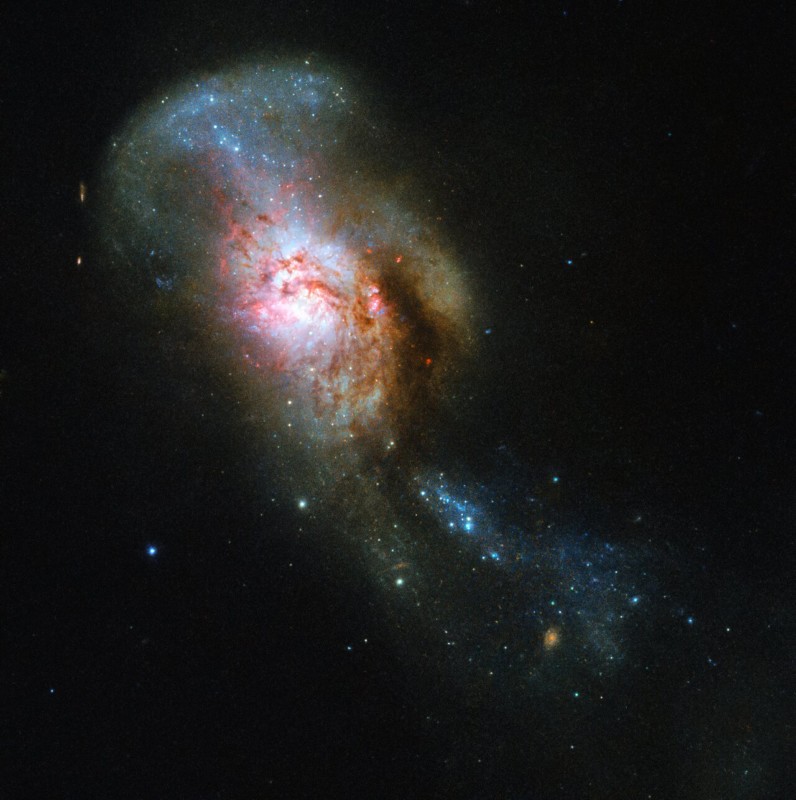
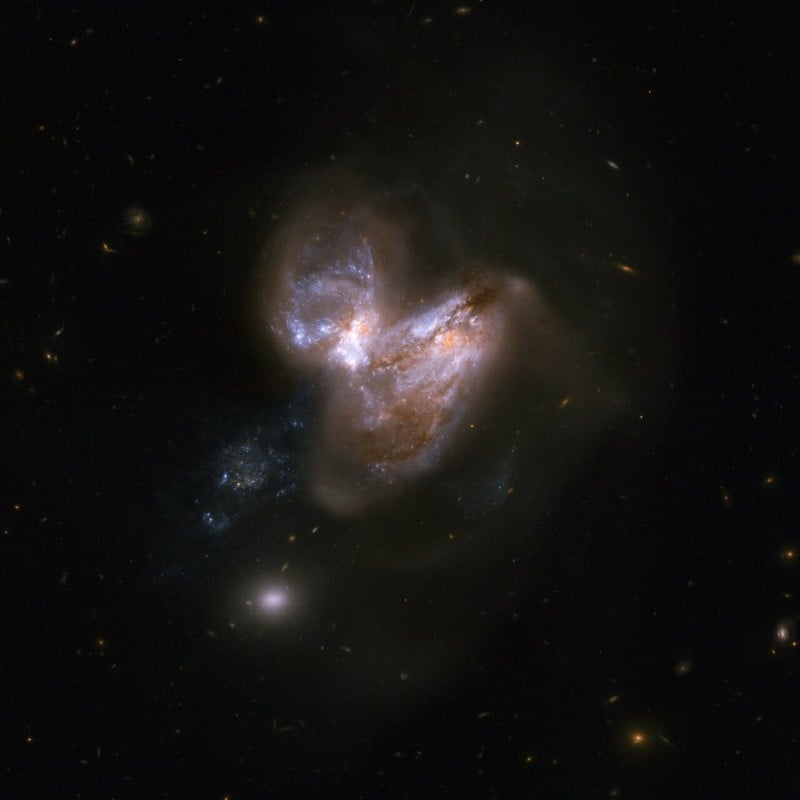
    The galaxy in this week’s image from Hubble has a particularly evocative name: the Medusa merger and is located about 130 million light-years away in the constellation of the Big Dipper (Great Dipper).
    This system consists of a pair of galaxies, called IC 694 and NGC 3690, which have passed roughly 700 million years ago. As a result of this interaction, the system underwent a violent explosion of star formation. In the past 15 years or so, six supernovae have appeared in the outer reaches of the galaxy, making this system a distinct supernova factory.

    These events give off a lot of light, and even after the collision, when the resulting galactic system fades into a calmer state, massive star clusters will continue to shine brightly.
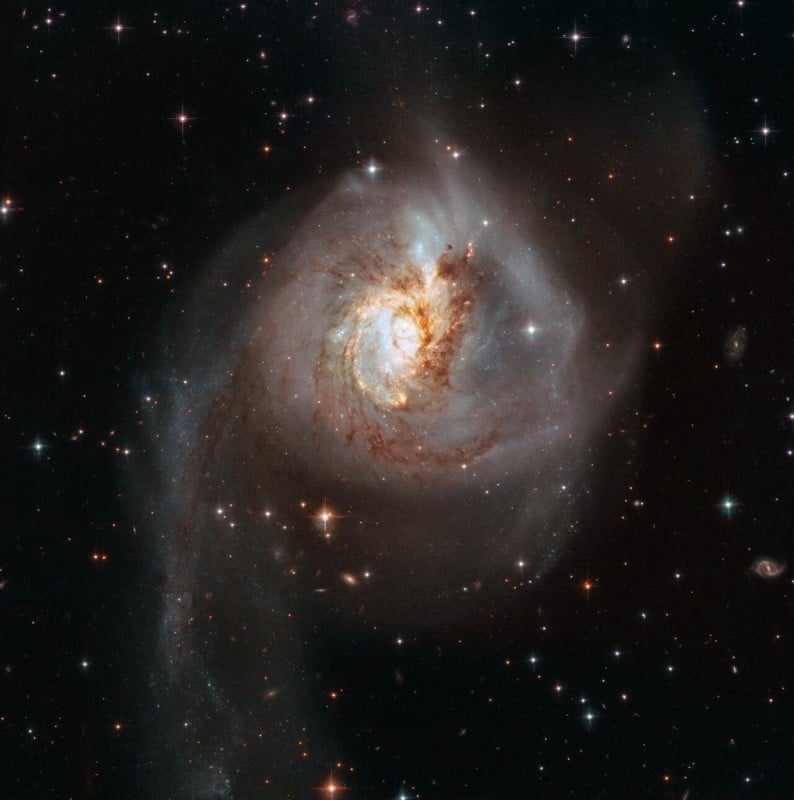
    This image shows the strange galaxy NGC 3256. The galaxy is located about 100 million light-years from Earth and is the result of a previous galactic merger that led to its distorted appearance. As such, NGC 3256 provides an ideal target for investigating stellar explosions caused by galaxy mergers.

    These photos are a selection of six from Set of 59 Which was published early 2008 through October 2020.
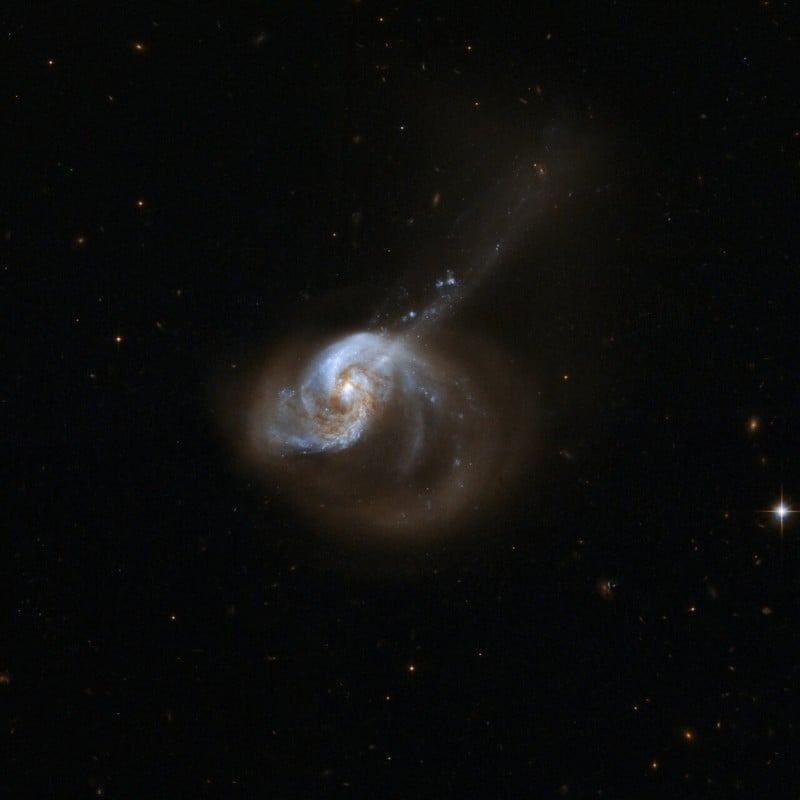
    The galaxy system NGC 1614 has a bright optical center and two clearly symmetrical inner spiral arms.
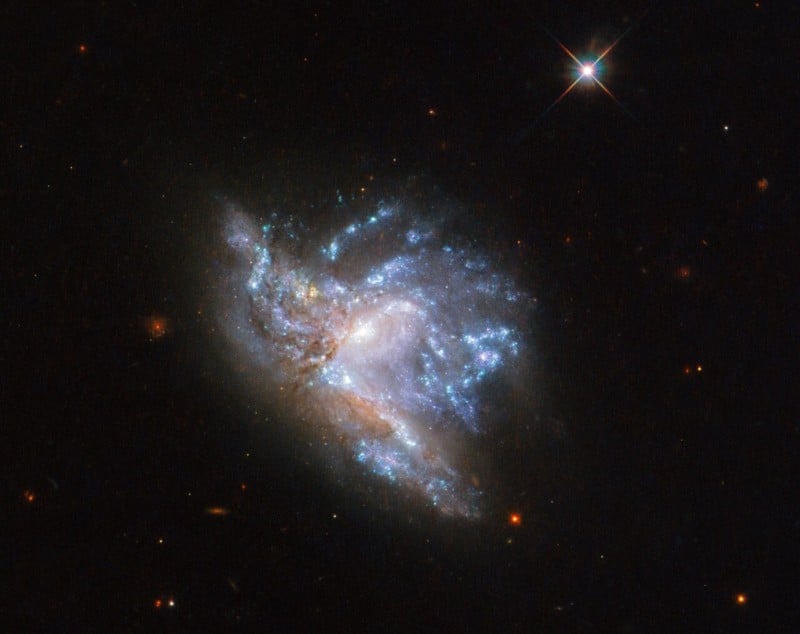
    NGC 6052 is located in the constellation Hercules, about 230 million light-years distant, and is a pair of colliding galaxies.

    “By studying the six galaxy mergers described here, the Hubble Imaging Survey of Extreme Environments and Clusters (HiPEEC) investigated how star clusters during collisions are affected by rapid changes that greatly increase the rate of new star formation in these galaxies, writes NASA / ESA.

    “Hubble’s capabilities have made it possible to solve the” knot “of large star formation into many compact young star groups. Hubble’s observations of ultraviolet and near-infrared radiation from these systems have been used to derive star mass ages, masses, and extinctions and to analyze the rate of star formation within these six galaxies The HiPEEC study reveals that star clusters undergo large and rapid changes in their properties, with the most massive clusters forming at the end of the fusion stage.
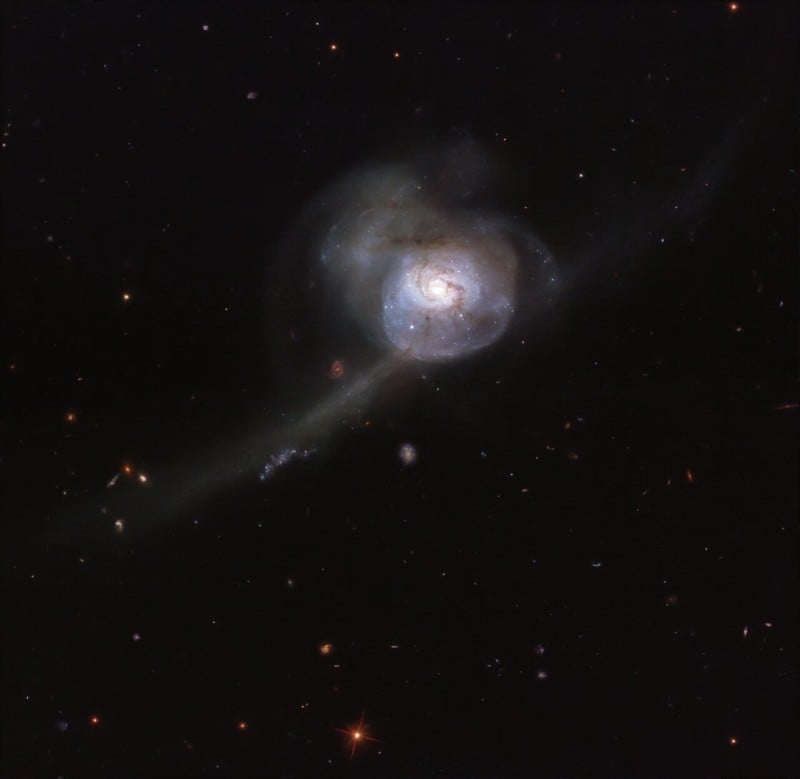
    NGC 34 is located in the constellation Cetus (the Sea Monster). The outer region of the galaxy is translucent, with strange smooth stars and tendrils.

    (Across Mashable)


    Image credits: Images provided by the European Space Agency / Hubble, NASA

    Share. Facebook Twitter Pinterest LinkedIn WhatsApp Reddit Tumblr Email
    Maria Gill

    "Subtly charming problem solver. Extreme tv enthusiast. Web scholar. Evil beer expert. Music nerd. Food junkie."

    Related Posts

    Rare Earth Metals: Essential Uses and the Global Supply Chain

    October 4, 2025

    200 meteorites found on Earth could be linked to Martian craters, allowing new insight into Mars’ history

    August 28, 2024

    Antibiotics that reduce the risk of stomach cancer

    August 26, 2024
    Facebook X (Twitter) Instagram Pinterest
    © 2025 ThemeSphere. Designed by ThemeSphere.

    Type above and press Enter to search. Press Esc to cancel.