


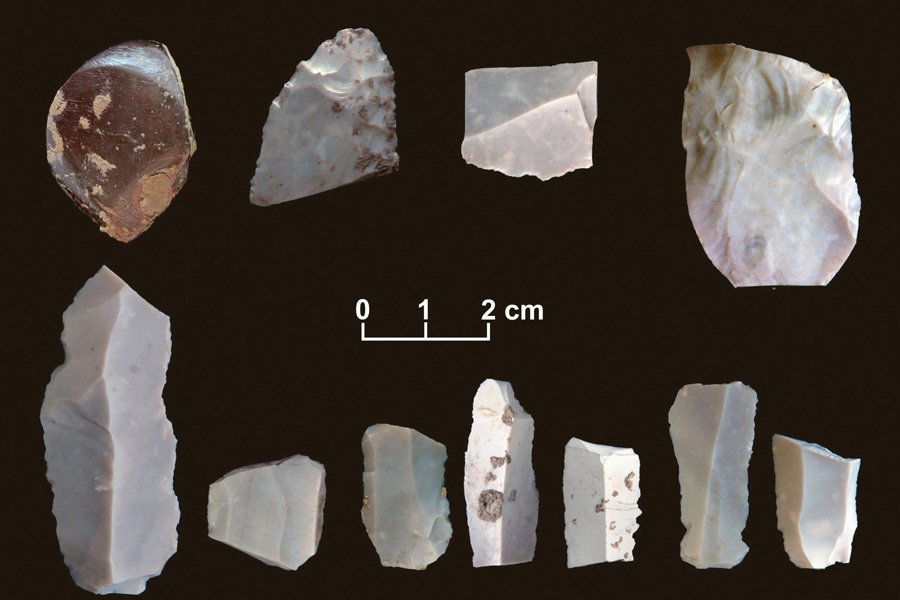

Photo: AP / Science
Several stone tools and 15,500-year-old arrowheads have been discovered in Texas, making this the oldest archaeological site in North America.

The discovery of an archaeological site in Texas containing thousands of remains dating back 15,500 years, reconnects America’s early inhabitants of more than 2,000 years, raising questions about the current theory about colonizing the continent.
The latter traces the early Americans to the peoples of the so-called Clovis culture, whose remains have been found in many locations since 1932.
According to this controversial hypothesis, the bearers of this culture – which has a very special technique for cutting double-sided points of flint – came from Asia about 13 years ago. 500 years across the Bering Strait through glaciers. Then they spread across the continent to reach southern South America.
The new archaeological site in Texas, named “Debra L. Friedkin” located about sixty kilometers northwest of Austin, documents an unprecedented number of remnants of a human occupation of the American continent by the Clovis peoples.
Therefore, this calls into question the current theory of early American settlements, asserts Michael Waters, director of the Center for Early American Studies at the University of Texas and lead author of this work, which was published in the American journal Science on March 25. .
“This discovery forces us to rethink the origins of colonialism in the Americas,” he insists. He adds, “There is no doubt that these tools and weapons were made by humans and are about 15,500 years old, making them the oldest remains found so far in North America.”
“This site is important to advance discussion about when the first inhabitants of the Americas arrived but also to understand the origins of the Clovis culture,” he said.
Michael Waters indicated during a conference call that the settlement theory of the American continent by the Clovis peoples suffers from several important weaknesses.
Hence, there is no trace of the Clovis flint-cutting “technology” in Northeast Asia where these colonists would have come.
Subsequently, flint arrowheads were discovered in Alaska and preceded the arrival of the Clovis tribes by a thousand years differently.
Finally, this archaeologist adds, six sites dating from the same period of the “Clovis culture” discovered in South America do not contain any traces that could be assimilated into this “culture”.
“These facts alone lead to the conclusion that the Clovis people could not have been the first Americans and that men had already been in America before,” the scientist insists.
In addition, archaeologists, who have searched for many years for evidence of sites that predate the Clovis culture in North, Central and South America, have discovered many “credible” sites, he said.
In particular, the researcher mentions two sites in Wisconsin (North) dating back 14,200 to 14,800 years, the Paisley Caves in Oregon (14,100 years) and the site of Monte Verde in southern South America (14,500 years).
In short, it is time to abandon Clovis’ theory of peoples once and for all and to develop a new paradigm explaining the inhabitants of the Americas. In this regard, Debra L. Friedkin is taking a major step towards this new understanding of early inhabitants of the New World, Michael Waters insists.
The dating was done using a luminescence technique to calculate when sediments covering the remains were last exposed to light.
