


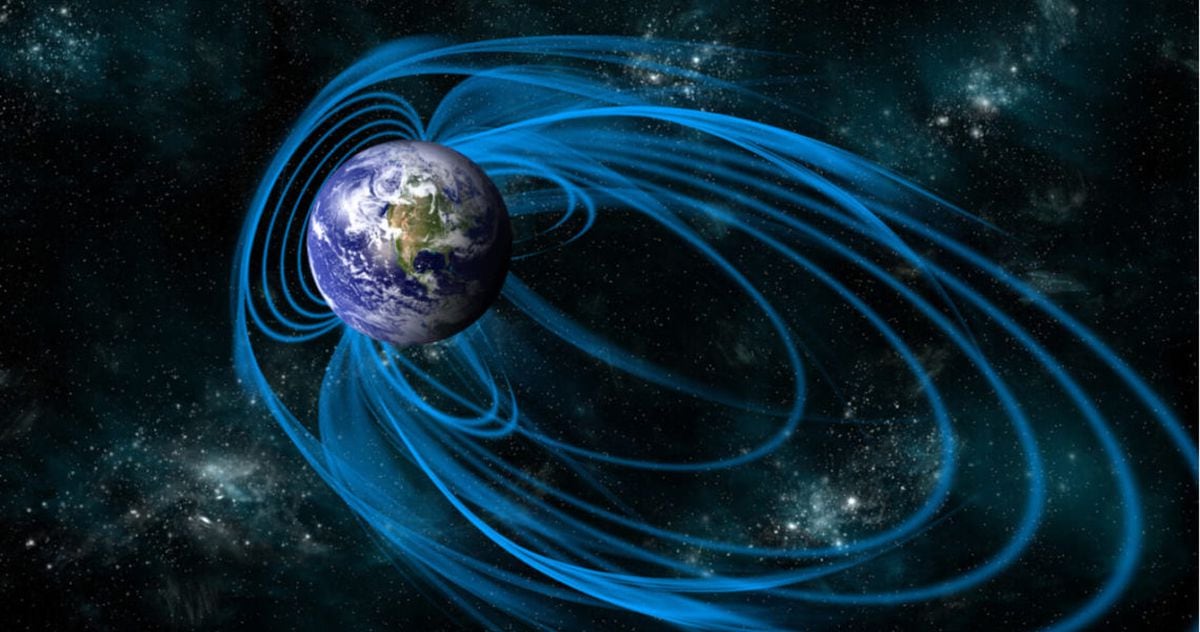
We often take the most important things for granted. For example, when was the last time you thought about the Earth's magnetic field, if that? Directing compass needles besides north or directing migratory birds, does the Earth's magnetic field have any other effect on our daily lives?
SPOILER ALERT: Every second, Earth's magnetic field deflects about 1.5 million tons of material ejected from the Sun at high speed. If it were not there, the atmosphere would suffer direct and continuous erosion. It would not be able to avoid the direct impact of those solar particles, which would sweep away everything that protects us with it. Therefore, without the Earth's magnetic field, life as we know it would not exist on the surface of our planet. Of course, our technological societies would not be possible either, because the magnetic field also protects our electronic equipment, not just our DNA, from this same bombardment.
Earth (like Mercury, Jupiter, Saturn, Neptune, and Uranus) is surrounded by a relatively intense magnetic field that originates, for the most part, within the planet. It is believed that at the present stage of the Earth's evolution, it is fueled by the cooling and crystallization of the core. This causes the liquid iron surrounding it to stir, generating powerful electrical currents that generate a magnetic field that extends into space. This type of magnetic field is known as a geodynamo, and the force field structure that deflects most of the solar wind and forms a protective shield is called the magnetosphere.
To understand how it works in more detail, let's now travel about 80 kilometers (50 miles) overhead. At this altitude, something fundamental happens. A large portion of the gas in this region is ionized. In other words, gas molecules have an electrical charge, generally because they have lost an electron in their structure due to energetic radiation coming from our star. Charged particles behave in a very special way. They follow magnetic field lines and thus move as if they were in lanes on a highway.
Before we continue, it is important to point out that the Sun, like all stars, ejects large amounts of material in the form of charged particles at very high speeds. It does this in addition to electromagnetic energy across the entire range – our eyes are only sensitive to visible light, which is a very narrow range. This is known as stellar wind; Or the solar wind, in the case of our star. The relationship between the magnetosphere and the solar wind is the heart of what is known as space weather.
If we could visualize the Earth's magnetic field, we would see that it is what we scientists call a dipole magnetic field. This is where the lines of force leave one hemisphere and enter the other. In the natural tradition, the outgoing field lines are magnetic north and the incoming field lines are magnetic south. In the case of Earth, and sometimes to avoid confusion with geographic north, the convention is reversed with the magnetic north pole pointing south and the magnetic south pole pointing north. To the north, the field lines point inward, which is the opposite of what happens in a magnet. The sphere is also tilted by 11.5 degrees relative to the planet's rotation axis, which defines the geographic north and south poles.
Great structure
The Earth's magnetic field at the poles is twice as strong as the magnetic field at the equator. We know this thanks to instruments on satellites that have explored the intensity and direction of Earth's magnetic field and confirmed its dipole nature. In addition to being complex, the form it takes is variable. Some of its components are Van Allen radiation belts, toroidal current, magnetotail, and magnetic gap.
Among some fascinating details about the structure of the magnetic field that surrounds our planet is a region made up of cold, dense plasma that orbits with Earth. There are also Van Allen belts, where particles move with relativistic energy, that is, at a speed close to the speed of light.
In what is known as a ring current, the energetic ions move at a much slower speed than the Van Allen belts, but they have a higher density and produce an electric current that surrounds the Earth. Electrons move from the twilight zone to the night zone and the positively charged ions move in the opposite direction. This toroidal current generates a magnetic field that points in the opposite direction to the Earth's magnetic field, and when it intensifies, the field strength measured at the surface decreases. There are more currents that connect the loop current to the ionosphere and play an essential role in the northern lights and space weather.
To understand the global configuration of the way particles move in our space environment, we need another key element. The solar wind is also magnetic. One way to visualize this interaction is simply to imagine the solar wind as a river current and the Earth and its magnetic field as a giant stone. Since the solar wind is faster than sound, we have a bow shock and behind the obstacle we have a tail. In this case, it is a magnetic tail. As for magnetic storms and where they come from, we will leave that for another occasion.
Subscribe to Our weekly newsletter For more English-language news coverage from EL PAÍS USA Edition
