


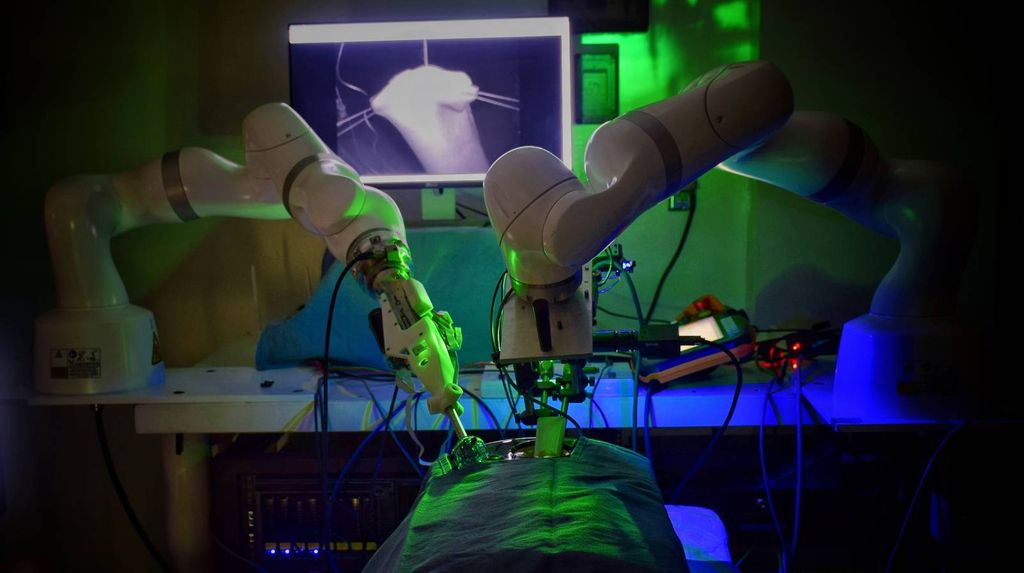
The robot named “STAR” for autonomous smart tissue robot, Designed by a team of researchers from Johns Hopkins University in the United States. At the moment, the ratings are very optimistic. ” STAR performed the procedure in four animals and achieved significantly better results than humans who had the same procedure.” Axel Krieger, co-lead author of the study published in the journal robotics scienceAnd He is a professor at the Johns Hopkins Whiting School of Engineering.

© BY H. SAEIDI JD OPFERMANN ET AL. Science Robotics, 2022
Laparoscopic Enhanced Soft Tissue Surgery. (a) Components of the STAR system, including medical robotic arms, operating surgical instruments, 2-channel light endoscopic imaging system and 3D NIR. (b) The control architecture of the improved STAR autonomy strategy.
>>> To read also: Video: Here are the first humanoid robots that can fly
Robot: What challenges did you face to implement this process?
One of the main challenges of creating a STAR robot was making it as autonomous and accurate as possible. ” What makes STAR special is that it is the first automated system to plan, adapt and execute a surgical plan in soft tissue, with minimal human intervention. Hamid Saeedi, co-lead author of the study and a visiting scholar in mechanical engineering at the Johns Hopkins Whiting School of Engineering in communication.
From a model built in 2016, researchers have created a new version of the robot by equipping it with the latest technology in surgery. With a guiding system, advanced suture tools, and the latest technology in surgical imaging, STAR has gained ultra-resolution vision for repairing and suturing pig intestines.
>>> To read also: Robots: The Surgeons of Tomorrow?
consequences ? The robot has excelled in performing an intestinal anastomosis, one of the most complex procedures in gastrointestinal surgery. In fact, connecting both ends of the intestine requires extreme precision! The slightest mistake can lead to leakage and therefore very serious consequences for the patient.
The best medical equipment is not enough to ensure the smooth running of this surgery. Robotic programming also had to innovate to manage another challenge: unpredictability. This factor obliges surgeons, and thus the STAR robot, to adapt to any unexpected event. Thus, the researchers equipped the STAR with a control system that allows it to adapt in real time to any obstacle.
>>> Read also: Here are the first robots capable of self-reproduction
Are robots the future of surgery?
The STAR-guided system consists of a 3D endoscope based on structural light and type algorithm machine learning Researchers believe that all these innovations will make robots smarter, but above all safer.
The study authors believe that roboticizing surgical procedures could lead to the democratization of patient care. Surgeons’ skills vary, and the expectations and outcomes of surgeries vary between each patient. Therefore, the robotic anastomosis “A way to ensure that surgical tasks that require high precision and reproducibility can be performed with greater precision and accuracy in every patient, regardless of the skill of the surgeon” According to researcher Axel Krieger. And you, would you be ready for surgery by a robot?
>>> Read also: Artificial intelligence, the technology of the future for cancer treatment
Source: DOI: 10.1126 / scirobotics.abj2908
Originally Posted on 01/27/2022
