

Close Menu
    Facebook X (Twitter) Instagram
    Trending
    • Hauser’s Marks 45 Years With Province-Wide Customer Celebration and Renewed Focus on Community Care
    • Young drivers face elevated collision risks after consuming edible cannabis, new CAA-funded study finds
    • Salvation Army Thrift Store Marks 40th Ontario Location with Peterborough Opening
    • Early Blast of Winter Prompts Safety Warnings from Ontario Road Authorities
    • HONOR Takes Home Two TIME Best Inventions 2025 Awards for Smartphone Breakthroughs
    • Toronto Set to Host Largest LEGO® Fan Event in Canadian History
    • Hank Azaria and Caitlin Morrison Champion Mental Health Through Music at Toronto’s Koerner Hall
    • Bricks in the Six to Build Canada’s Largest-Ever LEGO® Fan Event This November
    Facebook X (Twitter) Instagram YouTube
    Vaughan TodayVaughan Today
    • Home
    • Top News
    • World
    • Banking
    • Explore Canada
    • How to
    • Solutions
    • Contact Form
    Vaughan TodayVaughan Today
    Home»science»To have FLRT with you…: Weakening the FLRT2 receptor on the cell surface
    science

    To have FLRT with you…: Weakening the FLRT2 receptor on the cell surface

    Maria GillBy Maria GillJune 15, 2022No Comments2 Mins Read
    To have FLRT with you…: Weakening the FLRT2 receptor on the cell surface
    Share
    Facebook Twitter LinkedIn Pinterest Email

    FLRT receptors act as ‘context identifiers’ that control the formation of different signaling complexes to regulate brain development. So far, research has focused on the extracellular domain of these receptors, which allows communication between two cells.

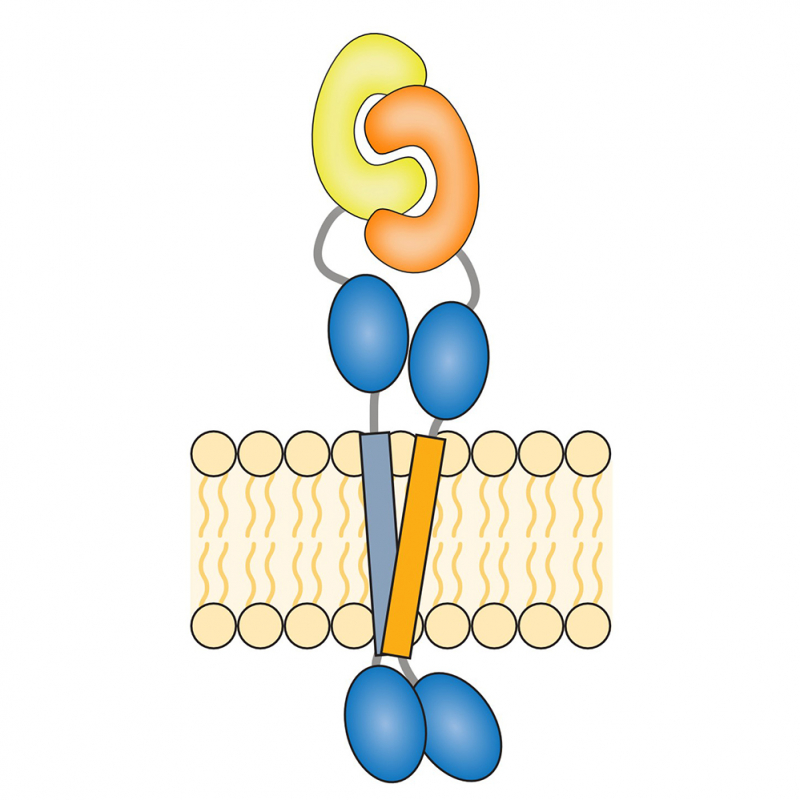
    Thanks to an international collaboration involving French and British researchers, scientists have demonstrated a new type of FLRT2 receptor interaction. By combining molecular dynamics simulations with single-molecule fluorescence microscopy experiments, it was possible to quantify this interaction at the surface of the same cell. This interaction includes both the transmembrane domain of this receptor as well as the extracellular domain.

    This work adds an additional level of complexity to all aspects of operating the FLRT receiver. It provides a new basis for understanding the structural mechanisms that determine the function of these receptors in tissue growth and suggests a new competitive binding mechanism between FLRT receptors on the same cell surface and those that can interact between two cells.

    Face
    © Mathieu Chavent
    the shape : a model of the cis interaction of the FLRT2 receptor obtained by fusion
    Molecular dynamics modeling (lower panel) quantifying transmembrane domain interaction via small-xxx-motifs and single-molecule fluorescence microscopy (right panel) allowing to follow the co-diffusion of these receptors).

    To find out more :
    The guidance and adhesion protein FLRT2 is dimerized in cis via the small-X . dimer3Small membrane patterns.
    Jackson V, Hermann J., Tynan CJ, Rolf D. J., Corey Ra, Duncan L., Noriega M, Cho A, Kali AC, Jones EY, Sansom MSP, Martin Fernandez ML, Ciradaki E, Shavent M.
    structure. 3 June 2022. doi: 10.1016 / j.str.2022.05.014.

    Share. Facebook Twitter Pinterest LinkedIn WhatsApp Reddit Tumblr Email
    Maria Gill

    "Subtly charming problem solver. Extreme tv enthusiast. Web scholar. Evil beer expert. Music nerd. Food junkie."

    Related Posts

    Rare Earth Metals: Essential Uses and the Global Supply Chain

    October 4, 2025

    200 meteorites found on Earth could be linked to Martian craters, allowing new insight into Mars’ history

    August 28, 2024

    Antibiotics that reduce the risk of stomach cancer

    August 26, 2024
    Facebook X (Twitter) Instagram Pinterest
    © 2025 ThemeSphere. Designed by ThemeSphere.

    Type above and press Enter to search. Press Esc to cancel.