

The period that currently allows for launch, which is determined by the positions of the Earth and Moon, ends on Tuesday, but liftoff is likely by then. No longer on the table
NASA Associate Administrator Jim Frey said at a press conference, without announcing a possible new date at this time.
The periods following the launch are from September 19 to October 4, and then from October 17 to 31.
It was originally scheduled to take off at 2:17 p.m., with a two-hour launch window. But after more than three hours of trying to solve the problem of fuel leaks during refueling operations, the launch teams were running out of time.
A NASA commentator said in a video broadcast that launch manager Charlie Blackwell Thompson made the final decision to cancel from the Kennedy Space Center in Florida.

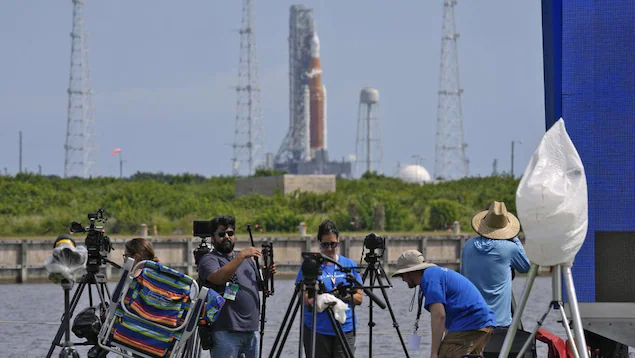
Artemis was scheduled to take off at 2:17 pm on Saturday, but the flight was postponed due to a fuel leak.
Photo: Getty Images/Joe Raedle
Fifty years after Apollo
Fifty years after the last Apollo mission, this first test mission, without a crew on board, is the first phase of the Artemis program, which aims to establish a permanent human presence on the Moon, then allow it to be used as a priority. starting point. towards Mars.
The orange and white SLS rocket, whose maiden flight was supposed to take place on Saturday, has been in development for more than a decade to become the most powerful in the world.
Shortly before 6 a.m., the go-ahead was given to begin filling the rocket’s tanks with its cryogenic fuel – a total of about three million liters of super-cold liquid hydrogen and oxygen.
But at about 7:15 a.m., a big
A leak was detected at the base of the rocket, at the level of the tube through which hydrogen passes into the tank. The flow stopped while the teams tried three times in a row to solve the problem, without success
NASA tweeted.
technical problems
On Monday, during the first attempt, the launch was also canceled at the last moment due to technical problems, first a similar leak that could have been clogged, and then due to cooling of the engines.
Cancel boot It is absolutely the right decision
In the event of a leak, astronaut Victor Glover, who is on the spot, responded to reporters on Saturday. With these frequent tests, which make it possible to better understand this new car, People’s trust should go up, not go down
he argued.
The orange and white SLS missile, which has never flown before, has been in development for more than a decade to become the most powerful in the world.
In the middle of a long weekend in the US, as many as 400,000 people were expected to like take off, especially from the surrounding beaches.
Several astronauts have also made the flight, including Frenchman Thomas Pesquet.

The launch of NASA’s massive new rocket to the moon again on Saturday was called off at the last minute. Analysis with Charles Tessier, David Saint-Jacques and Robert Lamontani
I should make it possible for Artemis to verify that the Orion capsule, which is on top of the rocket, is safe for the transportation of future astronauts.
Thanks to this new ship, the US space agency intends to reconnect with distant human exploration, as the moon is 1,000 times farther from the International Space Station.
On the way to the moon
The trip is expected to take a total of six weeks. Orion will venture up to 64,000 kilometers behind the moon, farther than any other habitable spacecraft to date.
The main purpose of the Artemis I is to test the capsule’s heat shield, which is the largest of all. Returning to the Earth’s atmosphere, it will have to withstand a speed of 40,000 km / h and a temperature half the temperature of the surface of the Sun.
In total, the ship would have to travel about 2.1 million kilometers to land in the Pacific Ocean.
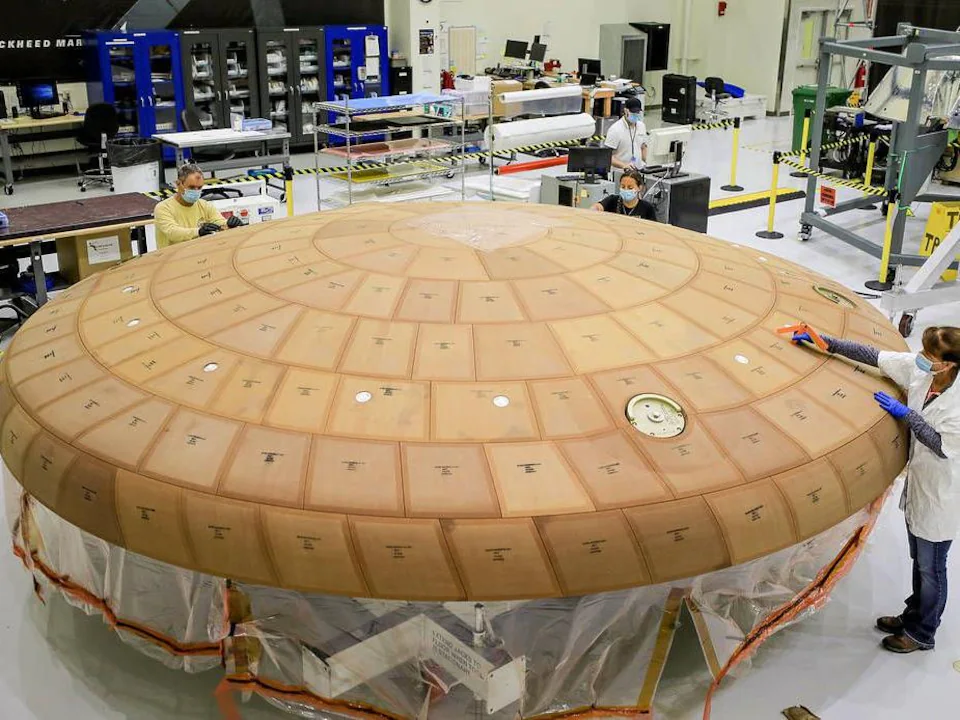
NASA personnel prepare the heat shield to protect the Orion capsule during the Artemis II mission.
Photo: NASA/Isaac Watson
The success of the full mission would be a relief to NASA, which was originally intended for the 2017 debut of the SLS. NASA will spend more than $90 billion on its new lunar program by the end of 2025, according to a public audit.
A varied and comprehensive journey
The name Artemis was chosen after a female character, the twin sister of the Greek god Apollo, echoing the Apollo program, which sent only white men to the lunar surface between 1969 and 1972.
This time, NASA wants to allow the first person of color and the first woman to walk on the moon.
The next mission, Artemis II, will take astronauts to the Moon in 2024, without landing there. This honor will be reserved for the crew of Artemis III, in 2025 at the earliest. Then NASA wants to launch about one mission each year.
It would then be a matter of building a space station in the lunar orbit GateA base on the moon.
Here, NASA wants to test the technologies needed to send the first humans on a round trip to Mars. This trip, which will last several years, can be attempted at the end of the 30s of the last century.

Evan McKenzie is a contributor at Vaughantoday.ca, covering a wide range of topics including local news, politics, business, technology, sports, entertainment, and lifestyle. He focuses on clear, balanced reporting that helps readers stay informed about current events and issues that matter to their communities. His work aims to provide useful information, timely updates, and relevant stories presented in an accessible and reader-friendly way.