

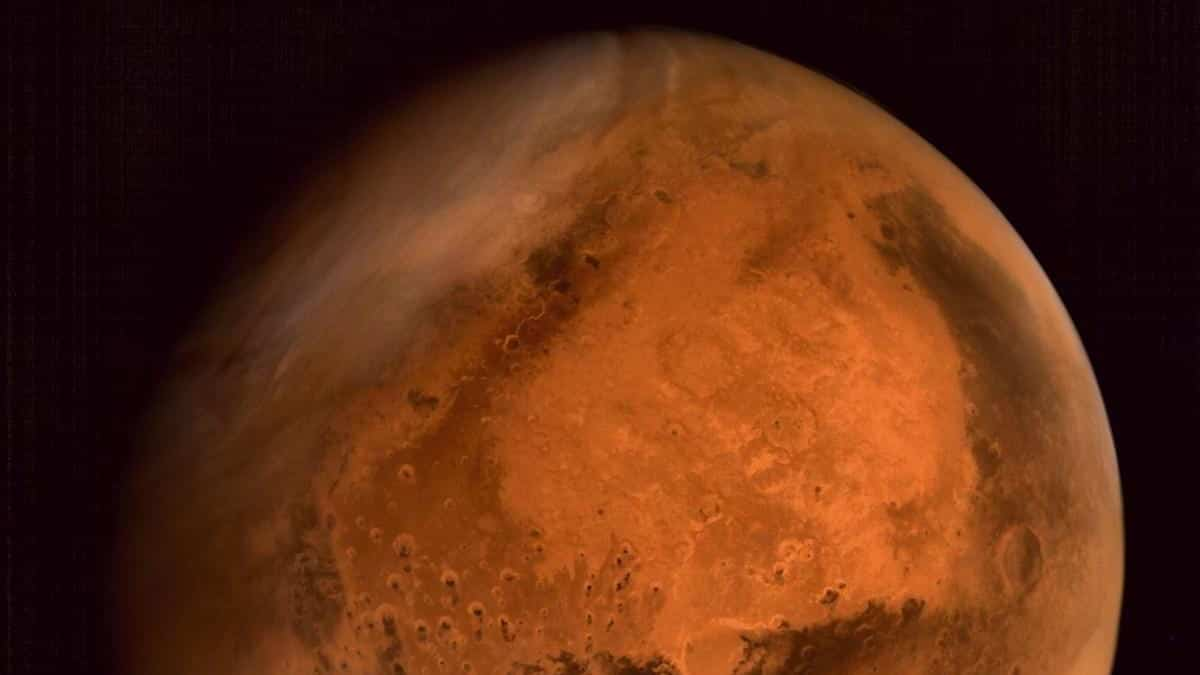
Mars wasn’t always the arid planet we know today: billions of years ago, it was home to lakes, rivers, and even oceans. But the question of where did all this water go was a mystery.
Until now, researchers believe it escaped into space. But according to a new study, it actually ended up being largely locked in the crust of Mars.
Also read: The SuperCam on Mars for the Tenacity Rover is extremely healthy
Also read: Mars: a mysterious cloud 1,800 km long reveals its secrets
Also read: The persistent rover has crossed its first meters on the surface of Mars
Eva Schiller, a researcher at the California Institute of Technology and lead author of the study, published Tuesday in the prestigious journal Science, cautioned that this finding does not imply “some kind of gigantic reservoir of water” under the surface of Mars. .
“We say that the crust is made up of what we call aqueous minerals, that is, minerals that contain water in their composition,” she told AFP.
Early in its history, Mars had enough liquid water on its surface to cover it below the equivalent of an altitude of between 100 and 1,500 meters, according to the scientists.
For comparison, 1,000 meters across the entire Red Planet equals half of the Atlantic Ocean, according to Eva Schiller’s calculation.
Today the height is only 20 to 40 meters according to the same measurement. Water is either in the atmosphere or in the form of ice in the polar peaks or the interior of Mars.
So where did the rest go?
Until now, researchers have considered this water loss to be caused by atmospheric exhausts.
This phenomenon is also present on Earth, but is more pronounced on Mars due to its lower gravity.
Water molecules are made of oxygen and hydrogen, and Eva Schiller explains that “hydrogen atoms are very light.” As a result, they can free themselves from Mars’ gravitational field and escape into space. ”
But this explanation was not sufficient to explain the loss of only a small amount of water.
However, satellite observations and analyzes by the various rovers sent to Mars showed that they actually included more.
Additionally, studying the level of deuterium on Mars, which forms a small fraction of hydrogen and escapes less into space because it is heavier, also did not adhere to atmospheric escape theories alone.
The study, published on Tuesday, builds for the first time a model adding complementary theory.
Eva Schiller explains: “When a stone interacts with water, there is a series of very complex chemical reactions that form a hydrated mineral.”
Clay is a very common example of such a mineral, and it is also the most common on Mars, according to the researcher.
“The loss of water in the Martian crust is at least equal to or greater than atmospheric exhaust,” she says. Thus, up to 99% of the water that vanished from the surface of Mars could be trapped in rocks.
The study indicated that “the loss of water in the crust is a very important mechanism for planets, which dictates when they become barren,” as the researcher affirms.
This process also occurs on Earth, but thanks to plate tectonics (which are not found on Mars), trapped water is recycled via volcanic phenomena.
Additionally, knowing that the deadly minerals on Mars are at least three billion years old, this means that the red planet has already lost most of its water by that time, according to the study.
“Mars was more or less as we know it today, three billion years ago,” says Schiller.
It hopes to be able to improve the various scenarios considered in her study thanks to the NASA Perseverance rover, which has just arrived on the red planet.
“The Perseverance Wagon will study exactly those processes and interactions that cause water retention in the crust,” she says. It can turn out to be the “most important piece of the puzzle”, providing a final answer to the puzzle.

Evan McKenzie is a contributor at Vaughantoday.ca, covering a wide range of topics including local news, politics, business, technology, sports, entertainment, and lifestyle. He focuses on clear, balanced reporting that helps readers stay informed about current events and issues that matter to their communities. His work aims to provide useful information, timely updates, and relevant stories presented in an accessible and reader-friendly way.