

Close Menu
    Facebook X (Twitter) Instagram
    Trending
    • Hauser’s Marks 45 Years With Province-Wide Customer Celebration and Renewed Focus on Community Care
    • Young drivers face elevated collision risks after consuming edible cannabis, new CAA-funded study finds
    • Salvation Army Thrift Store Marks 40th Ontario Location with Peterborough Opening
    • Early Blast of Winter Prompts Safety Warnings from Ontario Road Authorities
    • HONOR Takes Home Two TIME Best Inventions 2025 Awards for Smartphone Breakthroughs
    • Toronto Set to Host Largest LEGO® Fan Event in Canadian History
    • Hank Azaria and Caitlin Morrison Champion Mental Health Through Music at Toronto’s Koerner Hall
    • Bricks in the Six to Build Canada’s Largest-Ever LEGO® Fan Event This November
    Facebook X (Twitter) Instagram YouTube
    Vaughan TodayVaughan Today
    • Home
    • Top News
    • World
    • Banking
    • Explore Canada
    • How to
    • Solutions
    • Contact Form
    Vaughan TodayVaughan Today
    Home»Tech»A probe flies over the largest moon in the solar system
    Tech

    A probe flies over the largest moon in the solar system

    Jillian CastilloBy Jillian CastilloJune 8, 2021No Comments2 Mins Read
    A probe flies over the largest moon in the solar system
    Share
    Facebook Twitter LinkedIn Pinterest Email

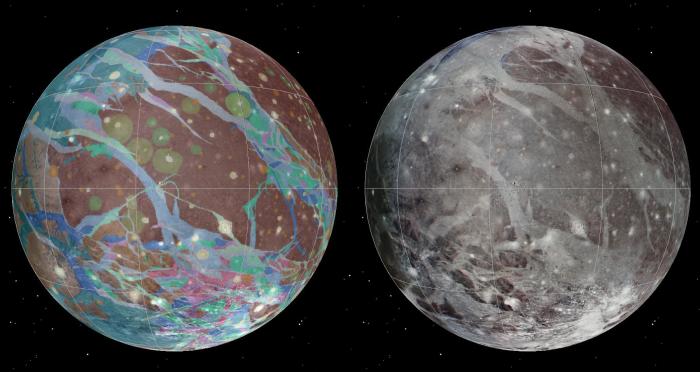
    Monday, June 7, 2021 8:05 p.m. – NASA’s Juno probe is currently flying above the largest moon in the solar system: Ganymede. The Jovian satellite has not been visited in twenty years. Scientists expect some nice surprises.


    First meeting in 20 years

    On June 7, the Juno probe approached 1,000 kilometers or less from the surface of Ganymede, one of Jupiter’s many satellites. It is the largest moon in the solar system. Ganymede is larger than the planet Mercury. Only this moon has a magnetosphere, a layer containing charged particles around the celestial body. NASA’s probe will approach Jupiter’s moon for the first time in nearly 20 years.

    frozen moon

    Instruments aboard the probe will allow scientists to learn more, particularly about the ice covering the Jovian satellite. This ice crust contains dark areas and some light areas. Researchers’ analyzes will eventually be able to determine its composition and structure.

    amazing pictures

    JunoCam will send snapshots with an increasing level of detail that researchers will compare to images taken by the Voyager and Galileo probes, some of which date back four decades. Observing these images will allow scientists to see the changes Ganymede’s surface has undergone over the past 40 years.


    See also: Two missions to Venus

    Share. Facebook Twitter Pinterest LinkedIn WhatsApp Reddit Tumblr Email
    Jillian Castillo

    "Proud thinker. Tv fanatic. Communicator. Evil student. Food junkie. Passionate coffee geek. Award-winning alcohol advocate."

    Related Posts

    MSI Unveils Black Friday Discounts on Flagship Laptops and Handhelds

    November 1, 2025

    Rare Earth Metals: Essential Uses and the Global Supply Chain

    October 4, 2025

    Bell error 2000: Troubleshoot and Solutions

    June 4, 2023
    Facebook X (Twitter) Instagram Pinterest
    © 2025 ThemeSphere. Designed by ThemeSphere.

    Type above and press Enter to search. Press Esc to cancel.