


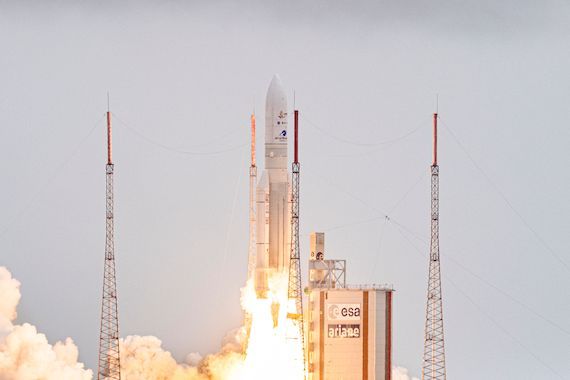

The telescope, which cost $10 billion and is the largest and most powerful astronomical observatory ever launched, flew on December 25 from French Guiana. (Photo: Getty Images)
Cape Canaveral – NASA’s new space telescope is about to complete the most dangerous part of its mission – deploying and stretching the heat shield – as NASA’s ground control units have solved two problems.
The heat shield of the James Webb Space Telescope, the size of a tennis court, is now fully open and strained. The process is expected to end on Wednesday.
The telescope, which cost $10 billion and is the largest and most powerful astronomical observatory ever launched, flew on December 25 from French Guiana. The heat shield and main mirror had to be folded to enter the European Ariane missile.
The heat shield is necessary to keep infrared sensors at sub-zero temperatures, which scan the universe for the first stars and galaxies.
The extension of the heat shield last Friday “was a huge achievement for us,” said project manager Bill Ochs. All 107 motors unlocked properly.
But there were some obstacles.
Flight controllers in Maryland had to reset the solar panel to absorb more energy. Engineer Amy Lo, of Northrop Grumman, the telescope’s main subcontractor, explained that the observatory – considered the successor to the old Hubble Space Telescope – was never in danger, because it received a constant stream of energy.
They also reoriented the telescope to limit sunlight from reaching six superheated engines. Officials said those engines had cooled enough to begin deploying the shield, a three-day process that could be halted if the problem recurs.
“Everything is back to normal and going well,” said Ms. Lu.
Project manager Ochs expects the rest of the tension to go smoothly.
“The best thing that can happen to us is boredom. This is what we expect in the next three days: boredom,” he told reporters on a conference call.
If so, the telescope’s gold-plated mirror, which has a diameter of more than 6.5 meters, could go live as early as this weekend.
Webb is expected to reach its destination 1.6 million kilometers from Earth by the end of January. As of Monday, the telescope was past the halfway mark.
The telescope uses a precision-guided detector, a non-slit imager and a near-infrared spectrometer, a tool that allows astronomers to observe distant galaxies and study the atmospheres of exoplanets.
Both of these tools are designed and built in Canada.
In exchange for its contribution to the telescope, Canada is guaranteed to have at least five percent of the telescope’s observation time, once the data starts arriving.
The infrared telescope is expected to begin observing the universe at the end of June, eventually revealing the first stars and galaxies that formed in the universe 13.7 billion years ago. It was barely 100 million years after the Big Bang that created the universe.
Launched in 1990, Hubble, which sees mainly visible light, has been tracked 13.4 billion years ago. Astronomers hope to fill that gap with Webb, which is 100 times more powerful.
And in more good news, officials said Monday, they expect Webb to last much longer than originally planned, given its energy efficiency.
