


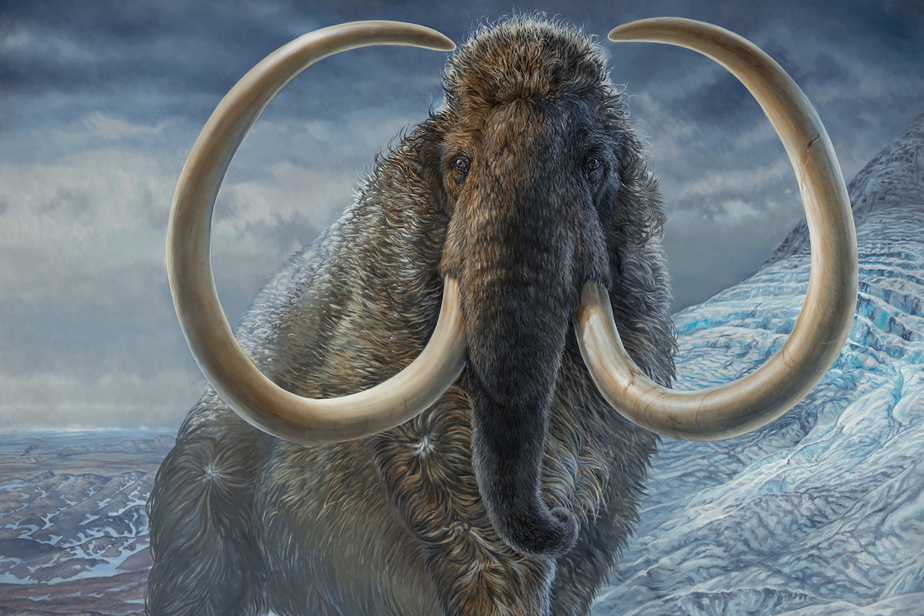
(Washington) A distance twice the Earth’s circle in 28 years of life: Researchers have traced the path taken by the woolly mammoth that lived about 17,000 years ago in Alaska, proving for the first time that this symbolic animal was truly a great walker.

Their discovery was published Thursday in the prestigious journal Sciences, could shed light on hypotheses regarding the extinction of these giant mammals, whose teeth were larger than a human fist.
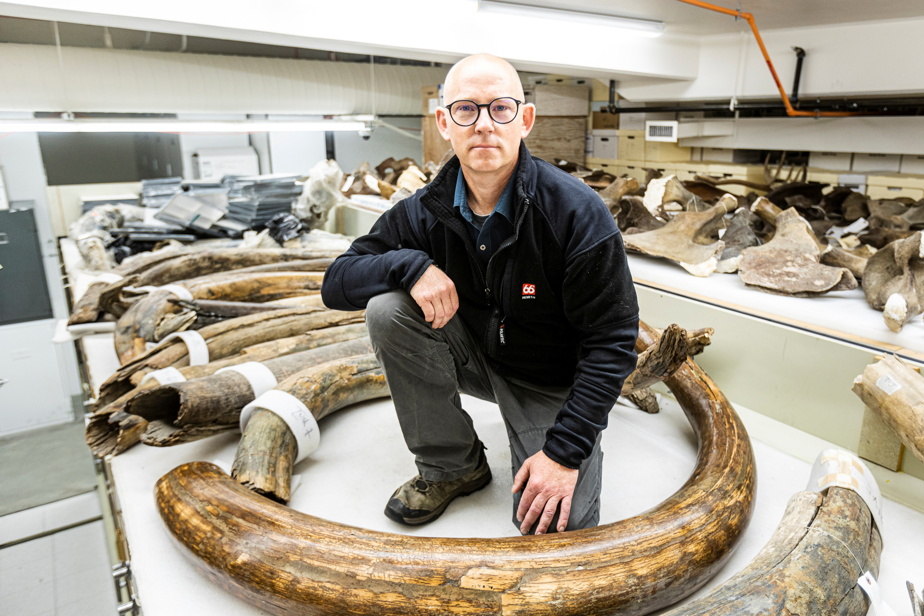
Photo JR ANCHETA, via Reuters
woolly mammoth tusks
“In all popular cultures, for example if you watch (cartoons) ice AgeClement Patai, assistant professor at the University of Ottawa and one of the study’s lead authors, noted that there are always mammoths that migrate, move, and move a lot. “There is no real reason that it is such a huge animal that takes a lot of energy to move around,” he told AFP.
However, the researchers were amazed by their findings: the mammoths studied traveled a “tremendous” distance, about 70,000 kilometers, and did not remain on a plain as they expected. “We see it traveling all over Alaska, and thus a vast region,” confirms Clement Patai. “It was really a surprise.”
Readings on the tusk
For their work, the researchers chose a male who lived at the end of the last Ice Age. A particularly interesting specimen, because it is very recent and therefore close to the time of the extinction of its species, about 13,000 years ago.
One of the canines was cut in half to take readings of the so-called “strontium isotope ratios”. Strontium is a chemical element very similar to limestone. Isotopes are different forms of this element.
The strontium in the soil moves to vegetation, and when the latter is ingested by a living organism, it is lodged in bones, teeth … or fangs.
The latter is constantly growing: the tip reflects the first years of life, and the last rule.
Since isotopic ratios vary depending on geology, Clément Bataille developed an isotopic map of the region. By comparing it with data from the canines, it is thus possible to determine precisely where the mammoths are.
long trips
At that time, all the mountains of the Brooks Range in the north and the Alaska Range in the south were covered by glaciers. In the center is the Yukon River Plain.
In general, the animal regularly returns to certain areas, where it can survive for several years. But his movements changed drastically depending on his age, before he eventually died of starvation.
During the first two years of her life, researchers were able to notice signs of breastfeeding. Then between 2 and 16 years, the movements are recorded, but mainly in central Alaska.
“What was really surprising was that after the teenage years, the isotopic differences started to be more significant,” explains Clément Bataille. A mammoth, “three or four times in its life, has made an enormous journey of 500, 600, even 700 kilometers, in the span of a few months.”
To explain these movements, scientists have two hypotheses. As with elephants, the male mammoth may have moved alone, from herd to herd, to breed.
Or perhaps he was facing a drought or a particularly harsh winter, forcing him to search for an area where food was more plentiful.
Today’s lessons
Whether it comes to questions of genetic diversity, or resources, it is clear that this species needs a very large space to live, notes Clement Bataille.
However, at the time of the transition between the Ice Age and the Ice Age, that is, at the time of their extinction, “the area shrunk, because more forests grew” and “humans exerted a fairly strong pressure on its south.” Alaska, where perhaps the movement of mammoths is much less” , as he explains.
According to the researcher, understanding the factors that led to the mammoth’s disappearance could help protect other currently threatened megafauna species, such as caribou or elephants.
Today, on the one hand, climate change is warming the planet. On the other hand, he said, “We will be limited to these types of megafauna in parks” or protected areas.
“Do we want our children 1,000 years from now to see elephants the same way we look at mammoths today?” ”
