


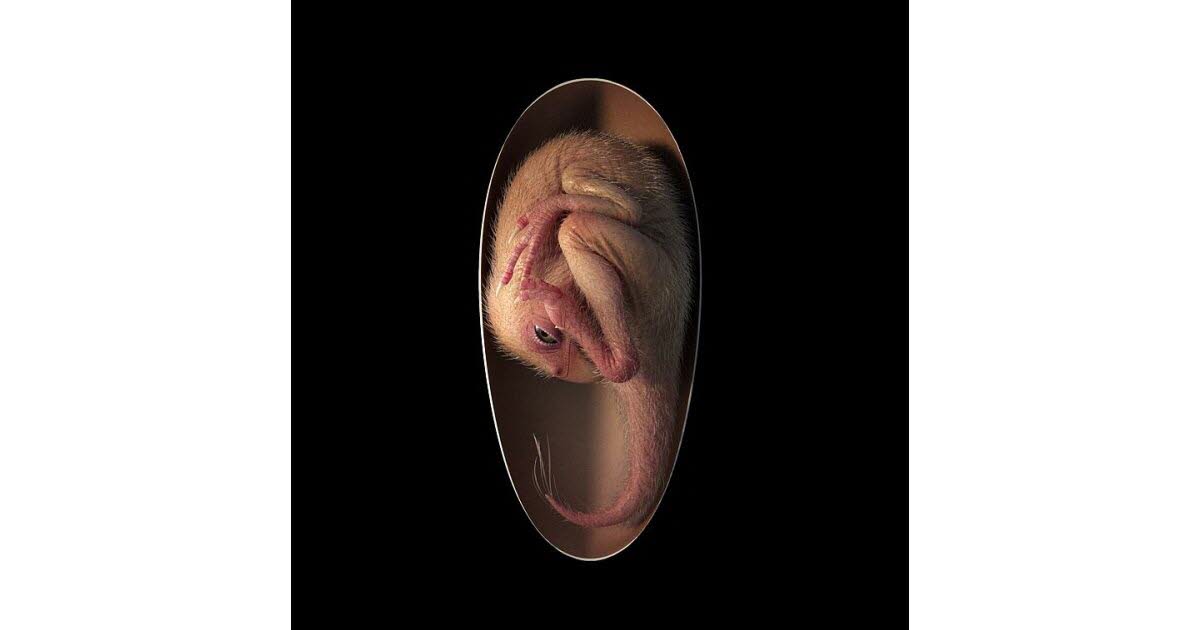
It is a discovery that cannot see the light of day. Many neglected and forgotten egg fossils over the years have caught the interest of a team of scientists interested in dinosaurs. By scratching part of an egg shell found in Ganzhou, China, they discovered a beautifully preserved embryo, dating back at least 66 million years, preparing to emerge from its egg.
Researchers have dubbed the Oviraptorosaur fossil “Baby Yingliang”. It is “one of the best dinosaur embryos ever found,” according to Fionn Wiseom Ma, of the University of Birmingham and co-author of the study, which was published Tuesday in iScience. It is even “one of the most beautiful fossils” observed by Professor Steve Brusatte of the University of Edinburgh and a member of the research team.
A unique niche for a dinosaur
“Baby Yingliang” was found with her back bent, her feet on either side of her head, and herself folded in her stomach. A position not previously seen in dinosaurs, but well known in birds.
When the chicks are preparing to hatch, they are already arching their heads under a wing, while piercing their shell with their beak. (see chart below). Embryos that fail to position themselves have a higher chance of dying from a failed hatch.
“This suggests that such behavior in modern birds has its origins in their dinosaur ancestors,” explains Fion Waisum Ma. An alternative might be what crocodiles do, which take a sitting position, with their heads only tilted downward on their stomachs.
The specimen “looks just like a chick wrapped in its egg, which is further evidence that many characteristics of today’s birds derive from their dinosaur ancestors,” says Steve Brusatte.
It is up to eight meters long
Oviraptorosaurs, whose name means “egg-stealing lizard,” were feathered dinosaurs that lived in Asia and North America during the late Cretaceous period. They can have different shapes and diets, and their sizes range from monkeys to giant giants, reaching eight meters in length.
A little history…
Dinosaurs appeared at the end of the middle Triassic period, 232 to 234 million years ago. This Mesozoic period, formerly called the Age of Reptiles, was followed by the Jurassic (−201.3 to 145 million years ago), and then the Cretaceous.
All dinosaurs became extinct during the Cretaceous and the third extinction at the end of the Cretaceous period, about 66 million years ago. All of them, with the exception of birds, who today are the only representatives of theropod dinosaurs and direct descendants of feathered dinosaurs.
Baby Yingliang measures 27cm from head to tail and rests in a 17cm egg at the Yingliang Stone Museum of Natural History. Scientists say it is between 72 and 66 million years old, and may have been well preserved thanks to the mud slide that buried it and protected it from scavengers.
It would have reached two or three meters in length if it reached adulthood, and it would have fed on plants. The researchers hope to be able to study the fetus in more detail using imaging techniques, in order to reveal its entire skeleton.
