


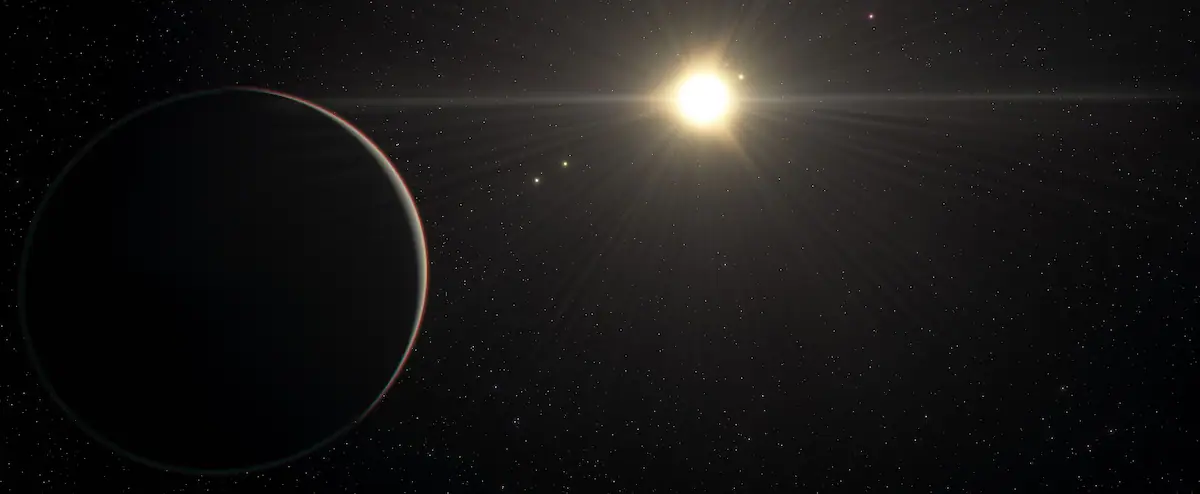
Washington | The James Webb Space Telescope has detected for the first time the presence of carbon dioxide in the atmosphere of an exoplanet, that is, a planet outside our solar system, a discovery that demonstrates its enormous capabilities and excites scientists to make further observations.
• Read also: Researchers discover a rare ‘ocean planet’
• Read also: [EN IMAGES] James Webb Telescope reveals unprecedented images of Jupiter
• Read also: A scientist makes a slice of chorizo for a star
The planet in question is a hot gas giant where life as we know it would be impossible, but this discovery supports the idea that such observations can also be made on rocky planets – with the ultimate goal of determining if one of them harbors conditions favorable to life.
“For me, this is the door that opens to future studies of the super-Earth, and even of the Earth,” Atomic Energy Commission astrophysicist Pierre-Olivier Legge told AFP on Thursday. Of this work, to be published in the scientific journal Nature.
“My first reaction: Wow, we really have a chance to discover the atmospheres of Earth-sized planets,” astrophysics professor Natalie Batalha of the University of California, Santa Cruz, commented on Twitter.
NASA said that the discovery of carbon dioxide will also make it possible to learn more about the composition of this planet, called WASP-39 b and discovered in 2011. Located 700 light-years away, it is about a quarter of the mass of Jupiter, and it is very close to the Sun.
It was chosen because several criteria make it easier to observe, at a time when scientists are still evaluating the capabilities of the telescope, which revealed its first images less than two months ago.
WASP-39 b passes very regularly in front of its Sun (it goes around it in four days), and its atmosphere is expanding.
In his observations, James Webb uses the transit method: when a planet passes in front of its star, it picks up the tiny contrast in the resulting luminosity.
Then he analyzed the “filtered” light through the planet’s atmosphere. Various molecules present in the atmosphere leave specific signatures that make it possible to determine their composition.
The Hubble and Spitzer telescopes have already detected water vapor, sodium and potassium in the atmosphere of this planet, but James Webb was able to move forward thanks to his unusual sensitivity to infrared radiation.
In a NASA press release, Johns Hopkins University’s Zafar Rustamkulov recounted his feelings when the presence of carbon dioxide became apparent: “It was a special moment, a milestone transit in exoplanet science.”
